Showing posts with label finfish. Show all posts

Thursday, July 11, 2019

Showcasing Shellfish in Willapa Bay

Laura Butler
Washington State Aquaculture Coordinator


Marilyn Sheldon talk about some of the issues faced
by Willapa Bay oyster growers.
I recently joined some folks from the agencies and associations that interface with shellfish growers in Washington for an educational tour of Willapa Bay’s muddy tidelands.

The event, showcasing issues and aspects of shellfish aquaculture in the region, was hosted by the Pacific Coast Shellfish Growers Association.

It drew representatives from Washington state’s departments of Ecology, Health, Fish and Wildlife, Natural Resources, and Agriculture. Also joining were people from the Northwest Indian Fisheries Commission, the National Oceanic and Atmospheric Administration and growers associations.

Willapa Bay has roughly 40,000 acres of tidelands, the backbone for about 10,000 acres of continuously rotating oyster beds owned and operated by Taylor Shellfish Farms, Goose Point Oyster Company, and Northern Oyster Company to name just a few. In addition, the state owns some of these tidelands, those beds are managed by the state Department of Natural Resources.

In small ponga boat taxis, we made a quick trip up the meandering channels exposed by the low tide to the shimmering fields, where we saw several techniques used to optimize oyster cultivation in the fertile bay responsible for more than a quarter of the country’s oyster production.

Oyster farming techniques 

An oyster dredge at work in Willapa Bay.
We put our muckers to good use with the first steps out of the boat as we slopped around among some of Taylor Shellfish Farms’ oyster beds.

Acres and acres of bottom culturing dominate the seascape. In these expanses, growers simply spread out oysters across the seabed where they grow much like wild oysters would, then harvest them with dredges that scoop them up out of shallow water with a large basked towed behind a low-slung barge.


Oysters suspended above the muck on a long-line setup.
Likewise, young oysters packed into flip-bags that swing from lines in the tide flow fatten up to be served on the half-shell in high-end restaurants around the globe.

Long-lining and flip baskets are more costly than bottom culturing but they help growers capture a different segment by producing beautiful oysters for half-shell market.

Threats to the industry

Burrowing shrimp infestations are increasingly disrupting Willapa Bay oyster operations. When swarms of the shrimp dig into the oyster beds, they destabilize and soften the sea floor causing the oysters to sink into the muck and smother.

Burrowing shrimp pulled from the sand.
A stop on the way back to the shore brought the problem into clear focus. The infestation of small shrimp was obvious from the absence of oysters. With the first step, we could feel the mud give way under our boots. David Beugli of the Willapa-Grays Harbor Oyster Growers Association, pushed a water pump into the ground and quickly disgorged a dozen pale shrimp. The burrows dotted the ground.

Marilyn Sheldon of Norther Oyster Company said she’s seen entire swaths of oyster beds sink away into the unstable substructure caused by the shrimp.

“It’s really hard,” she said. “When it’s goes, it’s gone forever.”

Burrowing shrimp aren’t the only challenges. Predators, toxic algae blooms, shellfish disease, and unexplained die offs are all threats the industry. Growers experiment with growing techniques and disease resistant varieties to reduce losses.
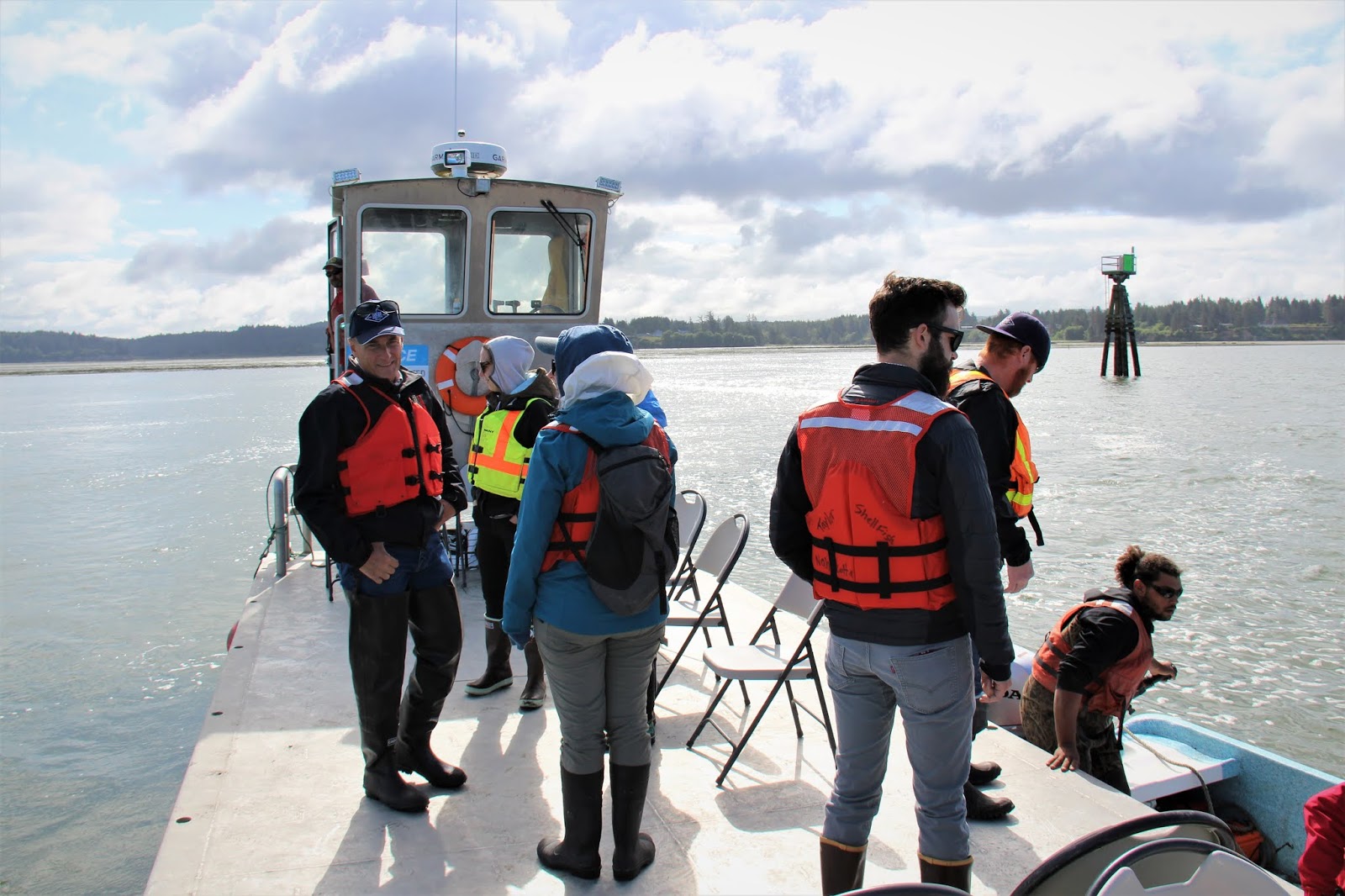
Meeting on board in Willapa Bay.
Erik Hall, Taylor’s Willapa Bay Director of Farms, said the company is always looking for ways to boost the survival rate.

“The one thing I can tell you about shellfish -- they’re worth a lot more when they’re alive then when they’re dead,” Hall said.

Oyster processing 

A little farther down the road, Ekone Oyster Company gave everyone a look at how the oysters are processed after they come out of the bay.

First stop was the shucking line. Here, men and women deftly wield oyster knives so fast, all you see is a blur.

Bang! The hard clump slams down onto the table. Click. The tip of the knife strikes down against the lip of the shell. Swip, swip. The blade slips under the shell with a back-and-forth swipe across the abductor muscle and the slippery animal flops out. Each shucker races to fill a large stainless steel basket, then carries it over to the wash rack for a rinse. Repeat.

Willapa Bay grows oysters to be served raw on the half shell, shucked to be sold by the pint, canned and smoked, and sold in bulk for processing into popular Asian ingredients such as oyster sauce. The industry is the life blood for the rural communities along the coast.
Bill Dewey talks oysters. 

The economic impact of aquaculture 


Rob Johnson, Ekone’s half-shell room manager, spent most of his professional life working in the lumber industry. When the mill he managed closed a couple years ago, his options were limited. He said he is grateful for the opportunity he found at the processing plant.

“It’s been a real blessing for me,” Johnson said. “If it wasn’t for this shellfish farming opportunity I would have had to leave the community. But I didn’t want to leave. This is my home.”

Johnson was excited about how the company helps the whole economy.

“We’re growing,” he said with a smile. “I just hired five people in the last six weeks. Those are full-time jobs.”

The Willapa Bay tour was a great way to educate people on this important industry and the challenges it faces. Thanks to Pacific Coast Shellfish Growers Association for organizing the event.

Please don’t hesitate to contact me with your thoughts and comments.

Tuesday, June 25, 2019

An ancient fish for a revolutionary new fish farm

Laura Butler
Washington State Aquaculture Coordinator

Thousands of juvenile black cod fish swirl in a tank at NOAA's research
facility at Manchester. 
In a collaboration that exemplifies the Northwest’s fusion of cultures, innovation, and entrepreneurial
spirit, the Olympic Peninsula’s Jamestown S’Klallam tribe is working with the National Oceanic and Atmospheric Administration (NOAA) researchers, Washington Sea Grant, and the University of Washington to develop a revolutionary new fish farm.

The remarkable if unlikely star of the whole venture? A lugubrious native fish the S’Klallam people have prized for more than a millennium, the black cod.

Kurt Grinnell, the tribe’s Aquaculture Program manager, met us at the NOAA research facility at Manchester to give us an early look at the project he believes will make a big splash for his community and our state’s finfish farming industry.

Kurt Grinnell has high hopes for farming black cod.
Grinnell said one of the reasons black cod (also known as sablefish) has so much potential for aquaculture is its great taste – and its natural vigor helps, too.

“It’s a real robust fish,” Grinnell said. ”As far as farming goes, it can handle low oxygen levels and algal blooms, and it grows fast. We have an all-female population here, so we can grow it in about 18 to 24 months.”

In addition, black cod has a strong cultural significance to the tribe, he said.
"Ever since we’ve been here, we’ve been eating them,"
                                               Kurt Grinnell – Jamestown S’Klallam Tribal Member

“The S’Klallams have always caught sablefish right there in the Strait of Juan de Fuca, so as a tribe, we’ve always eaten them,” Grinnell said. “It’s always been a native local fish for us going back thousands of years.”

Today, high-end chefs around the world, and especially in the Pacific Rim, prepare black cod with all manner of culinary magic. The flesh has a flakey texture and high oil content that makes it versatile, forgiving, and flavorful. You might see it in dishes such as “Miso Glazed Cod” – a recipe that literally made a name for an internationally renowned restaurant.

Grinnell says the ancient people were more unassuming.

“As far as the way we were preparing it, I would say it was probably cooked right over a fire, boiled or smoked.  In those remote areas, that’s what we had. We could boil water or could start a fire,” Grinnell said.

Economically, we think it’s going to be a viable fish for the market, we know it’s popular enough that people will buy it. It will definitely help the tribe in that way. It will pay for programs and things like that. But it’s culturally significant too,” Grinnell said.

Cutting-edge science

Also on hand was Rick Goetz, who leads the Program in Marine Fish and Shellfish Biology at the Northwest Fisheries Science Center’s Manchester Research Station.

Standing next to one of eight large tanks – the large dark fish circling behind him -- Goetz explained how he acquired his brood stock.

“We’ll go out with a charter fisherman who does quasi-longlining,” Goetz said. “He puts about a mile out. We do about 900 hooks and catch 70 fish. It’s important for us to get them alive, in good condition so we can bring them back and put them in the tanks.”

Black cod brood stock respond quickly to cold water tanks. 
Remarkably, these fish, which can be found up to 2,000 feet below the sea’s surface, can be transferred to shallow tanks on shore.

“They don’t have a swim bladder, the organ that maintains neutral buoyancy,” Goetz said. “That helps them.”

This quality also makes them good candidates for farming.

“They are remarkable fish. You bring them back, you put them in the tanks. They are feeding the next day,” Goetz said. “It’s one of the things that makes them easy to propagate. Whenever you have situations with your brood stock that makes it easy to get large numbers of eggs, that really helps the aquaculture operation.”

Growth spurts

Rick Goetz talks with Washington Grown
co-host Tomas Guzman while filming
an upcoming episode.
The speed at which black cod can be brought to mature sizes is also a plus.

Goetz said juvenile fish double their weight every ten days, and that’s only with cold water and proper feeding – no growth hormones or genetic engineering.

The Jamestown S’Klallam Tribe is in the process of getting permits to raise the black cod in net pens near Sequim as early as this fall, but that may not be easy.


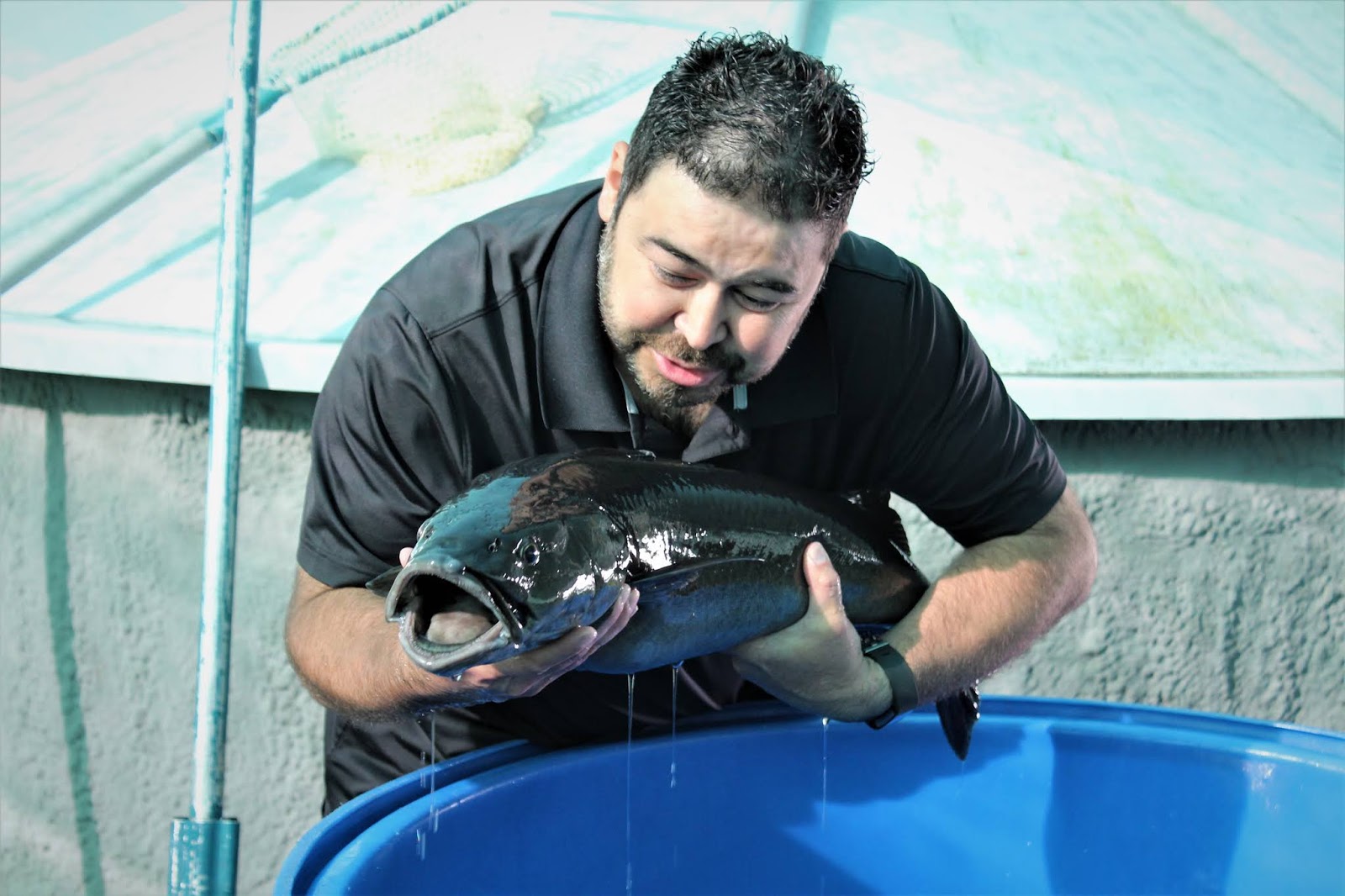
Washington Grown co-host Tomas Guzman gets up close with
the talent. 
“Permitting is tough because you have people on both sides of the issue,” Grinnell said. “I think people remember aquaculture pens from 50 years ago. And honestly, it’s come a long ways since then…And from a tribal point of view, we look at it as food security. We want to eat fish and with the issues we are having now, we’re going to have to grow fish to keep our children seven generations ahead eating fish.”


Just look at the facts

“We are working with the state aquaculture coordinator and multiple state agencies,” Grinnell added. ”We’re doing our best to get out there to the general public to let them know that finfish aquaculture does not have the environmental impact that they think it does. We are trying to get the facts out, using best practices and the best science out there.”

For more information about aquaculture in Washington, contact me by e-mail or at 360-902-1842.