Showing posts with label history. Show all posts

Thursday, July 11, 2019

Showcasing Shellfish in Willapa Bay

Laura Butler
Washington State Aquaculture Coordinator


Marilyn Sheldon talk about some of the issues faced
by Willapa Bay oyster growers.
I recently joined some folks from the agencies and associations that interface with shellfish growers in Washington for an educational tour of Willapa Bay’s muddy tidelands.

The event, showcasing issues and aspects of shellfish aquaculture in the region, was hosted by the Pacific Coast Shellfish Growers Association.

It drew representatives from Washington state’s departments of Ecology, Health, Fish and Wildlife, Natural Resources, and Agriculture. Also joining were people from the Northwest Indian Fisheries Commission, the National Oceanic and Atmospheric Administration and growers associations.

Willapa Bay has roughly 40,000 acres of tidelands, the backbone for about 10,000 acres of continuously rotating oyster beds owned and operated by Taylor Shellfish Farms, Goose Point Oyster Company, and Northern Oyster Company to name just a few. In addition, the state owns some of these tidelands, those beds are managed by the state Department of Natural Resources.

In small ponga boat taxis, we made a quick trip up the meandering channels exposed by the low tide to the shimmering fields, where we saw several techniques used to optimize oyster cultivation in the fertile bay responsible for more than a quarter of the country’s oyster production.

Oyster farming techniques 

An oyster dredge at work in Willapa Bay.
We put our muckers to good use with the first steps out of the boat as we slopped around among some of Taylor Shellfish Farms’ oyster beds.

Acres and acres of bottom culturing dominate the seascape. In these expanses, growers simply spread out oysters across the seabed where they grow much like wild oysters would, then harvest them with dredges that scoop them up out of shallow water with a large basked towed behind a low-slung barge.


Oysters suspended above the muck on a long-line setup.
Likewise, young oysters packed into flip-bags that swing from lines in the tide flow fatten up to be served on the half-shell in high-end restaurants around the globe.

Long-lining and flip baskets are more costly than bottom culturing but they help growers capture a different segment by producing beautiful oysters for half-shell market.

Threats to the industry

Burrowing shrimp infestations are increasingly disrupting Willapa Bay oyster operations. When swarms of the shrimp dig into the oyster beds, they destabilize and soften the sea floor causing the oysters to sink into the muck and smother.

Burrowing shrimp pulled from the sand.
A stop on the way back to the shore brought the problem into clear focus. The infestation of small shrimp was obvious from the absence of oysters. With the first step, we could feel the mud give way under our boots. David Beugli of the Willapa-Grays Harbor Oyster Growers Association, pushed a water pump into the ground and quickly disgorged a dozen pale shrimp. The burrows dotted the ground.

Marilyn Sheldon of Norther Oyster Company said she’s seen entire swaths of oyster beds sink away into the unstable substructure caused by the shrimp.

“It’s really hard,” she said. “When it’s goes, it’s gone forever.”

Burrowing shrimp aren’t the only challenges. Predators, toxic algae blooms, shellfish disease, and unexplained die offs are all threats the industry. Growers experiment with growing techniques and disease resistant varieties to reduce losses.
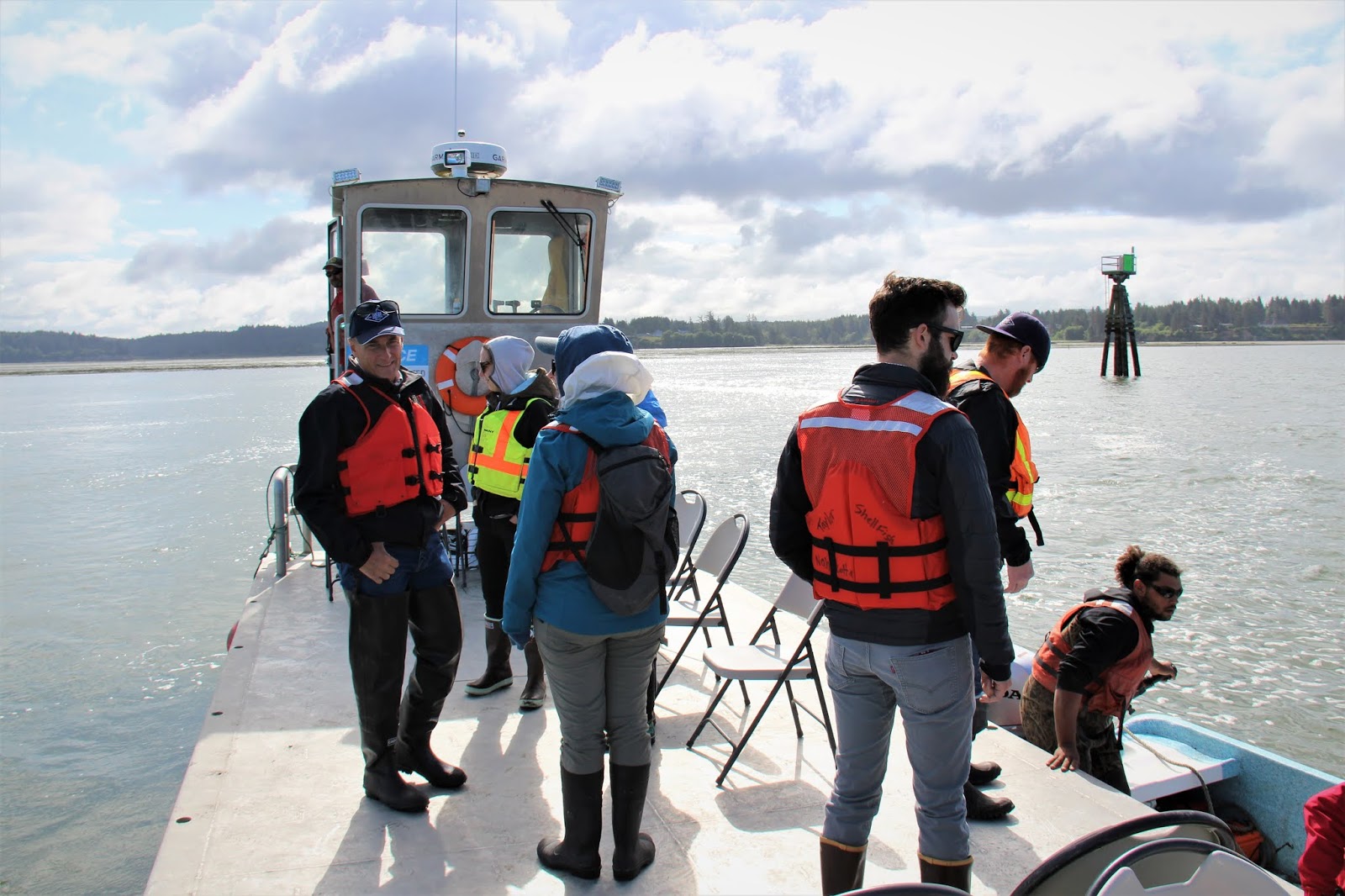
Meeting on board in Willapa Bay.
Erik Hall, Taylor’s Willapa Bay Director of Farms, said the company is always looking for ways to boost the survival rate.

“The one thing I can tell you about shellfish -- they’re worth a lot more when they’re alive then when they’re dead,” Hall said.

Oyster processing 

A little farther down the road, Ekone Oyster Company gave everyone a look at how the oysters are processed after they come out of the bay.

First stop was the shucking line. Here, men and women deftly wield oyster knives so fast, all you see is a blur.

Bang! The hard clump slams down onto the table. Click. The tip of the knife strikes down against the lip of the shell. Swip, swip. The blade slips under the shell with a back-and-forth swipe across the abductor muscle and the slippery animal flops out. Each shucker races to fill a large stainless steel basket, then carries it over to the wash rack for a rinse. Repeat.

Willapa Bay grows oysters to be served raw on the half shell, shucked to be sold by the pint, canned and smoked, and sold in bulk for processing into popular Asian ingredients such as oyster sauce. The industry is the life blood for the rural communities along the coast.
Bill Dewey talks oysters. 

The economic impact of aquaculture 


Rob Johnson, Ekone’s half-shell room manager, spent most of his professional life working in the lumber industry. When the mill he managed closed a couple years ago, his options were limited. He said he is grateful for the opportunity he found at the processing plant.

“It’s been a real blessing for me,” Johnson said. “If it wasn’t for this shellfish farming opportunity I would have had to leave the community. But I didn’t want to leave. This is my home.”

Johnson was excited about how the company helps the whole economy.

“We’re growing,” he said with a smile. “I just hired five people in the last six weeks. Those are full-time jobs.”

The Willapa Bay tour was a great way to educate people on this important industry and the challenges it faces. Thanks to Pacific Coast Shellfish Growers Association for organizing the event.

Please don’t hesitate to contact me with your thoughts and comments.

Tuesday, June 25, 2019

An ancient fish for a revolutionary new fish farm

Laura Butler
Washington State Aquaculture Coordinator

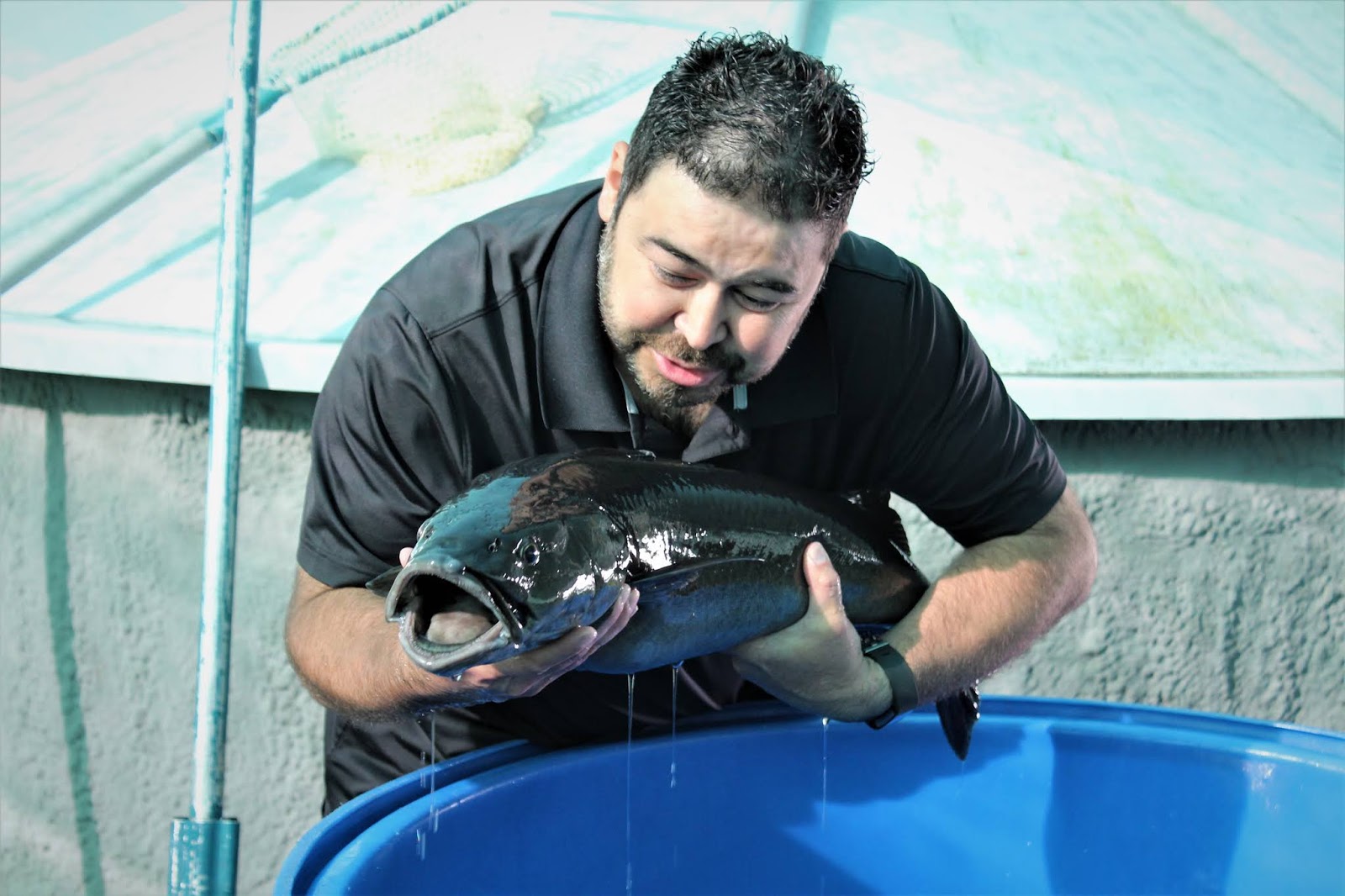
Thousands of juvenile black cod fish swirl in a tank at NOAA's research
facility at Manchester. 
In a collaboration that exemplifies the Northwest’s fusion of cultures, innovation, and entrepreneurial
spirit, the Olympic Peninsula’s Jamestown S’Klallam tribe is working with the National Oceanic and Atmospheric Administration (NOAA) researchers, Washington Sea Grant, and the University of Washington to develop a revolutionary new fish farm.

The remarkable if unlikely star of the whole venture? A lugubrious native fish the S’Klallam people have prized for more than a millennium, the black cod.

Kurt Grinnell, the tribe’s Aquaculture Program manager, met us at the NOAA research facility at Manchester to give us an early look at the project he believes will make a big splash for his community and our state’s finfish farming industry.

Kurt Grinnell has high hopes for farming black cod.
Grinnell said one of the reasons black cod (also known as sablefish) has so much potential for aquaculture is its great taste – and its natural vigor helps, too.

“It’s a real robust fish,” Grinnell said. ”As far as farming goes, it can handle low oxygen levels and algal blooms, and it grows fast. We have an all-female population here, so we can grow it in about 18 to 24 months.”

In addition, black cod has a strong cultural significance to the tribe, he said.
"Ever since we’ve been here, we’ve been eating them,"
                                               Kurt Grinnell – Jamestown S’Klallam Tribal Member

“The S’Klallams have always caught sablefish right there in the Strait of Juan de Fuca, so as a tribe, we’ve always eaten them,” Grinnell said. “It’s always been a native local fish for us going back thousands of years.”

Today, high-end chefs around the world, and especially in the Pacific Rim, prepare black cod with all manner of culinary magic. The flesh has a flakey texture and high oil content that makes it versatile, forgiving, and flavorful. You might see it in dishes such as “Miso Glazed Cod” – a recipe that literally made a name for an internationally renowned restaurant.

Grinnell says the ancient people were more unassuming.

“As far as the way we were preparing it, I would say it was probably cooked right over a fire, boiled or smoked.  In those remote areas, that’s what we had. We could boil water or could start a fire,” Grinnell said.

Economically, we think it’s going to be a viable fish for the market, we know it’s popular enough that people will buy it. It will definitely help the tribe in that way. It will pay for programs and things like that. But it’s culturally significant too,” Grinnell said.

Cutting-edge science

Also on hand was Rick Goetz, who leads the Program in Marine Fish and Shellfish Biology at the Northwest Fisheries Science Center’s Manchester Research Station.

Standing next to one of eight large tanks – the large dark fish circling behind him -- Goetz explained how he acquired his brood stock.

“We’ll go out with a charter fisherman who does quasi-longlining,” Goetz said. “He puts about a mile out. We do about 900 hooks and catch 70 fish. It’s important for us to get them alive, in good condition so we can bring them back and put them in the tanks.”

Black cod brood stock respond quickly to cold water tanks. 
Remarkably, these fish, which can be found up to 2,000 feet below the sea’s surface, can be transferred to shallow tanks on shore.

“They don’t have a swim bladder, the organ that maintains neutral buoyancy,” Goetz said. “That helps them.”

This quality also makes them good candidates for farming.

“They are remarkable fish. You bring them back, you put them in the tanks. They are feeding the next day,” Goetz said. “It’s one of the things that makes them easy to propagate. Whenever you have situations with your brood stock that makes it easy to get large numbers of eggs, that really helps the aquaculture operation.”

Growth spurts

Rick Goetz talks with Washington Grown
co-host Tomas Guzman while filming
an upcoming episode.
The speed at which black cod can be brought to mature sizes is also a plus.

Goetz said juvenile fish double their weight every ten days, and that’s only with cold water and proper feeding – no growth hormones or genetic engineering.

The Jamestown S’Klallam Tribe is in the process of getting permits to raise the black cod in net pens near Sequim as early as this fall, but that may not be easy.


Washington Grown co-host Tomas Guzman gets up close with
the talent. 
“Permitting is tough because you have people on both sides of the issue,” Grinnell said. “I think people remember aquaculture pens from 50 years ago. And honestly, it’s come a long ways since then…And from a tribal point of view, we look at it as food security. We want to eat fish and with the issues we are having now, we’re going to have to grow fish to keep our children seven generations ahead eating fish.”


Just look at the facts

“We are working with the state aquaculture coordinator and multiple state agencies,” Grinnell added. ”We’re doing our best to get out there to the general public to let them know that finfish aquaculture does not have the environmental impact that they think it does. We are trying to get the facts out, using best practices and the best science out there.”

For more information about aquaculture in Washington, contact me by e-mail or at 360-902-1842.

Wednesday, June 12, 2019

Checking in with aquatic farmers

Laura Butler
Washington State Aquaculture Coordinator

Tim Jones talks about his mussel farm in front of the
Washington Grown cameras. 
Where the road winds along the bluff above a tiny cove tucked into the leeward side of Whidbey Island, you’ll spot the rafts, about 40 of them, floating in orderly rows on the crystalline water. From here they appear nondescript, gray three-panel docks evenly punctuating the mirror blue expanse.

But on the 40-foot lines hanging just below the surface you’ll find some of the richest mussel production in the country, the anchor crop at one of the Northwest’s most iconic seafood companies, Penn Cove Shellfish.


Mussel rafts in Penn Cove near
Coupeville. 
Established in 1975, Penn Cove Mussels is the oldest and largest mussel farm in the United States. Their mussels have won top honors at international taste-test competitions for their sweet flavor and fabulous texture.

Listening to growers

We pulled into the parking lot outside the warehouse and were soon greeted by farm operations manager Tim Jones. This week we’re in north Puget Sound to check in with growers, talk about the issues they may be concerned about and, here at Penn Cove, we’re taking a guided tour of the operation as part of shellfish episode we’re filming with Washington Grown.

My role as the state’s aquaculture coordinator involves travel around the state’s coastal waters to connect with the folks who farm our state’s tidelands and aquatic farms to see how the issues associated with aquaculture are affecting the public.

The state aquaculture coordinator position, and the multifaceted roles and responsibilities that come with it, is a natural fit for WSDA.

What does the state aquaculture coordinator do?

To me it’s obvious.

Aquatic tractor? A Penn Cove Mussel worker taxis between
rafts. 
There’s no question that shellfish farmers are farmers. They buy seed, plant seed, and tend their
crops. Then they harvest the product and market it domestically and internationally. WSDA works with industries that do that on land, and this is no different.

It’s farming in a unique environment of a marine ecosystem. But because of the many concerns associated with that ecosystem, several local, state and federal agencies regulate activities that take place in it. One of my roles, and the role of WSDA, is to advocate for these producers, help them navigate the complex regulatory system, and promote their product.

In addition, these farmers and the public rely on clean water, verifiably sanitary handling processes, market access, and promotion -- all areas where this office can provide resources and support.

For the public, the value comes in protecting one of the crown jewels of our state’s history and economy. Commercial shellfish harvesting has been going on since the mid 1800s, and the region’s indigenous people have relied on shellfish for thousands of years. The industry provides critical jobs in the rural communities along the coast.

Mussels are processed fresh, right out
 on the water.
Back at the Penn Cove warehouse, Jones outfits our crew with life vests before we head down to a skiff that will taxi us out to the mussel rafts for the tour. As his truck bounces down to the beach, he talks about why Penn Cove uses a raft system and one his biggest predator pests. And no, it’s not an orca or a harbor seal.

“Ducks are our big predator,” he said. “Surf scooter ducks.”

“You know who Daffy Duck is?” he asked, revealing traces of his Maine accent. “Daffy Duck is a surf scooter. We’ll get big flocks of birds, 2,000 or more, in the winter months and they love eat’n mussels. There was no way we could protect the mussels from the ducks with a long-line system, so we went to a raft system so that we can put nets around the rafts to keep the ducks from getting in there.”

In spring, the cords below the rafts are
coiled to catch the mussel seed near
the water's surface. 
Out on the water, Jones steps off the skiff onto the raft. Thousands of lines hang into the clear water. Right now the lines are coiled to catch the mussel seed near the surface. But 14 months from now each line will be weighed down with as much as 50 pounds of mussels. With about 2,000 lines on each of the 42 rafts, “I’ll let you do the math,” Jones said with a smile.

Thousands of lines hang below the rafts.
Each cord can produce up to 50 pounds
 of mussels. 
Penn Cove never feeds or fertilizes their shellfish; they just give them an ideal place to grow and thrive. Clean water and abundant algae are the key ingredients. Although mussels require clean water, they also return the favor. Each mussel filters 18 gallons of water a day. That’s how mussel farming provides enhanced habitat and ecosystems, and adds to the overall health of the marine environment.

As the state aquaculture coordinator, I’m dedicated to working with farmers like Tim Jones to make sure the aquaculture industry will continue to prosper as a center part of Washington’s heritage and economy.

Laura Butler prepares for a Washington Grown interview
on the wharf in Coupeville. 
I hope to see you out on one of our many tidelands in the future. Please do not hesitate to contact me by e-mail or at 360-902-1842 if you need assistance with your operation or have questions about aquaculture in Washington.

And if you’d like to see more about mussels and other aquaculture, tune into Washington Grown at the beginning of next year and watch the episode we took part in.

Friday, April 19, 2019

Grain inspections on the mighty Columbia

Chris McGann
Communications
Measuring out wheat for
inspection.
WSDA staffer Benjamin Baxter,
 parses out a sample of wheat. 
A few cups of wheat randomly spill into an orange plastic contractor’s bucket under one of four dusty pipes extending down from the ceiling at WSDA’s Longview office.

This small sample weighs just a few pounds, but it wields tremendous power.

It could validate a multi-million dollar contract. Or it could bring a 124-million pound shipment to a standstill.

Even more than that, the inspections conducted every day by the 75 commodity inspectors and technicians at the four Washington loading docks along the Columbia River carry the responsibility of protecting a large slice of the U.S. agriculture export economy.
Grain Inspection Supervisor Colleen Butcher explains WSDA
commodity operations. In the background are hundreds of
 samples saved as a record

Grain Inspection Supervisor, Colleen Butcher, oversees operations at the Columbia River field offices.

She’s there to make sure the quality of the grain going onto the ship matches the specifications listed on each load order.

Her teams inspect the grain for impurities, moisture content, and overall quality or grade, comparing those findings with the specifications on the load order. They also inspect the facilities for sanitation and proper handling.

It’s all about quality control and consumer confidence, she says.

“There have been issues in the past of selling product and what they are receiving on the other end is not what they thought they were going to be getting,” Butcher said. “This is the United States’ way of guaranteeing that the grain that is being requested is the grain that they will receive.”

A Panamax vessel bound for Asia is loaded at a Longview,
Washington grain elevator. 
Washington is one of only a few states delegated to conduct export grain inspections by the U.S Department of Agriculture (USDA).

WSDA staff inspects, logs and sets aside portions of the samples in case of a future dispute at the same time the trainload of grain floats down sealed, air-cushioned conveyor belts onto a giant Panamax freighter at the dock.

"This whole operation is functioning on receiving that grain, that way they can export it," Butcher said.

Mountains of wheat from Eastern Washington arrive by river barge and train each year, but the grain, mainly wheat, corn, soybeans and sorghum, comes from all over the West including Idaho, Oregon,  the Dakotas, Montana, Colorado and beyond.

For Midwest grain, Longview and the other grain facilities along the lower Columbia River are the gateway to Asia.

WSDA Grain Inspector Laura Gould monitors the pathways
of grain as it is unloaded and transferred to the ship. 
The Columbia River has multiple elevators and loading operations.

"We receive grain twenty four hours a day, seven days a week, all year long," Butcher said. "In most cases, the grain’s final destination will determine which part of the United States it’s exported from.”

A different kind of continental divide

Flowing much like water on divergent paths from the Continental Divide, grain heads in one of two directions from western grain country.

In most cases the grain goes east to the Mississippi River and the Gulf of Mexico, bound for Europe and Africa, or West to the Columbia and the Pacific Ocean, with Asia and the Middle East as its likely destination.

For grain headed for Asia, “It will come through the Columbia River," Butcher said.

Linchpin for the industry

Benjamin Baxter, separates
 a wheat sample.
“We are quality assurance. We are making sure that the grain that is being loaded onto that export vessel is meeting contract specifications,” Butcher said.

A series of vibrating trays separate
wheat from other seeds, stems and
other impurities. 
Butcher says the inspections protect the buyers, but also, perhaps even more so, they protect the producers.

If a producer can’t assure the buyer that what they send is actually going to be up to the specification that the buyer wants and has agreed to, the whole market could be damaged, Butcher said.

More information about WSDA commodity inspections is available on our website.

Wednesday, September 14, 2016

Organic Roots: Washington’s extensive history of organic agriculture and certification

Heidi Peroni
Organic Outreach and Education Coordinator 

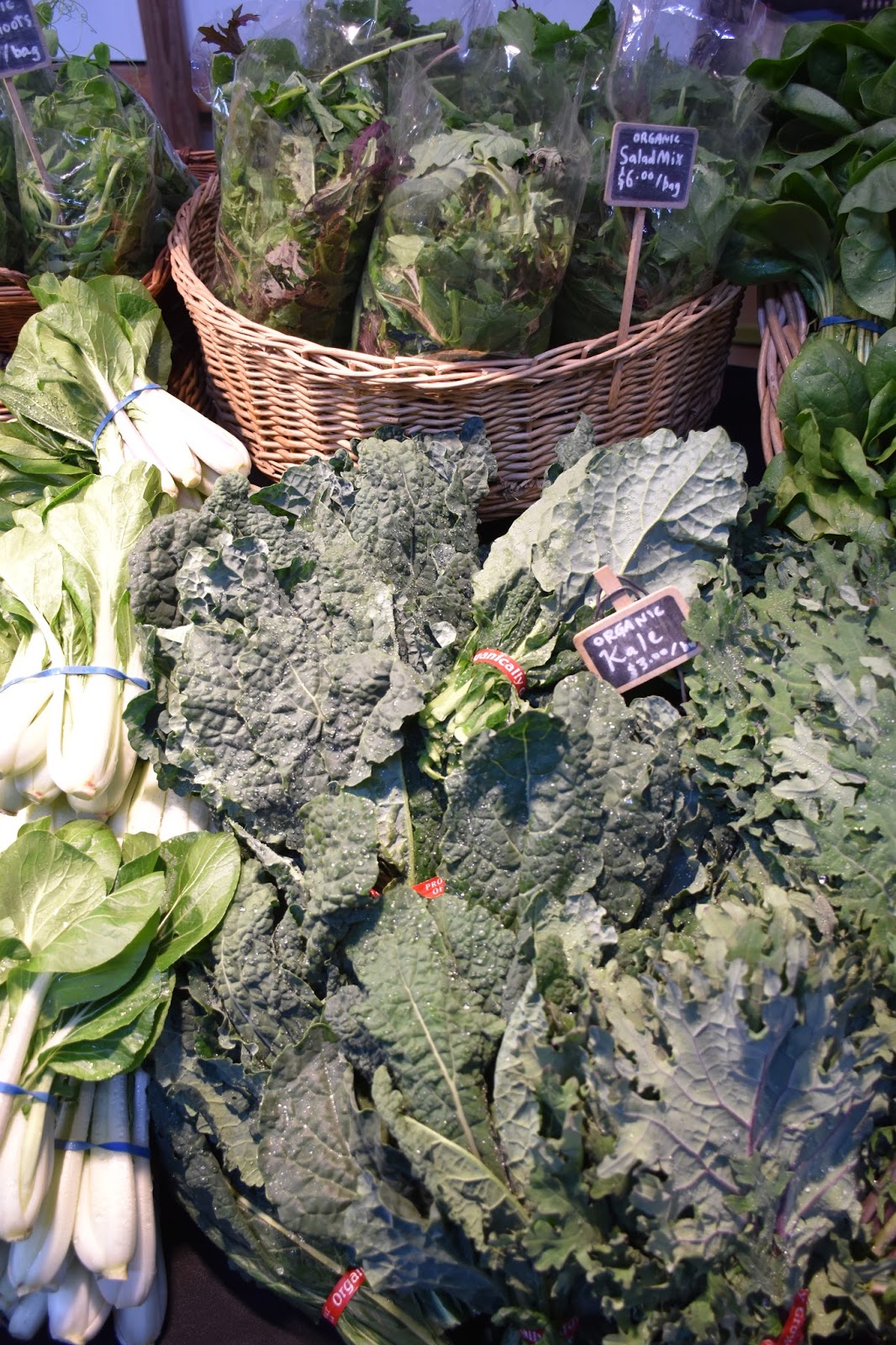
Today, WSDA’s Organic Program certifies more than 1,100 organic operations in Washington state where organic fruit and produce have become staples in farmers markets and most grocery stores. But it wasn’t always this way.

Organic certified kale at a
Washington farmers market.
In the 1970s, organic farming was still in its infancy in Washington and across much of the country. While farmers and gardeners were interested in alternative methods for crop production, information on organic cultivation was scarce and supporting organizations didn’t exist.

That began to change in 1974. Wendell Berry, farmer and poet, came to Spokane to speak at the ‘Agriculture for a Small Planet’ Symposium. With Wendell’s encouragement, a Washington-based group organized to promote organic agriculture. They called themselves Tilth, after the Old English tilian, meaning ‘till’ or 'strive for, obtain by effort.'

The Tilth Producers Cooperative worked on production, marketing, and distribution of organically produced crops. They also began a peer-based organic certification program, developing a framework for organic certification regulations by deciding which practices and materials were acceptable.

Certification lands at WSDA

In the mid-80s, Tilth worked with Ken Jacobsen, a state representative from Seattle, on legislation to house organic certification within WSDA. As a result, the Washington Organic Food Products Act, Chapter 15.86 RCW, was enacted in 1985.

Organic certification formally shifted to WSDA in 1987. Organic growers fund the program directly through a fee-for-service model similar to other services WSDA provides.

Tilth organizers meet at Seattle's historic PRAG house, circa 1980.
WSDA formed an Organic Advisory Board so stakeholders could provide input on developing organic standards. Several Tilth members joined members of California Certified Organic Farmers and Oregon Tilth to form the Western Alliance of Organic Certifiers to establish consistent standards between states. This work helped pave the way for the National Organic Program (NOP).

By 1988, the WSDA Organic Program had certified 68 organic farms. Soon the program expanded, offering processor and handler certification as well as registering brand-name material used in organic production.

Organic goes federal 

The 1990 U.S. Farm Bill included the Organic Foods Production Act which established the USDA NOP and National Organic Standards Board, bringing organic certification to the federal level.

The USDA’s first draft of the NOP standards in 1997 allowed irradiation, genetically modified organisms (GMOs), and sewage sludge in organic production. But protests from nearly 300,000 people nationwide prompted changes, and the Final Rule in 2002 prohibited these practices that became known as the “big three.”

In 2002, the WSDA Organic Program was accredited by USDA to provide certification services under the new federal standard, which continues today.

Of the first 100 farms certified by WSDA, 21 are still certified organic under their original name. Many others still farm, but have changed organizations or roles. Each of their stories, struggles, and successes helped create the path for the organic farmers and handlers of today.

Special thanks to Mark Musick, Anne Schwartz, and Diane Dempster, who have worked with Tilth Producers for many years, and Organic Program manager Brenda Book, for their input on this article.  Without their tireless efforts, Washington organic production would not be what it is today.

Monday, December 21, 2015

Longtime farm families highlight changes in agriculture

Mary Beth Lang
Bioenergy and Special Projects Coordinator

To celebrate Washington's 125th birthday, WSDA reached out to our Centennial Farm families - those families who had been recognized for continuously operating the same farm for at least 100 years at the time of the state's Centennial.

More than 400 farms participated in the 1989 Centennial Farms project. From these families, we learned about the establishment and early history of farms from across the state. Taken as a whole, they told the story of how Washington was settled, how the public land laws were used to acquire farmland, and how farm families were instrumental in building communities and setting the course for the state.

The author visits with Centennial Farm 
owner Rick Nelson at the 125th 
Anniversary of Statehood event, Nov. 11, 2014.
In 2014, we wanted to find out whether these farms were still owned by the same families and to learn a little about what had changed over 25 years. Over the course of a year, aided by hardworking volunteers, we heard back from 286 farms, with 88 percent reporting the farm was still in the same family.

The responses provide a snapshot of each farm’s 2014 ownership, size and operation. Together, they illustrate many of the changes that have occurred on our state’s farms over the past 25 years, including:
• The increased emphasis on “buy local” and sustainable agriculture.
• The advent and growth of organic farming.
• Major changes in the production of many of our top agricultural commodities.

To wrap up the project, we are producing an online publication -- Washington’s Centennial Farms, 25 Years Later. It includes information about all 286 participating farms and focuses on changes to these farms and our state’s agricultural industry over the last 25 years.

Cover of Centennial Farms publication
The Overview chapter and the first of eight regional chapters are now available on the WSDA website. The rest of the regional chapters will go online in the coming weeks.

I was a member of the small team that carried out the original Centennial Farms project and have led the 2014 project. I feel privileged to be connected with Washington agriculture all these years through my work at WSDA and to have had the opportunity to reconnect with farm families who have been part of our state’s history and agriculture industry for more than 125 years.