Showing posts with label beer. Show all posts

Thursday, July 29, 2021

Hops season right around the corner, planning ahead for workforce shortage with higher wages

Amber Betts WSDA Communications

Hops flower on the vine.
When we hired cherry inspectors earlier this year, we saw difficulty in filling all the positions, so we decided to increase the already competitive wage.

With hop season right around the corner, we are preparing for similar results with a limited workforce nationwide to do the work. So we’re doing it again. Washington State Department of Agriculture (WSDA) is preemptively increasing the pay for our hop samplers and graders to more than $17 an hour. That’s nearly $2 more an hour than it has been in the past.

Every year we provide a service to the hop industry in Washington state; “samplers” take a portion of the crop back to the lab in Yakima where our “graders” get to work. After all is said and done, farmers are left with a seed, leaf, and stem certificate that allows them to export their product worldwide.

We are gearing up to hire more than 40 people to work about six weeks from August to October. This is a busy job, full time, seven days a week, with overtime. We are looking for graders to work in the lab and samplers to go to the farms and warehouses to collect samples of the local hops.

As an “inspector” you’ll be part of the Plant Protection Division of WSDA. The program grades hops for seed, leaf and stem content, and analyzes hops for brewing value. The Yakima Valley produces over 70% of the U.S. hops and 25% of the world’s hops. But first, we need the samples of the hops to analyze. That’s where you come in.

Day in the life of a sampler

As a sampler, you’ll travel to farms and warehouses, maneuver bales of hops, collect the samples and label them correctly. You’ll enter the information into WDSA software that we will train you how to use. You’ll bring the samples back to the lab, where our graders will get to work.

This is the perfect chance to be part of the worldwide industry. If sampling isn’t your speed, lab work might be for you.

Graders get the job done

Once the samples arrive, graders begin their work. You’ll sort the samples, remove debris, record their weight, sift material into a divider, and split samples between seeds and leaves/stems. The seed samples will be taken to the oven, then the cones will be crushed into a powder leaving behind remnants of the stems and seed. This will further be sorted, leaving just the seed behind. Seed is something no farmer wants to see. It lowers the grade of the hop.

Hops core samples
taken for grading.
The leaf and stem will be sorted using a machine with stacked pans. This consists of using a shaker with stacked pans of varying size of screens for the sample to fall through. Once the sample is through the pans, the grader analyzes it at a grading table. Only the leaf and stem will remain. This takes good eyesight and hand dexterity. Hops are graded on how much of their product contains leaves and stems. The more leaves and stems, the lower the grade.

To apply, visit our employment page.


Friday, October 25, 2019

First-ever fresh hop beer for Seoul

Chris McGann
Communications

A can of Amazing Brewing's fresh hop beer. The Seoul-based
 brewery used Washington hops fresh from the field to bring
Korea that unique, fresh hop flavor.
It took several acts of reckless optimism, and help from WSDA’s International Marketing and Plant Services programs, but an ambitious Eastern Washington hops company has succeeded in supplying the key ingredient to enable Korean brewers to produce the country’s first-ever fresh hop beer made with U.S. hops.

Capturing the bright complexities of fresh hops in beer is a lot like trying to catch a fall flash of lighting in a bottle. For a true “fresh hop” beer – a nectar bursting with the flavors of cut grass, flowers, citrus or even pine trees -- brewers must add the delicate green hops cones to the brew within 24 hours of harvest.

That’s a tall order even for craft brewers in Washington state, where they have close access to some of the world’s top hop farms and almost three quarters of the nation’s total hops production.

For breweries in Seoul, Korea, trying to catch real lightning may be more realistic.

That didn’t stop Yakima Chief Hops. When they got the idea late last summer, they approached their Korean distributor to see if he would be willing to give it a try and with his nod, the bold adventure began.

The grower-owned network of family hops farms already supplies premium hops to brewers around the world in dried and frozen forms, but it had never attempted to deliver fresh product to Korea for a fresh hop beer.

The challenge was great

Though it seemed impossible, the siren call of a juicy new batch of India pale ale that would be brewed on the other side of the globe was just too intoxicating to ignore.

To pull it off, Yakima Chief not only had to ship the fresh hops cones from a field in the Yakima Valley to a brewery on the other side of the world in one day, they would also have to undergo U.S. export inspections and pass rigorous Korean Customs Service phytosanitary requirements on the way.

The company enlisted the help of WSDA International Marketing and Plant Services staff to help whisk an aromatic and highly perishable shipment out of Washington and through Korea Customs Service (KCS) fast enough for breweries in Seoul to hop up their beer.
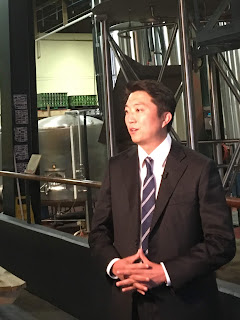
Danny Kim, WSDA's trade representative in
South Korea worked with Korean customs
officials to help bring in fresh hops. 
To make it all happen, Yakima Chief Sales Representative Jim Lambert reached out to Julie Johnson at WSDA’s International Marketing Program.

"I took this crazy idea to Julie a few months ago and with her help and a lot of other great people, it all lined up," Lambert said.

Johnson worked alongside Yakima Chief throughout the process and looped in WSDA’s trade representative in South Korea, Danny Kim, who worked with the Korean customs officials.  Johnson also connected the company with Sherry Lagerstam in WSDA’s Plant Services Program to find ways to streamline the domestic inspections process.

Lagerstam said she worked with Lambert and Yakima Chief warehouse staff to decide if it would be better to meet at the hops fields or the warehouse. In a seamless swoop, she double-checked the requirements, inspected the hops (at the warehouse) and issued the Phytosanitary Certificates.

A big win

Lambert acknowledged the challenges of sending fresh hops to the other side of the globe, through a strict inspection process, before they spoiled.

“A huge thanks to all for the quick responses and willingness to accommodate our tight timeline. Everyone’s help was deeply appreciated and we are so excited the fresh hops made it through Korean customs in a timely fashion,” Lambert said. “Shout-outs to you guys at Washington State Department of Agriculture for your major contributions to this effort – on the inspection here in the U.S. and with customs in Korea. We could not have done this without you.”

"It was a big win for all of us," he said.

Korean breweries and fresh hop beer

Yakima Chief's Korean Distributor, Brewsource, lined up three breweries to receive the hops.

Seoul Brewery was the first to brew with the fresh “Mosaic” hops. The brewery adjusted its entire week’s schedule and planned for a 3 a.m. brew day to make a fresh hop version of their signature Salinger Rye India Pale Ale. The beer was so popular, they sold out in about a week. Those lucky enough to taste it said it was: “Amazing, super juicy and drinkable with tropical flavors that really shine.”

Amazing Brewery also received the fresh Mosaic hops. They produced a wet-hop IPA called “Yakima Express.” This beer was scheduled to be released Oct. 25 and will also be available in cans that showcase the Yakima Chief Ranches logo.

Finally, Playground Brewery brewed a double IPA called “Big & Certain Hoppiness.” This beer is scheduled to be released on Nov. 1.

New Frontiers

Thanks to this year’s success, Mike Goettl, Yakima Chief CEO, said he has a few new challenges for fresh hop beer next year. He’s added Taiwan and Japan along with Korea as challenges for 2020 fresh hops.

Wednesday, November 2, 2016

Beer lovers benefit from committed WSDA hop inspection team

Mike Louisell
Communications

Drivers entering Yakima can’t miss the sign: “Yakima, the Palm Springs of Washington.” A good choice for another welcoming sign might be “Hop City, USA.”

The Washington Hop Commission, the Hop Growers of America and the American Hop Museum are all in Yakima or nearby towns. (However, the Washington Beer Commission is in Kirkland.)

Searching for hop leaves, stems and seeds
Grown on vines and with dozens of commercial varieties, hops are the key ingredient affecting the aroma, flavor and the bitter elements of beer. Forty growers in Yakima and Benton counties produce 75 percent of the hops grown in the U.S. The crop ranks as Washington’s 10th largest ag commodity, valued at $280 million, up 34 percent from 2014.

“Hops with high amounts of bitter acid are worth more,” said Mike Firman, program manager for WSDA's Chemical & Hop Laboratory. “And hops with high amounts of leaf and stem and seed are worth less. The market and the contract between growers and dealers determines by how much.”

WSDA’s lab hopping during hop season

With the growing popularity of craft brews, American pale ales and IPAs, WSDA is busier than ever supporting Washington’s hop industry.

The agency’s hops team—consisting of several permanent lab staff and up to 35 seasonal workers—sample, inspect, grade and certify hops with the growers paying a fee for the service. Even some growers from Oregon and Idaho truck part of their harvest to WSDA’s lab for inspection.

Hop harvest ends in October
Late August to mid-October is a hectic time for the lab team, according to Chris Wiseman, senior chemist and supervisor at the Chemical and Hop Lab. She has worked at the lab for 24 years.

“During harvest, we work seven days a week,” Chris noted. “We realize how important our work is for providing unbiased, neutral hop inspections.”

After putting the hops through a screen to remove fine debris, inspectors pick through to remove leaves and stems and look for unwanted seeds. Some customers also pay for the lab to determine the hops’ brewing value, the concentration of bitter acids in the hops.

Chris Wiseman, Chemical and Hop Lab
WSDA certification is necessary for growers to sell their hops. Growers get their inspection results quickly because lab staff emails them as soon as the process is completed. Use of barcodes links each lot of hops to its original grower.

On peak days, more than 100 lots are collected and sampled.

Chris said the peak was 140 lots in a single day, stretching staff capabilities to the max. Core samples from 350,000 bales this season have been analyzed for leaf, stem and seed content, surpassing last year’s 308,000 bales. Some 2,800 commodity inspection certificates were issued.

Hop workers get media spotlight

The Yakima Herald-Republic recently captured in words and photos the enormous effort it takes WSDA staff to support growers, dealers and brewers. So the next time you see a micro-beer in the store or on tap, or enjoy a cold brew, remember that it’s likely the hops in that product were grown in Washington and inspected by WSDA.


Thursday, July 7, 2016

Info-packed summit preps state alcohol makers to export products

Kathy Davis
Communications


Washington-grown wine grapes
on the vine
Wine, beer, cider and spirits are as much agricultural commodities as potatoes, apples and beef. As such, developing export opportunities for these products is important to the state’s economy and this industry sector. 

That’s why WSDA’s International Marketing Program sponsored a Beverage Export Summit on June 29. The event introduced Washington beverage businesses to resources to help them start or expand exporting activities. 

Did you know that a boom in popularity of Italian foods is driving increased sales of red wine in Japan? And with half of Vietnam’s population under age 50, young, trend-seeking consumers are looking for new products, such as craft beers.

WSDA’s in-country marketing experts

These were just a couple of the demographic and cultural factors presented by WSDA’s in-country marketing representatives. Each spoke about strategies to place Washington beverage products into overseas markets. They are:
Ship in Port of Seattle. Photo credit: Natalie Sullivan


  • Li Haidong – China
  • Scott Hitchman – Japan
  • Danny Kim – Korea
  • Francis Lee – Southeast Asia

Along with data about market share and growth trends, these representatives offered insights into the prospects and challenges of exporting to each country. For instance, Korea is half the size of Washington state and has seven times the population. Drinking, Danny said, is an important part of social life, doing business and celebrating special occasions.

While hard cider is becoming popular in the U.S. and especially in the Pacific Northwest, it’s not familiar to Asians. Because it’s made from fruits, Francis said there’s confusion about what it is – a vinegar, or used for cooking? He suggested cidermakers could use tasting demonstrations to establish it as a drink. 

Growing export sales


Washington hops used
in beers. 
Other summit presenters covered topics such as taxes and tariffs, managing the risks of international payment and preparing your business to be ready for export. 

About 25 company representatives attended, including wineries, breweries and cideries. By a show of hands, most are not exporting their products now. 

Morning one-on-one meetings with WSDA’s market representatives, the afternoon summit and follow-up networking reception, all held at McMenamin’s Anderson School in Bothell, armed these companies with resources and information to develop export strategies and grow their sales. 

The International Marketing Program webpage has more information on the program and how its staff can help businesses enter the export market. Contact them to be informed of future workshops and events.