Showing posts with label international trade. Show all posts

Monday, October 9, 2023

The Flavor of Success: How Olympia Coffee found its way to South Korea with the help of WSDA

Daniel Schafer
Communications

Never underestimate the power of great coffee.

Washington is known for its great coffee — from Port Angeles to Spokane to Goldendale to Bellingham, we’ve got some of the best cafés in the world. But something special has been brewing in Olympia. Actually, I should say something special has been roasting. This is the story of a Washington business with global reach, and how Washington State Department of Agriculture (WSDA) helped increase that reach, to share great coffee with the world. 

Olympia Coffee: Transparent sourcing and top-quality roasting

Sam Schroeder and Oliver Stormshak purchased Olympia Coffee in 2010, though the pair had worked for the previous owners since 2005 and 2009 respectively. They sought “to create a strong independent coffee roaster in the heart of the Pacific Northwest that will bring our coffee culture into the twenty-first century,” according to the company’s website. Olympia Coffee has accomplished this, and they’ve also succeeded in creating a transparent, equitable business that has created valuable partnerships throughout the supply chain that provides the coffee beans they roast. You can learn more about Olympia’s Coffee’s process in this short documentary, From the Source.

The combined efforts of Olympia Coffee and its partners have not gone unnoticed. The company has earned national acclaim, including first-place finishes in the 2023 U.S. Coffee Championships, where Co-owner Sam Schroeder won the Coffee in Good Spirits Championship and one of Olympia Coffee’s team members, Jake Donaghy, won the Cup Tasters Championship.

Though Olympia Coffee has sourcing partnerships with farmers in Central America and South America, it was being named Micro-Roaster of the Year by Roast Magazine in 2013 that sparked a different kind of international partnership — this time, in South Korea. 

A new partnership 

In late 2012 Roast Magazine made the announcement. Its Micro-Roaster of the Year would be Olympia Coffee. Though the award didn’t make national headlines, people in the coffee world noticed, including Jongseok Won, a café owner in Busan, South Korea. Mr. Won was intrigued by Olympia Coffee’s story and ordered some of the company’s beans from an overseas direct coffee-selling website called GoCoffeeGo.com. After trying the coffee, “he promptly fell in love with it and dreamed that someday he would bring it to Korea,” says Danny Kim, the WSDA’s South Korea representative. 

Condisco Coffee in Seoul, South Korea.
In time, Mr. Won began preparations for a new café in Seoul — one that would serve exclusively
Olympia Coffee. But making his dream a reality was a challenge. Mr. Won contacted Olympia Coffee via email, but both parties needed help navigating the export of products from the United States. That’s where Danny Kim comes into the story. With the help of Kim and the WSDA International Marketing Program, Won was able to connect with his partners in Washington and navigate the export process that would eventually bring Olympia Coffee to Seoul.

But the partnership would run even deeper. In February 2023 Danny Kim, who is based in South Korea, traveled with Mr. Won to Olympia to visit Olympia Coffee in person. The pair spent four days in Washington, learning about Olympia Coffee’s roasting process and visiting all its cafés because, as Danny Kim explains, “Mr. Won wanted to experience as much as possible and feel the philosophy of Olympia Coffee.” Then, in September, Olympia Coffee exported its first coffee shipment to South Korea, just in time for the grand opening of Condisco Coffee, Mr. Won’s new café in Seoul.

A model for the future

The partnership between Olympia Coffee, Jongseok Won, and WSDA offers a model that can be applied again and again. When Washington producers like Olympia Coffee aim to expand internationally, it can be challenging to navigate the export process. But WSDA is a committed partner that can help producers connect with trade partners and share Washington’s products — and in this case, products that started in Central and South America — with the world. 

To learn more, visit the WSDA International Marketing webpage. 

Monday, August 10, 2020

Boosting seafood exports to Vietnam virtually

Rebecca Weber and Elisa Daun 
International Marketing Program 

Washington seafood has faced some recent challenges, from trade issues with China to reduced demand from restaurant closures due to the COVID-19 pandemic.

At the same time, opportunities for seafood have emerged, especially for Washington shellfish products and particularly in Vietnam. But travel restrictions have limited the ability for in-person meetings and activities like trade missions or visits to Washington from potential overseas customers.
Workers sorting mussels.

So WSDA’s International Marketing team looked for other opportunities where virtual tools could help exporters and importers connect.

We selected Vietnam as the first market to try out a virtual export-import visit. It has strong market potential and already ranks among the top 10 markets for Washington exporters. Our in-market representative was keen to work with us, and 2020 marks the 25th anniversary of resumed diplomatic relations between the U.S. and Vietnam.

We decided to kick off this initiative by working with a small group of companies that had worked with us before, since new programs have a higher potential for implementation challenges.

WSDA’s International Marketing Program typically has contractors in several countries who help us and Washington state businesses build markets and navigate import requirements. We worked with our contractor in Vietnam to set up an online matchmaking meeting in late June to help Washington seafood exporters connect with Vietnamese seafood importers.

Trade mission goes online

For the event, we used a video conference platform that features “breakout rooms” allowing participants to hold side conversations. Four Washington export companies and six Vietnamese buyer companies participated, in addition to the WSDA International Marketing team—who spent quite a few hours and practice sessions preparing for launch!

We compiled buyer and supplier company profile information and provided to participants before the meeting, so companies could prepare by becoming familiar with each other.

The program kicked off at 5:30 p.m. in Washington state -- which is 7:30 a.m., the next day, in Vietnam. Everyone was a little outside their regular work hours, but all seemed happy to accommodate the time difference.

We began with all participants together in one session for introductions, a short market briefing, and an update on Vietnamese seafood trends. Then, we used the rest of our two and a half hours for one-on-one matchmaking meetings between participating buyer and supplier companies. Using the breakout room feature, importers and exporters were able to have direct conversations, with the WSDA team joining different sessions to assist as needed. In total, we facilitated 12 individual meetings.

The ability for companies to “meet” in “separate rooms” was well received and we learned a lot from this inaugural program that will improve similar programs in the future.

Future virtual visits

Although no transactions have yet resulted, several companies are corresponding with each other and conversations between them are continuing. The Vietnamese buyers are interested and eager to import Washington shellfish, such as live geoduck, oyster and king crab.

The Washington companies said they found the meetings valuable and worth their time, and all the businesses that participated expressed appreciation for the opportunity to meet, even online.

We are now planning for future similar encounters with new product sectors, such as fresh produce, dairy, and specialty beverages, as well as value-added products. We plan to try this again ourselves, but also working through our trade association, the Western United States Agricultural Trade Association.

Visit agr.wa.gov/international if you own or work for a business interested in learning more about our export assistance programs or future virtual export-import events.

Monday, October 29, 2018

Keeping the door open for ag exports in Asia

Chris McGann
WSDA Media Relations Coordinator 

Taylor Shellfish Co. International Sales Manager Tom Bettinger
explains the finer points of oyster tasting to WSDA Trade
Specialist Elisa Daun and overseas contractor Danny Kim.   
“There are four parts to tasting an oyster,” Tom Bettinger, Taylor Shellfish Co.’s International Sales Manager explained outside a large processing facility in Shelton. “The first is how it looks, the second is the nectar – that’s the seawater where it came from. The oyster is the third, and the aftertaste is the fourth.”

Bettinger was leading a facility tour for a small group of  overseas representatives contracted by WSDA to assist Washington agriculture exporters and promote our state's agricultural products in Asia.

Export assistance in key locations

With these contractors on the ground in key trading nations, WSDA's International Marketing Program helps build Washington's international reputation as a reliable source of wide-ranging, high quality agricultural products delivered at the highest safety and handling standards. By promoting this brand identity, the program puts Washington companies in position to export their products efficiently and profitably. And when producers encounter regulatory, logistic, or other exporting issues, the contractors are well positioned to provide assistance.

WSDA overseas representatives with Director Derek Sandison. From
the left: Scott Hitchman, Li Haidong, Sandison, Francis Lee and Danny Kim. 
The group was in Washington for a week-long visit that included tours where they learned about several of the products they promote to Asian buyers. They also participated in one-on-one  consultations with producers who are interested in expanding into overseas markets. The meetings are opportunities for sellers to get specific advice about logistics, markets and cultural preferences for major export countries.

In Seattle, the group toured a craft brewery and a handmade cheese factory. In Eastern Washington, they visited a hops farm and saw the harvest and processing of a key component of our state's renowned IPA beers. Their Eastside outing also included a trip to a local dairy farm, as well as other educational and seller-support events.

This year, in addition to their typical jam-packed itinerary, the annual visit was documented by a television crew from Seattle’s Q-13 FOX channel. Reporter Nadia Romero and camera crew interviewed the representatives and several of the producers who attended the seller meetings in Seattle.

Fresh is best 
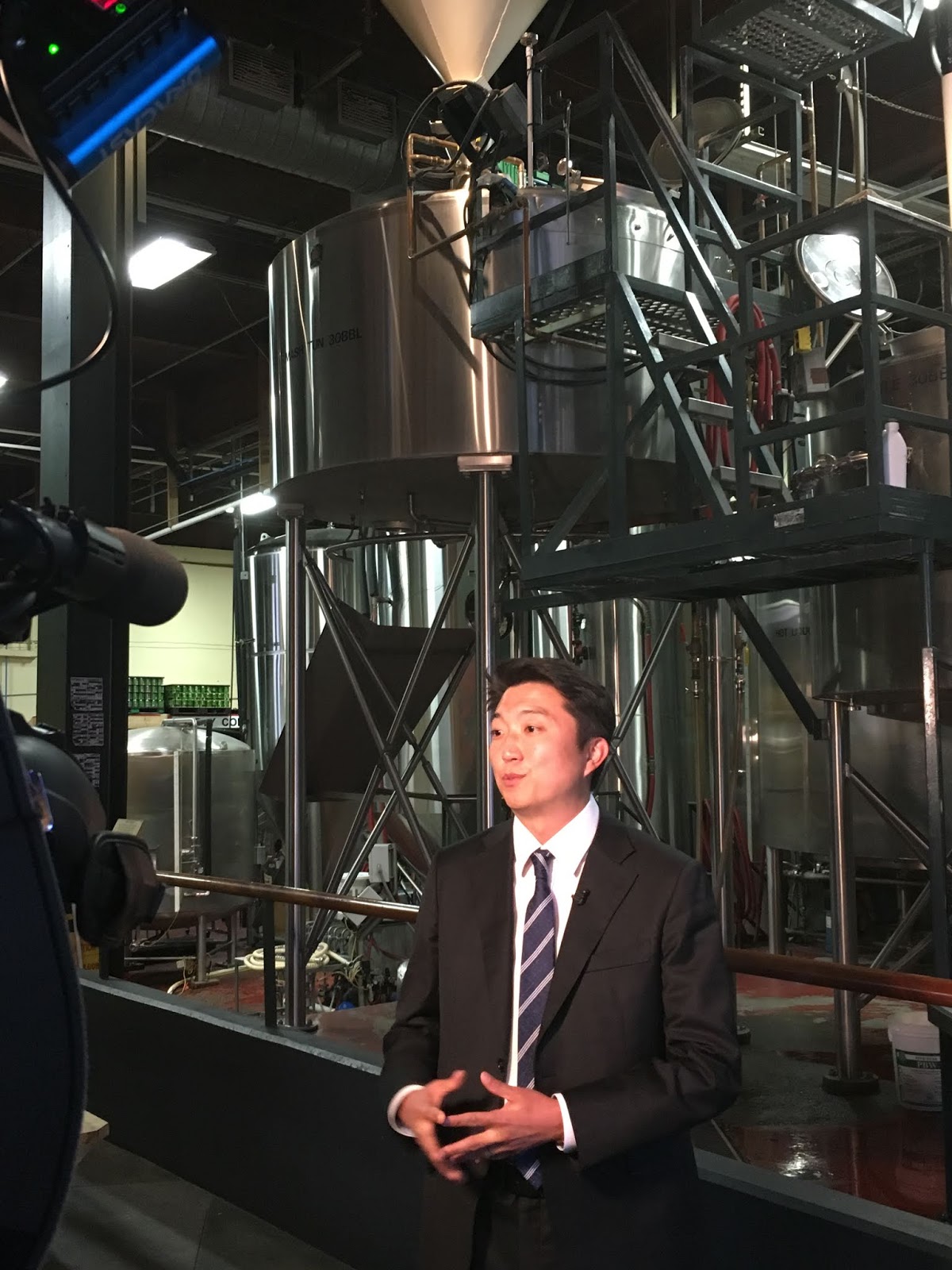
Hale's Ales Sales Manager Bill Preib talks to Q-13
reporter Nadia Romero about how WSDA consultants
 helped him evaluate Asia's beer market.
   

Back in Shelton, as we walked through the seafood plant with Bettinger, we could almost taste the oysters, clams, mussels and geoducks and the Puget Sound waters from which they were plucked that same morning.

Throughout bustling but immaculate facilities, the sweet, fresh smell of seafood infuses the air like the smell of the ocean on a cool coastal breeze – that must be the nectar.

Crews clad in heavy vinyl rain gear hovered along production lines cleaning, sorting, shucking, and packing the briny harvest. They hosed down the floors, swung forklifts in and around rows of crates and shells, and loaded tractor trailer trucks headed straight for the airport every day to deliver the goods to restaurants in Shanghai, Ho Chi Min City, and Tokyo and Seoul.

Oysters pulled from the water on Monday morning will be served on the half shell half a world away by Wednesday night, Bettinger said.

Representative Francis Lee described what he believes is "the biggest selling point for most seafood in Asia" with a single word: “fresh.” He smiled because he knows his buyers well and he knows he is working with a company that can meet that central demand.

Bettinger talks freshness with Francis Lee.
Lee is based in Ho Chi Minh City, Vietnam. He has worked as an overseas contractor for WSDA for five years. He is one of four overseas representatives contracted by WSDA who help Washington producers establish and maintain buyer-seller connections, deliver resources and advocate for market access in Vietnam, Japan, China, and Korea.

Q-13 TV interviews Danny Kim.
The other contractors are: Scott Hitchman, who has represented our state's ag products in Tokyo, Japan, for 25 years; Li Haidong is based in Shanghai, China and has been under contract with WSDA for 16 years; and Dong Hwan Kim (Danny Kim), in Seoul, South Korea, with 5 years working for WSDA.

In addition to these four overseas contractors, WSDA's International Marketing Program team includes five program staff based throughout the state.

Export expertise for Washington sellers

As liaisons between in-state sellers and overseas buyers, these reps juggle many tasks to assist producers who are interested or engaged in selling their products outside the U.S. They maintain databases of buyers, distributors and importers, keep up on market trends, industry news and regulatory compliance issues, and meet with businesses and government officials.

Bettinger said the reps can really be lifesavers.

"Recently, when we sent a container of cooked oyster meat to Vietnam, there was an issue with the health certificate. It was going to be parked and have to be returned back to the U.S.," he said. "Francis jumped on it and got it cleared up. That is a good example of sending up an SOS and getting rescued."

And even when operations are running smoothly, Bettinger said having reps helps.

"It's a lot easier to be in-country, with the representative there, and talk about an issue or talk about a potential sale than it is to try to do everything by e-mail."

 Rebecca Weber, Danny Kim, Rianne Perry and Elisa Daun (WSDA's International
 Marketing Program team) experience an icy blast in the Taylor Shellfish freezer.
 "It's about minus 20 in there," Bettinger said. 

Here  are a few links where you can find more information about WSDA’s International Marketing Program, upcoming international marketing events, and the overseas contractors.

Thursday, August 9, 2018

Capturing a taste of Washington

Chris McGann
Communications

Taiwanese buyers snap photos of the popcorn candy coating
 process at a Seattle-area factory. After sampling the gamut
 of flavors, truffle was a surprise standout!
WSDA is always busy looking for ways to expand markets for Washington producers. Our International Marketing Program helps facilitate buyer-seller connections, delivers resources and continually advocates for global market access.

Recently, the program joined forces with the Western United States Agricultural Trade Association to connect Taiwanese buyers with 17 Northwest suppliers.

After a whirlwind of face-to-face, buyer-seller meetings - more than 80 on the first day - the buyer group struck out on day two to see where the magic happens at three Seattle-area facilities. They visited Seattle Popcorn Company (Uncle Woody’s Popcorn);  AMES International (chocolate-covered fruits and nuts, nuts, and cookies); and SuperValu International (product consolidation/private label brands).

WSDA International Marketing Program Trade Specialist Elisa Daun organized the mission.

“Connecting professional buyers with Washington companies is a great opportunity,” Daun said. “These missions showcase the abundance of quality products available in our state and can be invaluable for producers trying to reach overseas markets.”

In 2017, Taiwan imported more than $264 million worth of Washington's agricultural and food products. The top five products were:

  1. Apples ($72 million)
  2. Frozen French Fries ($53 million)
  3. Sweet Cherries ($41 million)
  4. Frozen/Chilled Beef ($18 million)
  5. White Wheat ($16 million)

The International Marketing Program is working to help position Washington companies to export their products efficiently and profitably, while promoting our state’s consistent high quality, diversity of offerings, and high standard for food safety and handling.

Washington’s major crops and commodities have trade associations for promotion. The WSDA International Marketing Program helps bridge the gap for smaller suppliers, many of whom sell processed or packaged goods. The buyers can meet the operators, tour facilities and get a better sense of the quality of products and companies they will be working with.

For more information about upcoming international marketing events and activities, check out this WSDA calendar.

Friday, March 30, 2018

Washington agriculture, exports and China

Hector Castro
WSDA Communications 

For farmers, ranchers and those producing food and drink in Washington, international markets are crucial to maintaining a robust agriculture industry.

Washington exports about 30 percent of the food and agricultural products produced here, and the third largest market for our products is China. This is one reason WSDA is closely following developments regarding increased tariffs proposed on some imports from China, followed by the response from China to impose higher tariffs on 128 U.S. products.

Eight Washington agricultural products are on the list China has marked as subject to higher tariffs. Together, those products generated $120 million in revenue in 2017 in exports to China alone. Statistics in both charts below are based on the calendar year and are estimates based on data from World Trade Atlas.

Washington ag products possibly subject to higher tariffs by China

Product                                   
2017 value in export to China 
Sweet Cherries                         
$99.7 million
Fresh Apples                           
$17.6 million
Wine                                         
$1.6 million
Fresh Pears                             
$697,000
Dried Fruit                               
$544,500
Frozen Fruits & Berries           
$181,700
Fresh Cranberries                   
$92,400
Fresh Plums                             
$6,700

Two of the products listed, sweet cherries and fresh apples, are also among Washington’s top 10 ag exports to China. In fact, China is now the number one market for Washington sweet cherries. All told, Washington ag and food exports to China generated $594 million in export revenue in 2017. 

Top 10 exports to China in 2017

Exports                                   
Dollar Value
Ranking
1
Fish and Seafood                              
$154.5 million
#2 market
2
Hay                                            
$103.6 million             
#3 market
3
Sweet Cherries                      
$99.7 million
#1 market
4
Frozen French Fries                  
$54.4 million                
#3 market
5
White Wheat                              
$45.1 million               
#5 market
6
Dairy Products                           
$25 million                  
#5 market
7
Fresh Apples                             
$17.6 million                
#10 market
8
Seeds (fruit, veg, forage)           
$12.3 million                
#2 market
9
Frozen Vegetables                    
$10.5 million                
#2 market
10
Fishmeal 
$10.3 million                
#1 market
Like others in the agriculture industry, WSDA will continue to monitor the developing tariff situation. The negotiations on the North American Free Trade Agreement (NAFTA) and the recent completion of the Comprehensive and Progressive Agreement for Trans-Pacific Partnership (CPTPP) agreement without U.S. involvement are also expected to affect the agriculture industry, both in Washington and around the county.

With trade being so crucial, WSDA will continue to work with the agriculture industry and our federal partners to make sure that the voice of farmers, ranchers and food producers is heard.

Work also continues on maintaining and developing export markets for our state. Members of the WSDA International Marketing Program are already scheduled to participate in two trade activities involving China - one in May and another in June.

Wednesday, August 23, 2017

Explore export opportunities with WSDA's International Marketing Program

Hannah Street
Communications

WSDA's International Marketing Program often helps Washington-based businesses explore their export options. In September, the program will host a series of company consultations with international representatives from China, Japan, Korea, and Vietnam.

From Sept. 18-22, representatives gathered in Spokane, the Tri-Cities, and Seattle will provide one-on-one meeting opportunities.

"These meetings will help exporters and potential exporters learn about opportunities and requirements for exporting to Asia, Washington's largest export market," International Marketing Program manager Rianne Perry said.


Washington State apples


Navigating foreign markets can be a challenge, but expertise from knowledgeable representatives can help companies that are interested in expanding into foreign trade.

The representatives at these consultations can help a business operator understand distribution chains and import requirements, identify product opportunities and buyers, and develop export or marketing plans.

Although there is no charge to attend a consultation, space is limited. Anyone interested in joining a meeting should complete an application. Additional details are provided on the International Marketing Program's event flyer. You can also contact WSDA trade specialist Julie Johnson at jjohnson@agr.wa.gov or 360-902-1940.


International Marketing Program staff and international
representatives tour a fruit packing facility in 2016.

Friday, August 18, 2017

International trade visit puts Washington fruit front and center

Communications

Among its many trade support services, WSDA’s International Marketing Program facilitates trips for international buyers and Washington state producers. These trips, referred to as trade missions, put representatives from both sides of the trade relationship together so one can learn more about the crops and markets of the other. 

A recent “inbound” trade mission welcomed representatives from Southeast Asia, Mexico and Central America. WSDA trade specialists Rebecca Weber and Julie Johnson organized this large group that represented international markets interested in the fresh produce Washington offers. 

Apples and boxes travel on conveyor belts through the Stemilt packaging facility.
The delegates, representing import, retail, distribution and wholesale industries, expressed interest in looking for fruit suppliers, which made the Washington state portion of their trip an ideal opportunity.

In Yakima, the Washington State Fruit Commission delivered a briefing before the buyers participated in one-on-one meetings with 15 different Washington-based companies. Connecting buyers to suppliers is one of the primary functions of the international marketing program.

"These meetings created an opportunity for buyers to meet with known suppliers or build relationships with new ones," trade specialist Julie Johnson said.

In Wenatchee, the Washington Apple Commission also provided a market briefing to buyers, setting the tone for the day's tours of fruit packaging facilities and an orchard.

A day of Washington fruit

At Stemilt Growers, the large group of delegates was split into smaller tour groups organized by language. Two new international marketing team members, Zachary Garza and Elisa Daun, were a valuable addition to the trip. Both trade experts, they have additional multilingual skills; Zachary is a fluent Spanish speaker, and Elisa is fluent in Mandarin. 

The tour guide gathered attendees around him and discussed current and future apple trends, with an emphasis on Cosmic Crisp. Group members asked about the new variety’s color and size, and whether and when they’d be packaged and sold. 

The guide described Cosmic Crisp’s bright color and lustre, adding that it was an ideal size for packing and shipping.


Workers sort through cherries at the Domex Superfruit Growers packaging facility.
The group then made its way to Domex Superfresh Growers, where general manager Ron Gonsalves led the group into a hallway where the packaging process could be seen. “See all this? This is new,” he said, gesturing toward the room of machines and workers. Half of the facility was lost in a fire two years ago. 

But that day, in the middle of an industry-wide cherry processing peak, an unknowing observer couldn’t have guessed at the facility’s loss. Stainless steel machines hummed and workers combed through piles of cherries, separating leaves from fruit. 

Domex Superfresh Growers is one of the largest cherry lines in the state. At the peak of cherry season, it packs up to 2,000 bins per day, and workers pack in shifts 7 days per week to keep up.

A worker at Domex Superfruit Growers separates leaves from the cherries.

At the next stop, McDougall and Sons’ Legacy Orchard presented visitors with rows of ambrosia apple trees. Scott McDougall talked with the group about varieties and orchard operations. Learning about the goals and challenges fruit growers have gave visitors more context for how fresh fruit gets from the tree in Washington to their shelves and tables abroad. 

Washington was not the buyers' only destination; before turning in for the evening, the group would trek to Seattle before an early flight to California. 

An ambrosia apple at McDougall & Sons' Legacy Orchard.
“We hope that by the time they return home,” said Julie, “they have more knowledge about Washington agriculture and are eager for trade opportunities in the future.”

Thursday, June 29, 2017

Bringing together women of the seafood industry to connect producers and buyers

Hannah Street
Communications


A trade mission organized by WSDA’s International Marketing Program and the USDA Agricultural Trade Office in Shanghai brought together women leaders in the seafood industry from both China and the U.S. to discuss the logistics of potential business relationships.

The trade mission group poses at the National Oyster Company on June 23, 2017.
The group of a dozen mostly women met Friday at the agency’s main office in Olympia for a round-table discussion that included representatives from Washington shellfish operations and potential buyers from China. Afterwards, the group paid visits to local shellfish farms and operations. The previous day, WSDA staff had partnered with the Alaska Seafood Marketing Institute (ASMI) to bring the group of buyers to meet with women in other seafood industry sectors in the Seattle area.

China is one of Washington state’s top agriculture trading partners. In 2016, China imported $683 million worth of Washington food and agriculture products, with seafood, wheat and french fries topping their buying list.

Interest between the two groups at the Friday’s meeting was mutual. Producers are eager to expand their reach, and there’s a fresh food market in China with room for the unique flavors of Pacific Coast shellfish.

“Chinese consumers want high-quality shellfish and more of it,” said Ren Chen, Director of Strategic Sourcing at Shanghai Yiguo E-commerce Company.

Challenges include cultural differences and variances of shellfish knowledge that will test marketing and distribution skills. For example, one attendee explained testing practices differ between American and Chinese regulatory groups because consumers in both countries eat seafood differently.

Dungeness crabs, for example, have encountered testing holdup because Americans eat crab meat but Chinese eat the entire crab.

The group discusses trade and challenges women face in the shellfish industry
during a roundtable meeting on June 23, 2017.
The Chinese businesses included consumer grocery platforms and large-scale, regulatory entities with mainstream e-commerce and retail clients. Washington companies included local shellfish giants, like Taylor Shellfish, and niche companies like Set & Drift Shellfish which markets Fjordlux oysters.

Regardless of business model, the Chinese representatives emphasized hyper-fresh and hyper-available products. Smooth importing is crucial; getting seafood from the docks to stores is one battle. Familiarizing consumers with Pacific Northwest seafood products is another.

“Chinese are not very sophisticated about oysters, and there isn’t as much knowledge about Washington oysters,” said Helen Gao of Shanghai Gfresh.

To increase demand of Washington oysters in an overseas market dominated by the economy and familiarity of French oysters, education, like taste cards with flavor profiles and taste testing, is key.

In addition to product acclimation, marketing and selling the imported seafood must fit seamlessly with the Chinese consumer’s way of life. Americans do most grocery shopping once per week, whereas Chinese do their grocery shopping daily, at most going three days between trips, said Gao.

Another difference is that American markets can handle large shipments of shellfish because Americans buy large quantities, especially frozen products. Chinese representatives agreed, however, that their consumers would want smaller, consumer-friendly packaging within large shipments.

“It was amazing to see so many women in leadership positions come together to discuss these issues,” said Rianne Perry, manager of the International Marketing Program.

Representative from USDA, WSDA and ASMI pose in Seattle on June 22, 2017.