Showing posts with label Washington Department of Agriculture. Show all posts

Tuesday, August 8, 2023

Washington's blueberry bounty: A true taste of northwest delight

Daniel Schafer
Communications

When it comes to blueberries, Washington state can take a bow. That’s because our state is the #1
producer of blueberries in the world. In this blog, we’ll unpack why Washington provides such a favorable growing environment for blueberries, as well as what it means of all Washingtonians. 

Washington is a global blueberry leader

It's no understatement to say that the United States dominates the blueberry market — we grow far more blueberries than any other country — and Washington and Oregon are responsible for the vast majority of them. In 2021, Washington’s farmers produced an astounding 180 million pounds of these plump, juicy fruits, while Oregon pitched in with 150 million pounds. This significant production volume not only satisfies domestic demand but also supplies blueberries to consumers around the world, establishing Washington as a blueberry powerhouse. 

So Washington produces a ton of blueberries (actually, it’s more like 90,000 tons each year, but you know what we mean). What’s that mean for the folks who live in and visit our state? 

U-pick blueberry farms: A family-friendly tradition 

For residents and visitors alike, summertime in Washington means heading to the picturesque U-pick blueberry farms scattered throughout the state. These farms offer a unique and enjoyable experience, allowing families to immerse themselves in the beauty of the countryside while harvesting the freshest blueberries directly from the bush. If you’d like to pick blueberries at a local farm, check out this handy tool from the Washington Blueberry Commission. 

The tradition of U-pick farms fosters a sense of community while giving visitors a chance to appreciate the hard work and dedication of local farmers. What’s more, blueberries are just great. It’s hard to choose between eating them fresh, freezing them to enjoy during the winter (just rinse them off and store them in a plastic bag in your freezer), or baking them into tasty treats like muffins or scones. The good news is you don’t have to choose. Why not try all three? 

A blooming business: Growing blueberries in Washington 

Thanks to Washington's diverse geography, blueberries thrive in both western and eastern regions. Western Washington claims 55% of the state's blueberry production, while the remaining 45% of blueberries flourish in the sun-kissed lands of eastern Washington. 

Blueberries require slightly acidic and damp yet well-drained soil to thrive, which makes many parts of Washington an ideal environment for home gardeners to grow their own. If you have access to a few square feet of garden, you can nurture blueberries too. There’s nothing quite like caring for a blueberry bush that responds by providing fresh berries. 

Blueberry season is now!

Whether you choose to pick your own berries at a U-pick farm, enjoy locally grown blueberries from markets, or cultivate them in your backyard, Washington's blueberries promise an unparalleled taste of northwest delight. 

So, as summer rolls on, embrace the blueberry season, relish in their sweet flavor, and take pride in knowing that each berry you enjoy is a product of the state's dedication to agricultural excellence. Whether they're topping your morning cereal or making their way into luscious pies, Washington's blueberries are a symbol of Washington's agriculture and community.

Correction: A previous version of this blog incorrectly stated that the United States grows the majority of blueberries produced in the world. The U.S. in fact produces more blueberries than any other country, but it is not a majority of the global total.

Tuesday, August 1, 2023

Washington's hidden gem: The bountiful allure of garlic

Daniel Schafer
Communications

When people think about the verdant landscapes of Washington state and the crops that grow across them, they may think first of apples, cherries, or wheat. But Washington is also home to many other crops. Nestled within the fertile fields and farms, an aromatic and flavorful crop thrives, capturing the hearts of chefs, home cooks, and farmers alike — the humble yet extraordinary garlic.

Garlic, an ancient culinary treasure, is a flavorful addition to many dishes and a vital crop that contributes to the diversity and sustainability of agriculture in the Evergreen State. In fact, Washington state is a national leader in this regard as it ranks fourth in the nation in garlic production.

Despite its modest appearance, garlic boasts an impressive history and a broad spectrum of varieties that cater to an array of tastes and culinary preferences. With origins tracing back to Central Asia over 5,000 years ago, garlic's journey took it across continents, enriching the culinary cultures of numerous civilizations along the way. Today, Washington farmers continue this legacy, cultivating different garlic varieties, each with its unique flavor profile and growing requirements.

Bring garlic into your kitchen

In the diverse microclimates of Washington, a variety of garlic cultivars thrive, including softneck and hardneck varieties. The softneck varieties, known for their pliable stems and abundant cloves, dominate the market, while the hardneck types, characterized by their woody central stem and complex flavor, attract gourmands and connoisseurs. Whether it's the pungent and spicy Rocambole, the mild and versatile Silverskin, or the robust and bold Purple Stripe, each garlic cultivar carries its charm to complement an array of culinary delights.

The benefits of garlic extend beyond the farm and into the kitchen, where it adds a delightful punch to countless dishes. From sautéed vegetables and creamy pasta sauces to hearty soups and marinades, garlic's versatility knows no bounds. Chefs and home cooks alike treasure the potent and savory flavor garlic lends to their creations, making it an essential pantry staple.

Health benefits

Beyond being an essential ingredient for many dishes, garlic has a wide variety of positive health effects. Whether it is increasing your body’s immunity or decreasing inflammation, numerous studies have shown the benefits of garlic beyond the palate.

Garlic is typically harvested in Washington during June and July, so now is the perfect time to try a new recipe in your kitchen. 


Wednesday, July 5, 2023

Summer is here - time to put your Hornet Hunter hat back on

Karla Salp
Communications

man wearing sunglasses putting on a tan hat with a hornet on it
Gov. Inslee dons a hornet hunter hat while 
touring the hornet detection area in 2022. Gov.
Inslee and the Washington Legislature have been
very supportive of the hornet eradication efforts.
July is finally here and you know what that means around WSDA: time to start trapping for hornets! Our hornet trappers are already out in the field setting hornet traps in Whatcom County.

Since the first confirmed detection of the northern giant hornet (Vespa mandarina, also known as the Asian giant hornet) in 2019, there has been overwhelming interest from the public to help eradicate this invasive pest.

WSDA has welcomed this community support, leading to a hybrid government-public response that has been revolutionary – and effective. More than half of the confirmed hornet detections in the state have come from public reports. Three of the four nests eradicated in the state were found as the direct result of public reports.

The community has played a game-changing role in WSDA’s efforts to eradicate the hornets from our state. Although we had no detections last year, we’re not out of the woods yet.

We still need you.

northern giant hornet on paper plates
Hornet sighting reported
to WSDA via social media
in 2020.
Your eyes, ears, and traps are still needed to detect any hornets that might still be lurking in the state. Here are three ways that you can help.

  1. Trapping. WSDA has established a Public Hornet Trapping project, which provides community members with information on how to build and check hornet traps and report any hornets that are caught. The traps are placed in July and are left up through November.
  2. Watch a Wasp Nest. The public and WSDA staff have witnessed northern giant hornets repeatedly attacking paper wasp nests. These nests can easily be found under the eaves of many buildings. By joining the “Watch a Wasp Nest” program, you commit to spending five minutes a week observing paper wasp nests on your property and logging activity, including whether you notice hornets at the nest.
  3. Report sightings. Helping detect northern giant hornets can be as simple as being aware of your surroundings. If you think you spot one, get a photo if you safely can. Report suspected sightings with as much detail as possible, including where the insect was spotted, what it was doing, and if it flew off, the direction in which it headed.

EVERY hornet report matters. Whether found while trapping, watching paper wasp nests, or just being observant when you are out and about, it is critical to report each and every suspect hornet sighting. We get hundreds – if not thousands – of false reports each year, but we gladly accept them because it means you are on the lookout and that means we receive the few but critical confirmed detections we need to eradicate the hornets for good. 

Tuesday, June 20, 2023

Six ways you can help #BeatTheBeetles

Karla Salp
Communications

beetle in a green bag beetle trap
First WSDA-trapped Japanese beetle of 2023
The first Japanese beetle of 2023 has been detected! Our Japanese beetle trappers were out checking traps this morning and they discovered the first beetles in a trap near the high school in Grandview. So the adults are here and it is time to take action!

We conducted our second beetle treatment this spring and WSDA trappers have placed hundreds of traps in and near previous beetle detection sites that we’ll be checking regularly until the fall.

We’re doing everything we can to protect schools, parks, gardens, and farms from this invasive pest, but there are many ways that you can help.

  1. Report Japanese beetle sightings. If you spot a Japanese beetle (or several,) snap a photo and report them online or by emailing pestprogram@agr.wa.gov.

  2. Place your own traps. You can join the trapping effort by placing your own traps. Traps can be obtained at local farm and garden centers as well as online. If you do trap, please either count and report your trap catches online (with a photo of your catch!) or drop off traps with beetles in them at the following locations:

         - Valley Wide Cooperative (Grandview)
         - Riders True Value (Grandview)
         - Wapato City Hall (Wapato)

  3. Treat your property. If you notice beetles on your property, you may want to apply an effective treatment for adults (WSDA’s treatment earlier in the year was for grubs.) Washington State University has provided guidance to homeowners in English and Spanish on the best products for Japanese beetles (not all products listed for Japanese beetles have been proven effective.) If you choose to treat your property, follow the label instructions on using the product exactly.

  4. Graphic asking people not to spread Japanese beetle through yard waste, potted plants, or soil.
    Don’t move plants.
    If you live in or near an area where Japanese beetle has been found, do not move plants. Sharing plants from your yard with a friend or neighbor could spread the beetle from your yard to theirs. Don’t purchase plants from inside the quarantine area and take them home if you are outside the quarantine area. You could bring Japanese beetle into your yard.

  5. Keep yard waste and soil in the quarantine area. Yard waste and soil could also transport beetles. Moving plants, yard waste, or soil out of the quarantine area is prohibited if you live in the quarantine area. Instead, WSDA has established a yard waste drop-off site at 875 Bridgeview Rd. Grandview, WA.

  6. Spread the word, not the beetles. Learn more about Japanese beetles and encourage your friends and neighbors to help detect and eradicate this pest. On our Japanese beetle webpage, you can learn more about the beetle, how you can help, join our Washington Japanese Beetle Watch Facebook group, and sign up for email alerts to stay informed about the project.
Successfully eradicating the Japanese beetle from Washington is going to take several years. By working together, we can protect Washington from this invasive pest and #BeatTheBeetle. 

Espanol

Seis maneras en las que puede ayudar a #CombatirLosEscarabajos
 
Se detectó el primer escarabajo japonés de 2023. Esta mañana, nuestros tramperos de escarabajos japoneses revisaron las trampas y descubrieron los primeros escarabajos en una trampa cerca de la escuela secundaria en Grandview. Los adultos ya están aquí; por lo tanto, es momento de poner manos a la obra. 

Durante esta primavera, hemos realizado nuestro segundo tratamiento contra los escarabajos y los tramperos del Washington State Department of Agriculture (WSDA) han colocado cientos de trampas en los lugares anteriores donde se detectaron escarabajos y cerca de ellos, los cuales revisaremos con regularidad hasta el otoño. 

Estamos haciendo todo lo posible por proteger escuelas, parques, jardines y granjas de esta plaga invasora, pero usted también puede ayudar de numerosas maneras. 
  1. Notifique avistamientos de escarabajos japoneses. Si ve un escarabajo japonés (o varios), tome una fotografía y notifique en línea o por correo electrónico a través de pestprogram@agr.wa.gov. 

  2. Coloque sus propias trampas. Puede colaborar con los esfuerzos de colocación de trampas al colocar las suyas. Puede obtener las trampas en centros agrícolas y de jardinería locales, así como por internet. Si atrapa escarabajos, cuéntelos y notifique en línea (adjunte una fotografía de los escarabajos capturados) o entregue las trampas con los escarabajos en los siguientes lugares:

         - Valley Wide Cooperative (Grandview)
         - Riders True Value (Grandview)
         - Wapato City Hall (Wapato)

  3. Realice un tratamiento en su propiedad. Si detecta escarabajos en su propiedad, puede aplicar un tratamiento eficaz contra los adultos (a principios de año, el tratamiento del WSDA era contra los gusanos). Washington State University ha elaborado pautas para los propietarios en inglés y español sobre los mejores productos contra los escarabajos japoneses (no todos los productos que se enumeran para combatir el escarabajo japonés han demostrado ser eficaces). Si decide realizar un tratamiento en su propiedad, siga con exactitud las instrucciones que figuran en la etiqueta sobre cómo usar el producto. 

  4. No traslade plantas de un lugar a otro. Si vive en una zona donde se detectaron escarabajos japoneses o cerca de ella, no traslade plantas. Compartir plantas de su jardín con amigos o vecinos podría propagar los escarabajos de su jardín al de ellos. No compre ni lleve a su casa plantas que pertenecen a la zona de cuarentena si usted vive fuera de dicha zona. De esta forma, podría traer al escarabajo japonés a su jardín. 

  5. Mantenga los desechos de jardín y la tierra en la zona de cuarentena. Los desechos de jardín y la tierra también podrían transportar escarabajos. Está prohibido trasladar plantas, desechos de jardín o tierra fuera de la zona de cuarentena si vive en dicha zona. En cambio, el WSDA estableció un sitio de depósito de desechos de jardín en 875 Bridgeview Rd. Grandview, WA.

  6. Difunda el mensaje para que los escarabajos no se propaguen. Obtenga más información sobre los escarabajos japoneses y aliente a sus amigos y vecinos a colaborar con la detección y erradicación de esta plaga. En nuestra página web del escarabajo japonés, puede leer más sobre el escarabajo y cómo puede ayudar, puede unirse al grupo de Facebook “Washington Japanese Beetle Watch” (Detección del escarabajo japonés en Washington) y puede registrarse para recibir alertas por correo electrónico para mantenerse al tanto sobre el proyecto. 
Erradicar definitivamente el escarabajo japonés de Washington va a demorar varios años. Si trabajamos juntos, lograremos proteger a Washington de esta plaga invasora y #CombatirLosEscarabajos.  


Monday, August 10, 2020

Boosting seafood exports to Vietnam virtually

Rebecca Weber and Elisa Daun 
International Marketing Program 

Washington seafood has faced some recent challenges, from trade issues with China to reduced demand from restaurant closures due to the COVID-19 pandemic.

At the same time, opportunities for seafood have emerged, especially for Washington shellfish products and particularly in Vietnam. But travel restrictions have limited the ability for in-person meetings and activities like trade missions or visits to Washington from potential overseas customers.
Workers sorting mussels.

So WSDA’s International Marketing team looked for other opportunities where virtual tools could help exporters and importers connect.

We selected Vietnam as the first market to try out a virtual export-import visit. It has strong market potential and already ranks among the top 10 markets for Washington exporters. Our in-market representative was keen to work with us, and 2020 marks the 25th anniversary of resumed diplomatic relations between the U.S. and Vietnam.

We decided to kick off this initiative by working with a small group of companies that had worked with us before, since new programs have a higher potential for implementation challenges.

WSDA’s International Marketing Program typically has contractors in several countries who help us and Washington state businesses build markets and navigate import requirements. We worked with our contractor in Vietnam to set up an online matchmaking meeting in late June to help Washington seafood exporters connect with Vietnamese seafood importers.

Trade mission goes online

For the event, we used a video conference platform that features “breakout rooms” allowing participants to hold side conversations. Four Washington export companies and six Vietnamese buyer companies participated, in addition to the WSDA International Marketing team—who spent quite a few hours and practice sessions preparing for launch!

We compiled buyer and supplier company profile information and provided to participants before the meeting, so companies could prepare by becoming familiar with each other.

The program kicked off at 5:30 p.m. in Washington state -- which is 7:30 a.m., the next day, in Vietnam. Everyone was a little outside their regular work hours, but all seemed happy to accommodate the time difference.

We began with all participants together in one session for introductions, a short market briefing, and an update on Vietnamese seafood trends. Then, we used the rest of our two and a half hours for one-on-one matchmaking meetings between participating buyer and supplier companies. Using the breakout room feature, importers and exporters were able to have direct conversations, with the WSDA team joining different sessions to assist as needed. In total, we facilitated 12 individual meetings.

The ability for companies to “meet” in “separate rooms” was well received and we learned a lot from this inaugural program that will improve similar programs in the future.

Future virtual visits

Although no transactions have yet resulted, several companies are corresponding with each other and conversations between them are continuing. The Vietnamese buyers are interested and eager to import Washington shellfish, such as live geoduck, oyster and king crab.

The Washington companies said they found the meetings valuable and worth their time, and all the businesses that participated expressed appreciation for the opportunity to meet, even online.

We are now planning for future similar encounters with new product sectors, such as fresh produce, dairy, and specialty beverages, as well as value-added products. We plan to try this again ourselves, but also working through our trade association, the Western United States Agricultural Trade Association.

Visit agr.wa.gov/international if you own or work for a business interested in learning more about our export assistance programs or future virtual export-import events.

Thursday, November 7, 2019

Tilth Conference draws ag industry and WSDA staff

Chris McGann
Communications 

WSDA joins a host of agricultural experts participating in the annual Tilth Conference in Yakima this weekend.  Agency specialists from a wide range of disciplines will share their expertise and experience in workshops, meetings and presentations throughout the three-day event that begins Nov. 8.

This year's theme is "Growing a Resilient Future: Production and Beyond," and will provide an opportunity for farmers, food system professionals, researchers and educators to learn from one another, share best practices and network with others in the agriculture industry.

Attendees will have a chance to explore topics such as crop and livestock production, pest and weed management, marketing, certifications, land access, and opportunities and challenges in agriculture.

WSDA staff are among the numerous speakers at the conference, and will cover a variety of topics including:

Market Expansion and Development
  • Hear from our Farm to School team and learn the basics of selling to schools and how to get started.
  • Later, our WSDA staff will be involved in a panel discussion offering practical guides and checklists for hiring and training (including what hires need to know), market day operations, food safety requirements, booth and display set-up, customer service, working with market managers, and vehicle safety. 
Business Planning Toolkit
  • Get an update from the Office of the Washington State Veterinarian, including new outreach materials, animal disease status in the state, personnel changes, new programming, foreign-animal diseases of concern, regulation changes, and the new WSDA website.

Resource Opportunities to Support Farm Success
  • Listen to a panel discussion on the Farm to Food Pantry initiative where participating farmers, food pantry managers, WSDA, and Harvest Against Hunger partners recount their roles within this initiative, share their vision for scaling it up and sustaining it statewide, and how attendees can participate in the effort.
Technology, Regulations and Certifications
  • WSDA conducted their first season of inspections under the Food Safety Modernization Act’s Produce Safety Rule. Hear how farms responded and the results of these initial inspections. WSDA staff will share their inspection approach, the frequency of inspections and the prioritization process used by the WSDA Produce Safety Program.
  • Take part in a Q&A with the WSDA Organic Program staff and get an overview about the program, as well as updates on program activities. The session is intended to answer certification questions, cover the organic system plan, as well as recordkeeping, forms, processes, and other things to know about certification. 

Market Expansion and Development

  • The newest edition of the Handbook for Small and Direct Marketing Farms (popularly known as the “green book”) is now available for free. In this workshop, attendees will hear from the experts behind the handbook, learn what’s new in this updated edition and how to find the information needed for your farm business.

Visit the Tilth event schedule for a full list of the talks, workshops and panel discussions.

Thursday, October 10, 2019

Deadly deer virus detected in Western Washington yak

Chris McGann
Communications

The state animal disease lab confirmed a case of EHD in a
 Whatcom County yak this week.
Last week, a Whatcom County veterinarian  euthanized a six-year-old yak cow showing symptoms of Epizootic Hemorrhagic disease (EHD), a potentially deadly virus that primarily effects wild deer populations, but occasionally crosses over to cattle.

A subsequent Washington Animal Disease Diagnostic Laboratory (WADDL) necropsy confirmed the animal had EHD.

Two other yaks from the herd died in recent weeks after displaying similar clinical signs such as stiff gate, drooling and nasal secretions that are consistent with EHD.

According to the owner's report, the euthanized yak began showing signs of illness on Sept. 30.  It appeared to isolate itself from the herd, developed a thick-mucous runny nose, and had difficulty moving. The owner also observed small droplets of blood coming from possible fly bites near its eyes. They called the vet.

The clinical signs of EHD are similar to the much more devastating foot-and-mouth disease, so it is important to report suspected cases to the State Veterinarian.

EHD is not a threat to human health.

The the owners took the euthanized animal to WADDL in Pullman, where lab reports confirmed the EHD diagnosis.

The outbreak in Western Washington comes on the heels of a confirmed EHD diagnosis in four cows from Franklin and Walla Walla counties.

Biting midges or Culicoides gnats, commonly known as “no-see-ums” are the main way the disease is spread. Female biting midges can ingest blood from infected animals and then feed on uninfected animals. These midges typically breed near mud, so EHD outbreaks often occur when cattle and other ruminants congregate in wet areas.

No vaccines are available for EHD, so controlling the midges by eliminating standing water from areas used by cows, applying insecticides around water areas to decrease the swarms, or using bug repellent on the cows is the best defense.
.

For more information visit WSDA’s Animal Services Division webpage.

Monday, September 30, 2019

Deadly deer disease diagnosed in four Eastern Washington cows

Chris McGann
Communications

Controlling midges is the best defense against EHD.
Four cows in Franklin and Walla Walla counties were diagnosed this week with Epizootic Hemorrhagic disease (EHD), a potentially deadly virus that primarily effects wild deer populations but occasionally crosses over to cattle.

Cattle owners should be on the lookout for EHD symptoms such as excessive drooling, lethargy, difficulty walking, or oral and nasal lesions with ulceration, which are similar to the much more devastating foot-and-mouth disease.

Fever and anorexia due to the oral erosions were seen in the recently diagnosed cattle. Supportive care is the only treatment for infected cows.

Differentiating EHD from other animal diseases requires laboratory testing so you should contact your veterinarian if you observe these symptoms.

“Although EHD is seldom prevalent in cattle, we must show an abundance of caution and investigate each case due to the similarity of symptoms this disease has with the highly contagious and economically disastrous foot-and-mouth disease,” said Washington State Veterinarian Dr. Brian Joseph.

EHD is not a threat to human health.

The disease usually occurs in cattle where environmental conditions support large populations of biting midges.

Biting midges or Culicoides gnats, commonly known as “no-see-ums” are the main way the disease is spread. Female biting midges can ingest blood from infected animals and then feed on uninfected animals. These midges typically breed near mud, so EHD outbreaks often occur when cattle congregate in wet areas.

All ruminants can be affected, but generally it is a deer disease.

No vaccines for EHD are available for EHD so controlling the midges by eliminating standing water from areas used by cows, applying insecticides around water areas to decrease the swarms, or using bug repellent on the cows is the best defense.

In the coming weeks, the cool fall weather and frost is expected to limit the gnat population and the spread of the disease.

For more information visit WSDA’s Animal Services Division web page.


Thursday, September 26, 2019

WSDA joins the national call to reduce food waste

Chris McGann
Communications

In the U.S., more than one-third of all available food goes uneaten through loss or waste. Food is the single largest type of waste in our daily trash.

According to the Food and Agriculture Organization of the United Nations, 1.3 billion tons of food worth nearly $680 billion are wasted each year. In Washington, more than 350,000 tons of edible food was disposed of in landfills in 2015.

WSDA Director Derek Sandison (L) speaks
with a colleague at the NASDA conference.
* credit NASDA 
For the industry that feeds the world and also depends on limited, costly and increasingly scarce resources, that’s an unsustainable problem that needs to be addressed and it’s one of the big issues addressed this month at the National Association of State Departments of Agriculture (NASDA) annual meeting.

NASDA, a non-profit organization supporting agriculture, held its annual conference in New Mexico this year, drawing agriculture leaders from around the country, including WSDA Director Derek Sandison. Conference attendees discuss a broad range of food policy issues, including food waste.

Director Sandison joined NASDA members at the meeting as they adopted a new policy on food waste that follows the group’s “Pledge to End Food Waste.”

"Agriculture both defines and demands sustainability," he said. "It’s too costly to the agriculture industry, the environment and the people who rely on the nutritious food we work so hard to produce to let it go to waste."

WSDA has joined NASDA's pledge to support:

• public policies that offer opportunities to reduce, recover and recycle food waste.
• efforts to improve coordination and communication among federal, state and municipal stakeholders to use resources more efficiently and effectively to address food waste.
• the food waste hierarchy framework.
• research efforts and new technologies that address reduction and recovery of food waste.

Waste reduction in Washington 

Washington state has already adopted a waste-reduction goal shared by our federal partners.

For more than a year, WSDA worked with lawmakers, stakeholders and other agencies to craft food-waste-reduction legislation that was passed this year.

The newly approved legislation directs the state Department of Ecology to develop a plan to cut food-waste in half by 2030 in consultation with WSDA and the Department of Health.

To achieve that waste-reduction goal, the first step is preventing food waste in the first place, then rescuing edible food that would go to waste and getting it to hungry people. When that’s not possible, recovering the nutrients in that food through composting and anaerobic digesters is another option.

WSDA's role in waste reduction 

WSDA is leading two stakeholder engagement groups – one for food businesses and one for hunger relief professionals.

This month, WSDA organized a meeting of stakeholders from Kroger, Washington Hospitality Association, Pasco Farmers Market, the Washington Dairy Council and the Washington State Tree Fruit Association. The group shared ideas, voiced their concerns, and let us know what they’ve been doing to to reduce food waste in their respective industries.

Over the coming months, WSDA will engage experts in food safety, food waste collection and conversion, education and behavioral change, hunger relief and food business as partners in developing the plan.

Drafts of the Washington Food Waste Reduction Plan are scheduled to be available in spring 2020, with a final plan ready by September 2020.

Thursday, July 11, 2019

Showcasing Shellfish in Willapa Bay

Laura Butler
Washington State Aquaculture Coordinator


Marilyn Sheldon talk about some of the issues faced
by Willapa Bay oyster growers.
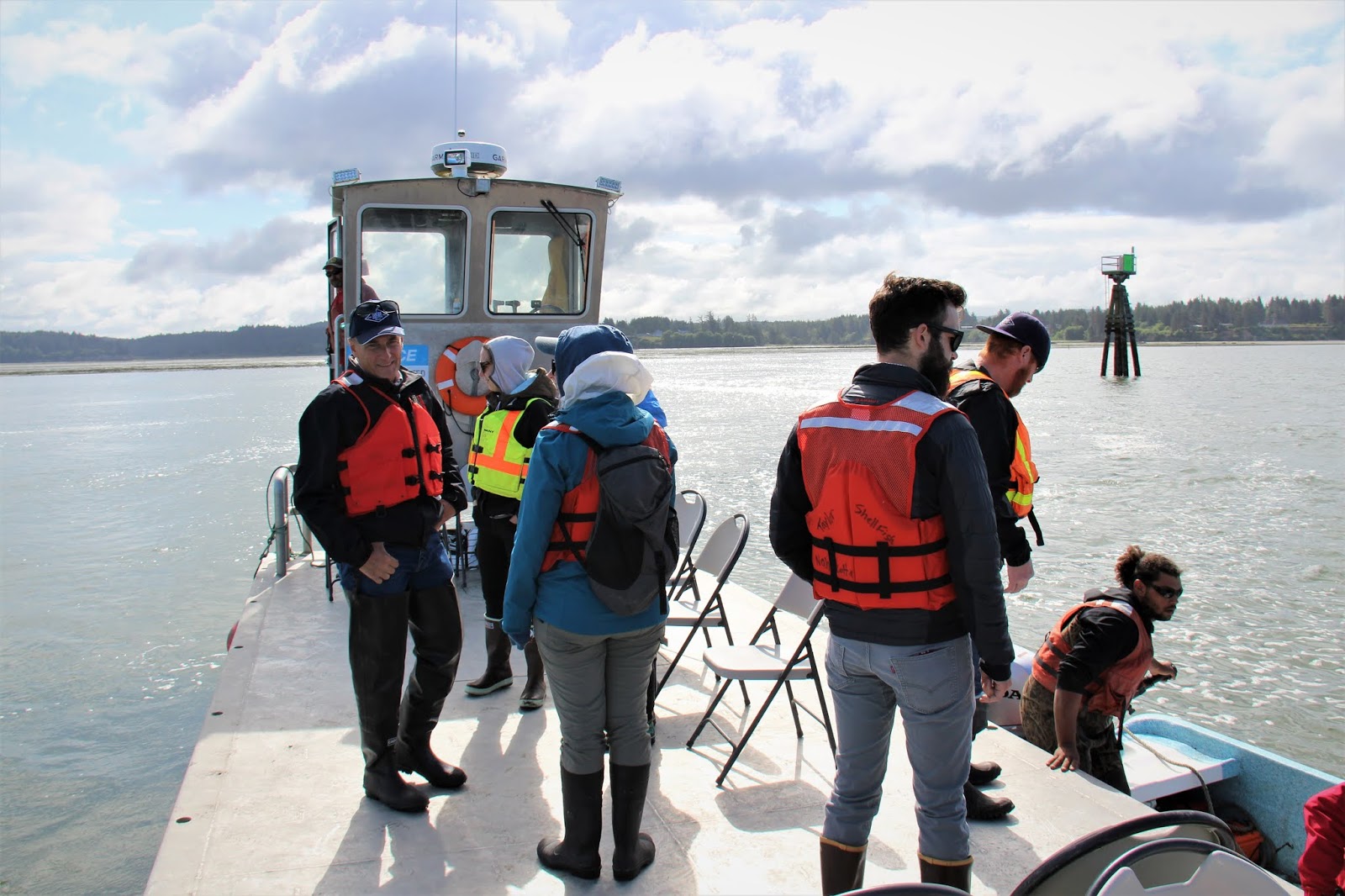
I recently joined some folks from the agencies and associations that interface with shellfish growers in Washington for an educational tour of Willapa Bay’s muddy tidelands.

The event, showcasing issues and aspects of shellfish aquaculture in the region, was hosted by the Pacific Coast Shellfish Growers Association.

It drew representatives from Washington state’s departments of Ecology, Health, Fish and Wildlife, Natural Resources, and Agriculture. Also joining were people from the Northwest Indian Fisheries Commission, the National Oceanic and Atmospheric Administration and growers associations.

Willapa Bay has roughly 40,000 acres of tidelands, the backbone for about 10,000 acres of continuously rotating oyster beds owned and operated by Taylor Shellfish Farms, Goose Point Oyster Company, and Northern Oyster Company to name just a few. In addition, the state owns some of these tidelands, those beds are managed by the state Department of Natural Resources.

In small ponga boat taxis, we made a quick trip up the meandering channels exposed by the low tide to the shimmering fields, where we saw several techniques used to optimize oyster cultivation in the fertile bay responsible for more than a quarter of the country’s oyster production.

Oyster farming techniques 

An oyster dredge at work in Willapa Bay.
We put our muckers to good use with the first steps out of the boat as we slopped around among some of Taylor Shellfish Farms’ oyster beds.

Acres and acres of bottom culturing dominate the seascape. In these expanses, growers simply spread out oysters across the seabed where they grow much like wild oysters would, then harvest them with dredges that scoop them up out of shallow water with a large basked towed behind a low-slung barge.


Oysters suspended above the muck on a long-line setup.
Likewise, young oysters packed into flip-bags that swing from lines in the tide flow fatten up to be served on the half-shell in high-end restaurants around the globe.

Long-lining and flip baskets are more costly than bottom culturing but they help growers capture a different segment by producing beautiful oysters for half-shell market.

Threats to the industry

Burrowing shrimp infestations are increasingly disrupting Willapa Bay oyster operations. When swarms of the shrimp dig into the oyster beds, they destabilize and soften the sea floor causing the oysters to sink into the muck and smother.

Burrowing shrimp pulled from the sand.
A stop on the way back to the shore brought the problem into clear focus. The infestation of small shrimp was obvious from the absence of oysters. With the first step, we could feel the mud give way under our boots. David Beugli of the Willapa-Grays Harbor Oyster Growers Association, pushed a water pump into the ground and quickly disgorged a dozen pale shrimp. The burrows dotted the ground.

Marilyn Sheldon of Norther Oyster Company said she’s seen entire swaths of oyster beds sink away into the unstable substructure caused by the shrimp.

“It’s really hard,” she said. “When it’s goes, it’s gone forever.”

Burrowing shrimp aren’t the only challenges. Predators, toxic algae blooms, shellfish disease, and unexplained die offs are all threats the industry. Growers experiment with growing techniques and disease resistant varieties to reduce losses.

Meeting on board in Willapa Bay.
Erik Hall, Taylor’s Willapa Bay Director of Farms, said the company is always looking for ways to boost the survival rate.

“The one thing I can tell you about shellfish -- they’re worth a lot more when they’re alive then when they’re dead,” Hall said.

Oyster processing 

A little farther down the road, Ekone Oyster Company gave everyone a look at how the oysters are processed after they come out of the bay.

First stop was the shucking line. Here, men and women deftly wield oyster knives so fast, all you see is a blur.

Bang! The hard clump slams down onto the table. Click. The tip of the knife strikes down against the lip of the shell. Swip, swip. The blade slips under the shell with a back-and-forth swipe across the abductor muscle and the slippery animal flops out. Each shucker races to fill a large stainless steel basket, then carries it over to the wash rack for a rinse. Repeat.

Willapa Bay grows oysters to be served raw on the half shell, shucked to be sold by the pint, canned and smoked, and sold in bulk for processing into popular Asian ingredients such as oyster sauce. The industry is the life blood for the rural communities along the coast.
Bill Dewey talks oysters. 

The economic impact of aquaculture 


Rob Johnson, Ekone’s half-shell room manager, spent most of his professional life working in the lumber industry. When the mill he managed closed a couple years ago, his options were limited. He said he is grateful for the opportunity he found at the processing plant.

“It’s been a real blessing for me,” Johnson said. “If it wasn’t for this shellfish farming opportunity I would have had to leave the community. But I didn’t want to leave. This is my home.”

Johnson was excited about how the company helps the whole economy.

“We’re growing,” he said with a smile. “I just hired five people in the last six weeks. Those are full-time jobs.”

The Willapa Bay tour was a great way to educate people on this important industry and the challenges it faces. Thanks to Pacific Coast Shellfish Growers Association for organizing the event.

Please don’t hesitate to contact me with your thoughts and comments.

Tuesday, June 25, 2019

An ancient fish for a revolutionary new fish farm

Laura Butler
Washington State Aquaculture Coordinator

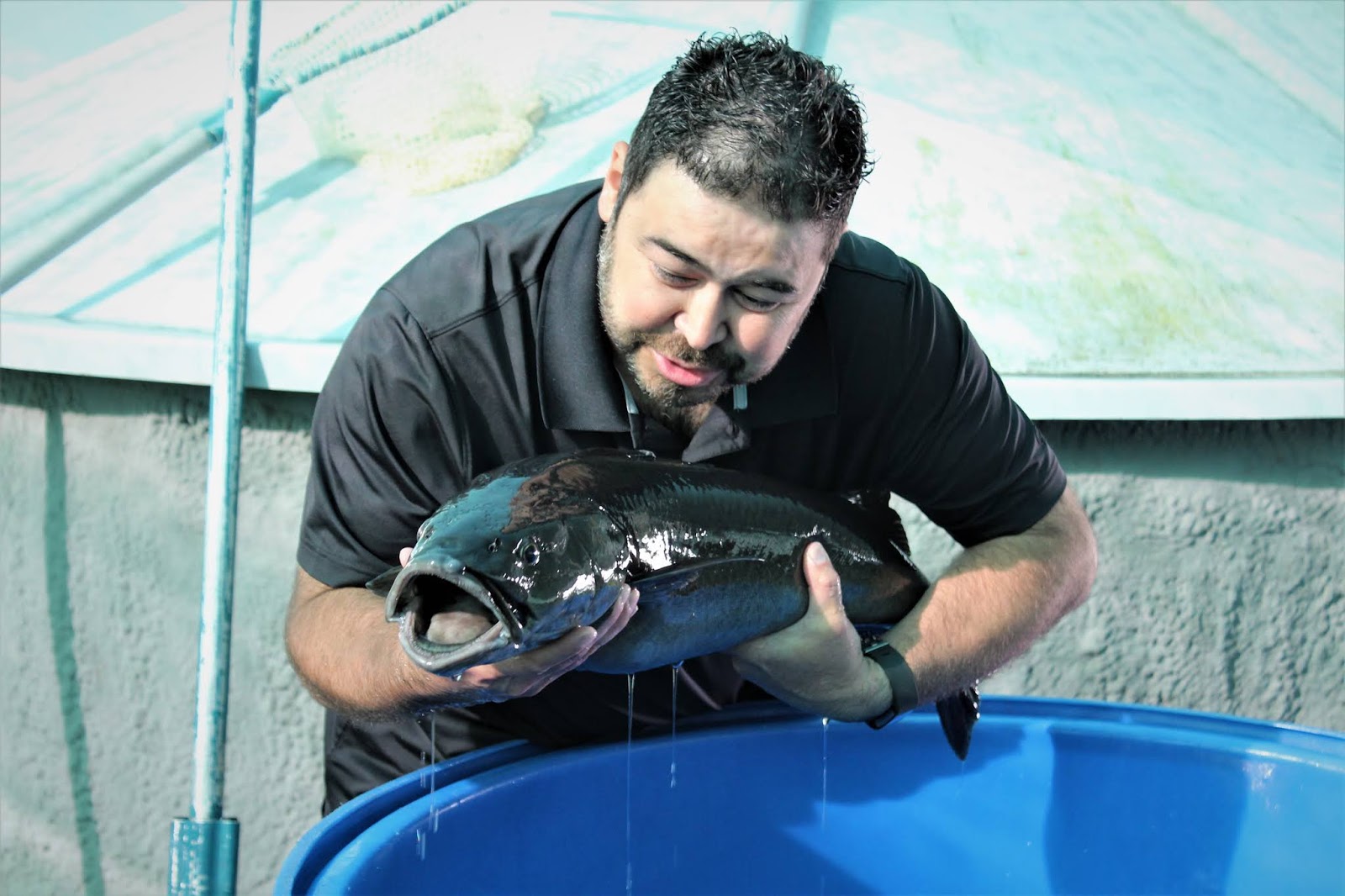
Thousands of juvenile black cod fish swirl in a tank at NOAA's research
facility at Manchester. 
In a collaboration that exemplifies the Northwest’s fusion of cultures, innovation, and entrepreneurial
spirit, the Olympic Peninsula’s Jamestown S’Klallam tribe is working with the National Oceanic and Atmospheric Administration (NOAA) researchers, Washington Sea Grant, and the University of Washington to develop a revolutionary new fish farm.

The remarkable if unlikely star of the whole venture? A lugubrious native fish the S’Klallam people have prized for more than a millennium, the black cod.

Kurt Grinnell, the tribe’s Aquaculture Program manager, met us at the NOAA research facility at Manchester to give us an early look at the project he believes will make a big splash for his community and our state’s finfish farming industry.

Kurt Grinnell has high hopes for farming black cod.
Grinnell said one of the reasons black cod (also known as sablefish) has so much potential for aquaculture is its great taste – and its natural vigor helps, too.

“It’s a real robust fish,” Grinnell said. ”As far as farming goes, it can handle low oxygen levels and algal blooms, and it grows fast. We have an all-female population here, so we can grow it in about 18 to 24 months.”

In addition, black cod has a strong cultural significance to the tribe, he said.
"Ever since we’ve been here, we’ve been eating them,"
                                               Kurt Grinnell – Jamestown S’Klallam Tribal Member

“The S’Klallams have always caught sablefish right there in the Strait of Juan de Fuca, so as a tribe, we’ve always eaten them,” Grinnell said. “It’s always been a native local fish for us going back thousands of years.”

Today, high-end chefs around the world, and especially in the Pacific Rim, prepare black cod with all manner of culinary magic. The flesh has a flakey texture and high oil content that makes it versatile, forgiving, and flavorful. You might see it in dishes such as “Miso Glazed Cod” – a recipe that literally made a name for an internationally renowned restaurant.

Grinnell says the ancient people were more unassuming.

“As far as the way we were preparing it, I would say it was probably cooked right over a fire, boiled or smoked.  In those remote areas, that’s what we had. We could boil water or could start a fire,” Grinnell said.

Economically, we think it’s going to be a viable fish for the market, we know it’s popular enough that people will buy it. It will definitely help the tribe in that way. It will pay for programs and things like that. But it’s culturally significant too,” Grinnell said.

Cutting-edge science

Also on hand was Rick Goetz, who leads the Program in Marine Fish and Shellfish Biology at the Northwest Fisheries Science Center’s Manchester Research Station.

Standing next to one of eight large tanks – the large dark fish circling behind him -- Goetz explained how he acquired his brood stock.

“We’ll go out with a charter fisherman who does quasi-longlining,” Goetz said. “He puts about a mile out. We do about 900 hooks and catch 70 fish. It’s important for us to get them alive, in good condition so we can bring them back and put them in the tanks.”

Black cod brood stock respond quickly to cold water tanks. 
Remarkably, these fish, which can be found up to 2,000 feet below the sea’s surface, can be transferred to shallow tanks on shore.

“They don’t have a swim bladder, the organ that maintains neutral buoyancy,” Goetz said. “That helps them.”

This quality also makes them good candidates for farming.

“They are remarkable fish. You bring them back, you put them in the tanks. They are feeding the next day,” Goetz said. “It’s one of the things that makes them easy to propagate. Whenever you have situations with your brood stock that makes it easy to get large numbers of eggs, that really helps the aquaculture operation.”

Growth spurts

Rick Goetz talks with Washington Grown
co-host Tomas Guzman while filming
an upcoming episode.
The speed at which black cod can be brought to mature sizes is also a plus.

Goetz said juvenile fish double their weight every ten days, and that’s only with cold water and proper feeding – no growth hormones or genetic engineering.

The Jamestown S’Klallam Tribe is in the process of getting permits to raise the black cod in net pens near Sequim as early as this fall, but that may not be easy.


Washington Grown co-host Tomas Guzman gets up close with
the talent. 
“Permitting is tough because you have people on both sides of the issue,” Grinnell said. “I think people remember aquaculture pens from 50 years ago. And honestly, it’s come a long ways since then…And from a tribal point of view, we look at it as food security. We want to eat fish and with the issues we are having now, we’re going to have to grow fish to keep our children seven generations ahead eating fish.”


Just look at the facts

“We are working with the state aquaculture coordinator and multiple state agencies,” Grinnell added. ”We’re doing our best to get out there to the general public to let them know that finfish aquaculture does not have the environmental impact that they think it does. We are trying to get the facts out, using best practices and the best science out there.”

For more information about aquaculture in Washington, contact me by e-mail or at 360-902-1842.

Tuesday, June 18, 2019

Wanted: Livestock Identification Advisory Committee nominations

Jodi Jones
Animal Services

Brand Program Manager Robbie Parke talks with Danny
DeFranco, Washington State Cattlemen's Association
Executive Vice President. 
WSDA is seeking nominations for its Livestock Identification Advisory Committee.

Earlier this month, we took an opportunity to provide information about legislative updates to our Livestock Inspection Program and get the call out for nominations to the newly expanded advisory committee when we met with industry representatives at a meeting in Ellensburg.

In April, lawmakers passed Senate Bill 5959, a new law intended to modernize the program and restore it to financial solvency.

It also expanded the advisory board from six to 12 members. The law requires WSDA’s director to appoint two Livestock Identification Advisory Committee members from each of six industry groups including beef producers, public livestock market owners, horse producers, dairy producers, cattle feeders, and slaughter facility owners. No more than two committee members may reside in the same county.

Most of the bill’s new provisions go into effect on July 28, but there is still some confusion in the livestock community about the details.

"I’m just glad that you are doing this,” said Sen. Judy Warnick, prime sponsor of SB 5959. “I’ve been hearing so many misstatements and misinformation out there, and we put so much work into [the bill], so we have to do whatever it takes to make it happen and dispel some of the misinformation that has been bandied about.”

Warnick said the top two rumors she’s been hearing are:

  • It’s going to cost $20 per head to register your cows. 
  • Dairy farmers are going to have to brand all their cows. 

Both are false.

However, it is true that cattle identification fees are changing.

  • Inspection fees for identified cattle will be $1.21 per head.
  • Inspection fees for unidentified cattle will be $4 per head.
  • Inspection fees for horses are $3.85 per head.
  • Audit fees for certified feedlots is 28 cents per head. 
  • A $20 call-out fee replaces the time and mileage fee and will be collected for all inspections.


And, dairy farmers do not have to brand their cows. They can identify them with electronic official individual identification for $1.21 a head or leave them unbranded/unidentified at the $4 per-cow rate.

A recent WSDA Ag Briefs article outlines all of the new rates.

Animal Services Acting Assistant Director Jodi Jones reviewed the timeline for implementing the proposed rules. She explained that most of the new fees go into effect July 28.  The use of the Electronic Cattle Transaction Reporting (ECTR) program and subsequent licensing fees and the certified veterinarian and field livestock inspector certification fees will require rule changes that will take several months to complete.

The ECTR system will accept credit cards and electronic checks when it becomes available as early as October. However, payment of fees with credit cards in the field will not be possible until a few legal and technical issues are resolved.

The law also expands the field of people authorized to do brand inspections. Trained certified veterinarians or field livestock inspectors dispersed throughout the state will be able to conduct brand inspections. Those certified by the department to conduct brand inspections will be required to collect and remit the fees outlined in the bill to WSDA.

A few Washington brands on the side-
walk outside the Cattlemen's Association.
Inspection training for certified veterinarians and field livestock inspectors will be scheduled in the coming months.

“We don’t want to have any conflicts of interest with those authorized to do brand inspections,” Jones said. “We plan to put some language in the [proposed rules] to make sure we have a sound asset protection program.”

For more information about the Livestock Inspection Program, contact Jodi Jones at (360) 902-1889 or Robbie Parke at (360) 902-1836.


Friday, June 7, 2019

Q fever: What sheep and goat owners should know

Dr. Amber Itle
Washington State Veterinarian

Don't let Q fever "jump the fence."
Lambing and kidding season, the time of year when goats and sheep give birth, is winding down. But goat and sheep owners should remain diligent to protect themselves and their animals when assisting with a difficult birthing.

In these circumstances,  Q fever, a serious but seldom fatal zoonotic disease, can be transmitted to humans and other animals by sheep, goats and cattle.

Caution should be taken in the case of animals that have aborted. Goat and sheep owners should be aware of the issues around testing, risks of exposure and prevention of this disease.

What is Q fever?

Q fever is a disease caused by the bacteria Coxiella burnetii. This bacteria naturally infects some animals, such as goats, sheep, and cattle. C. burnetii bacteria are found in the birth products (i.e. placenta, amniotic fluid), urine, feces, and milk of infected animals.

  • Usually Q Fever does not show any clinical signs in animals, but can cause abortion. 
  • Q Fever is most likely to be shed around partition in the placenta, uterine fluids, or aborted material.
  • Animals can become infected when in direct contact with highly infectious material associated with parturition or nursing from an infected dam. 
  • People can get infected by breathing in dust that has been contaminated by infected animal feces, urine, milk, and birth products. Some people never get sick; however, those who do usually develop flu-like symptoms including fever, chills, fatigue, and muscle pain.
  • Q fever is commonly found in the environment and can survive for many years.
  • Q fever is considered to be an endemic disease in Washington.

Who is most at risk?

  • The highest risk of transmission is for those that drink raw milk and those that have direct contact with birthing fluids/ placenta, or aborted fetuses. 
  • Q fever is primarily an occupational hazard for farmers, veterinarians, and slaughterhouse workers in contact with infected domestic animals, especially around birthing. 
  • Immunosuppressed, the elderly, pregnant women and young children are most vulnerable to the disease.  
  • About 60 percent of people exposed to it do not get sick.  Those that do most commonly develop flu-like symptoms. 

Prevention

  • WSDA has created a detailed biosecurity plan. Goat and sheep owners may find this voluntary Q fever management plan useful. 
  • If you experience abortions on your farm, contact your veterinarian for a full diagnostic work up.  

How to avoid Q fever
  • Avoid drinking unpasteurized milk products from cattle, sheep, and goats. 
  • Limit contact with birthing fluids and placentas during birthing. 
  • Protect yourself. Gloves, eye protection, and a protective mask can be worn when handling highly infectious materials and cleaning manure or bedding, especially from birthing pens.  

Testing for Q fever

Q fever tests detect antibodies to Coxiella burnetii. Antibody tests only determine past exposure rather than active shedding of the disease organism. The test does not determine if the animal is actively infected or if the animal is shedding the organism in the milk. Currently, there are no commercially available testing procedures for Q fever that give accurate and reliable definitive results. Therefore, WSDA does not recommend euthanasia of goats with a positive antibody test.

For more information

Contact WSDA’s Animal Health Program


Wednesday, April 24, 2019

Don't let pesticides drift off target

Joel Kangiser
Pesticide Management
Measuring nozzle output, as practiced in a WSDA training
for pesticide applicators. 
As crop-planting and growing season gets into full swing, now is peak time for applying pesticides across Washington agriculture country. Pesticide applicators are responsible for assuring that pesticides do not drift off target.

Last year, WSDA’s Pesticide Management Division investigated 165 incidents involving potential violations of the state’s pesticide laws and 60 of those involved allegations of pesticides drifting onto neighboring property. So far this year, WSDA has received four complaints of pesticide drift and most involve potential human exposure. All are currently being investigated. Though this number is lower than previous years, the late spring will bring on more spraying with the potential of drift.

To ensure that pesticides do not drift beyond the intended treatment area, WSDA offers the following suggestions to reduce the risk.
• Read the label on the pesticides being applied and abide by all precautions and restrictions on safe handling, necessary protective equipment, buffers, the effect on crops and more.
• Pay special attention near sensitive areas such as highways, homes, schools and other occupied dwellings or where workers are present.
• Properly calibrate equipment, using the proper nozzles and pressure to keep the spray on-target.
• Based on the amount of foliage and tree size and shape, optimize your sprayer by using the appropriate volumes of water and air, and the correct pressure and nozzle size.
• Scout the areas bordering the place that’s being treated.
• Evaluate conditions such as wind speed, wind direction, and temperature. Do not spray during a temperature inversion.
• Stop applying immediately if conditions change in ways that increase the risk of drift to unsafe levels or if anyone approaches the area without proper protection.

Illustration of the steps to calibrate a sprayer, from a
WSDA training presentation for pesticide applicators.
WSDA licenses about 28,000 pesticide applicators, dealers, consultants and inspectors. Licensees are trained to apply pesticides safely. If problems do occur, WSDA will investigate complaints that allege the state’s pesticide laws have been violated -- including cases of drift, worker exposure, or environmental harm.

If you need assistance calibrating and configuring your airblast sprayer, please contact WSDA’s Technical Services and Education Program at: (509) 249-6939 or  by email.

To file a complaint, email pesticide compliance or call toll free to 1-877-301-4555. When you call, have as much information as possible ready to share with the investigator.

The state Department of Health investigates potential cases of pesticide illnesses. Visit their website for more information.


Friday, March 22, 2019

Stepping into the South Korea Market

Chris McGann
Communications

Washington delegation in Seoul: Amy Teo (F.C. Bloxom Co.), Debra French
(Dairy Farmers of WA), Julie Johnson (WSDA), Sean Connell (EDASC),
  Bryan Sakuma (Sakuma Brothers) and James Smith (JBR International)
If you’re a Whatcom County dairy looking for new artisan cheese customers -- or a blueberry producer, beer broker or maybe you specialize in selling hot sauce and pet food -- a huge overseas market such as South Korea could sound intriguing.

But Seoul is a long way from Ferndale.

And for all their opportunity, markets like South Korea are complex. Stepping in can be overwhelming and very intimidating.

Enter Julie Johnson, WSDA’s export development and outreach trade specialist.

Johnson and WSDA’s International Marketing Program is ready to help connect sellers with foreign buyers and help Washington companies navigate everything from busy airports to trade restrictions in some of our largest export countries.

Fried chicken and beer Seoul style. Watch
out, it's got a bite!
She can even help with little things.

What if a buyer in Seoul invites you out for a fried chicken and beer dinner? No problem, it’s a trend right now, Johnson will explain. But be careful.

“It looks like American fried chicken, but they put their own spicy spin on it,” Johnson said. “It’s got a bite!”

Last month, WSDA’s International Marketing Program completed a first-of-its-kind outbound trade mission to South Korea. It was, in a way, a pilot program.

Although WSDA organizes many trade missions, the trip last month was the first to focus on new-to-market and new-to-export companies going to learn about opportunities, import rules, and the consumer preferences of South Korea.

The program wanted to know if companies interested in entering the market would be willing to pay their own way to go on a mission. The resounding answer was, yes.

Johnson quickly identified 17 companies that were interested. Five of them, including the before-mentioned dairy, berry producer and specialty product brokers, participated in the outbound mission organized by WSDA and the Economic Development Alliance of Skagit County (EDASC). Dairy Farmers of Washington, Port of Skagit, and Economic Alliance of Snohomish County also made the trip.

A clear potential

South Korea is the sixth largest U.S. agricultural export market with exports of $6.9 billion in 2017, according the United States Department of Agriculture, Foreign Agricultural Service.
Dragon’s beard candy (Ggul-ta-rea).

“For businesses out there looking for new markets, South Korea is full of opportunities,” Johnson said. “South Korea is open to our products because we have excellent food safety and high quality products. It’s one of Washington's top five export markets.

“There’s a lot of potential there, for sure,” she said.

But to tap into it, businesses must understand the legal requirements and cultural norms to determine if it would be a good fit and build an effective strategy to entering.

“It’s really key to go to those markets so you can learn about the customs and the culture,” she said.

Expert help on the ground

“The great thing about working with WSDA to explore new markets like South Korea is we have someone on the ground ready to help,” she said. “South Korea is a big bustling place. It can be complicated.”

Washington delegation poses in front of the 40th Anniversary Monument
of King Gojong’s Enthronement in Sejongno, Jongno-gu, Seoul.
Based in Seoul, Danny Kim is one of WSDA’s four contracted overseas trade representatives.

“Danny met us at the airport, made sure we got on the right bus and got to the right hotel. It took a lot of the nervousness out. That’s a big help, especially for people who had not traveled internationally,” she said.

“We got really great feedback,” she said.

International Marketing, a good fit 

Johnson is one of four trade specialists in the International Marketing Program, but her role in the program is unique.

While other staff are assigned to specific markets and product sectors, Johnson's position is focused on “export development and outreach,” meaning she primarily works with companies that are at the beginning of their explorations into overseas markets.

Johnson has worn many hats at WSDA. She’s worked here on and off since high school.
But she’s really found her stride in the International Marketing Program.

“It’s great,” she said. “I’ve been allowed to do some international travel so that I can learn about the markets. It’s one thing to talk to somebody about a market, but when you’ve actually been there and experienced it, it’s a lot easier to really tell them what the markets are like.”

Daniel Wavrin (Ferndale Farmstead), Julie Johnson (WSDA),
 and Danny Kim (WSDA contract representative).
Downsides? Johnson is a self-proclaimed picky eater, so sampling the pickled radishes, fermented kimchi and other traditional Korean cuisine is not her favorite aspect of the work.

But that’s just a quibble.

“I love the outreach,” she said. “I love people. I get excited about companies that are interested in exporting. I feel like it’s a really good fit. I work with new-to-export companies, getting them the resources they need to become export-ready.”

For more information check out the International Marketing Program.