Showing posts with label pest program. Show all posts

Monday, December 18, 2023

CSI meets agriculture: WSDA's pathology lab leads next-gen pest detection

Telissa Wilson
WSDA Plant Pathology and Molecular Diagnostics Lab

Northern giant hornets in vials awaiting testing.
Did you know WSDA’s Plant Pathology & Molecular Diagnostics Lab (PPMDL) uses cutting-edge molecular tools to detect unwanted pests and pathogens? Our PPMDL lab runs tests and uses equipment that many of you have probably seen on CSI or heard about in recent years due to COVID-19. PPMDL tests a wide variety of materials and runs an even wider array of tests, all with the shared goal of finding pests early and preventing them from being established. 

Like a forensic lab, PPMDL maintains highly trained staff, follows strict quality control measures, contributes to research and development of detection tools, and often collaborates with a wide array of organizations. Below is a snapshot of some recent work that showcases PPMDL projects straight out of a CSI episode.

Haplotyping invasive weeds

Sometimes it can be difficult to differentiate between species - whether it is a weedy plant or an invasive insect. Is this species a crime suspect or victim? Haplotyping compares genetic information among different samples to better understand how closely the samples are related - whether it is a native species or a wolf in sheep's clothing. 

Enter suspect number 1:  the highly invasive, aquatic grass Phragmites australis. Because the different subspecies of Phragmites grass are so difficult to tell apart visually, their haplotypes are used to assign them a native or non-native status, which is needed to guide treatment plans. 

For this work, PPMDL staff first extract DNA from submitted leaf samples. Then staff use a process called Polymerase Chain Reaction (PCR) to copy the DNA of very specific regions- regions that have been empirically determined to be good markers for haplotyping in a given species. The last step requires sequencing of the resulting PCR product so the sample haplotypes can be compared against a database of known haplotypes. In the case of Phragmites australis, haplotyping has allowed wetland managers across multiple agencies to preserve their native grass stands and only destroy the invaders. In our CSI analogy, you could say that haplotyping ensures that only the true perpetrator - Phragmites australis – does time for the crime. 

Forensic swabbing for trace DNA

Forensic swabbing can detect
where a pest has been. 
One of the biggest challenges in preventing the establishment of an invasive species is detecting the pest very soon after it is introduced. Sometimes WSDA receives reports of suspected invasive species, but the specimen was not collected and a determination cannot be made if a photo was provided. But what if you didn’t need a specimen – or even a photo – to confirm that a pest had been at a particular location?

You have probably seen shows where crime scenes are swabbed for the presence of DNA left behind on surfaces. These swabs are then shipped to a forensic lab, where scientists extract DNA and perform various molecular tests to analyze the sample. Even though forensic scientists have been utilizing trace DNA for decades to confirm presence at a crime scene, using trace DNA to detect agricultural pests is in its infancy. 

eDNA

Our pathology lab is changing that. PPMDL has been using swabs to collect environmental DNA (eDNA) left behind by two invasive insects – the spotted lantern fly (SLF) and the northern giant hornet (NGH). Once validated, these assays can confirm the presence of SLF and NGH at sites where a physical sample cannot be collected and early on before pest density is high enough to use alternative survey methods.

Pathogen detection

An exponential curve corresponds
to positive detection in a qPCR test
When someone passes away and the cause of death is unknown, forensic scientists may test for the presence of certain pathogens. PPMDL uses these same molecular methods to test for plant pathogens that threaten our state’s numerous agricultural resources. Quantitative Polymerase Chain Reaction (qPCR) is a highly specific and sensitive method that PPMDL routinely uses. In fact, PPMDL ran over 2,500 qPCR tests for plant pathogens alone in 2022! These test results help clear exports for trade, certify growing areas free of pests, and help prevent the establishment of high-risk pests through early detection surveys. 

DNA analysis of fecal samples

PPMDL conducts fecal analysis
to determine hornets' diet
One of the strangest-sounding projects that PPMDL has taken on recently involved extracting DNA from giant hornet fecal pellets to discover what the larvae were being fed here in Washington. To do this, PPMDL scraped fecal pellets from inside combs of the four nests that the WSDA Pest Program eradicated. They then extracted the total DNA, which theoretically contains traces of DNA from each organism that was fed to the larval hornet. Next, PPMDL used PCR to amplify a universal genetic segment (called the COI barcoding region) found in all insects and animals. Using advanced molecular magic (aka indexed metabarcoding) PPMDL was able to obtain thousands of genetic sequences that could be correlated to specific prey species. This work allowed researchers to see what NGH has been eating in Whatcom County and how that contrasts with diets in its native habitats. 

What did we find? Well, many folks have heard that northern giant hornets are a major threat to honey bees, but many other pollinators were also on their menu. PPMDL also found that bald-faced hornets made up a majority of the sequences obtained across all nests. Check out this "Wings menu" our Communications folks put together showing some of what they were eating. 

fake menu of what hornets eat

Learn more: 

Wednesday, July 5, 2023

Summer is here - time to put your Hornet Hunter hat back on

Karla Salp
Communications

man wearing sunglasses putting on a tan hat with a hornet on it
Gov. Inslee dons a hornet hunter hat while 
touring the hornet detection area in 2022. Gov.
Inslee and the Washington Legislature have been
very supportive of the hornet eradication efforts.
July is finally here and you know what that means around WSDA: time to start trapping for hornets! Our hornet trappers are already out in the field setting hornet traps in Whatcom County.

Since the first confirmed detection of the northern giant hornet (Vespa mandarina, also known as the Asian giant hornet) in 2019, there has been overwhelming interest from the public to help eradicate this invasive pest.

WSDA has welcomed this community support, leading to a hybrid government-public response that has been revolutionary – and effective. More than half of the confirmed hornet detections in the state have come from public reports. Three of the four nests eradicated in the state were found as the direct result of public reports.

The community has played a game-changing role in WSDA’s efforts to eradicate the hornets from our state. Although we had no detections last year, we’re not out of the woods yet.

We still need you.

northern giant hornet on paper plates
Hornet sighting reported
to WSDA via social media
in 2020.
Your eyes, ears, and traps are still needed to detect any hornets that might still be lurking in the state. Here are three ways that you can help.

  1. Trapping. WSDA has established a Public Hornet Trapping project, which provides community members with information on how to build and check hornet traps and report any hornets that are caught. The traps are placed in July and are left up through November.
  2. Watch a Wasp Nest. The public and WSDA staff have witnessed northern giant hornets repeatedly attacking paper wasp nests. These nests can easily be found under the eaves of many buildings. By joining the “Watch a Wasp Nest” program, you commit to spending five minutes a week observing paper wasp nests on your property and logging activity, including whether you notice hornets at the nest.
  3. Report sightings. Helping detect northern giant hornets can be as simple as being aware of your surroundings. If you think you spot one, get a photo if you safely can. Report suspected sightings with as much detail as possible, including where the insect was spotted, what it was doing, and if it flew off, the direction in which it headed.

EVERY hornet report matters. Whether found while trapping, watching paper wasp nests, or just being observant when you are out and about, it is critical to report each and every suspect hornet sighting. We get hundreds – if not thousands – of false reports each year, but we gladly accept them because it means you are on the lookout and that means we receive the few but critical confirmed detections we need to eradicate the hornets for good. 

Wednesday, May 31, 2023

Watch a wasp nest to help detect northern giant hornets

Cassie Cichorz
Pest Program

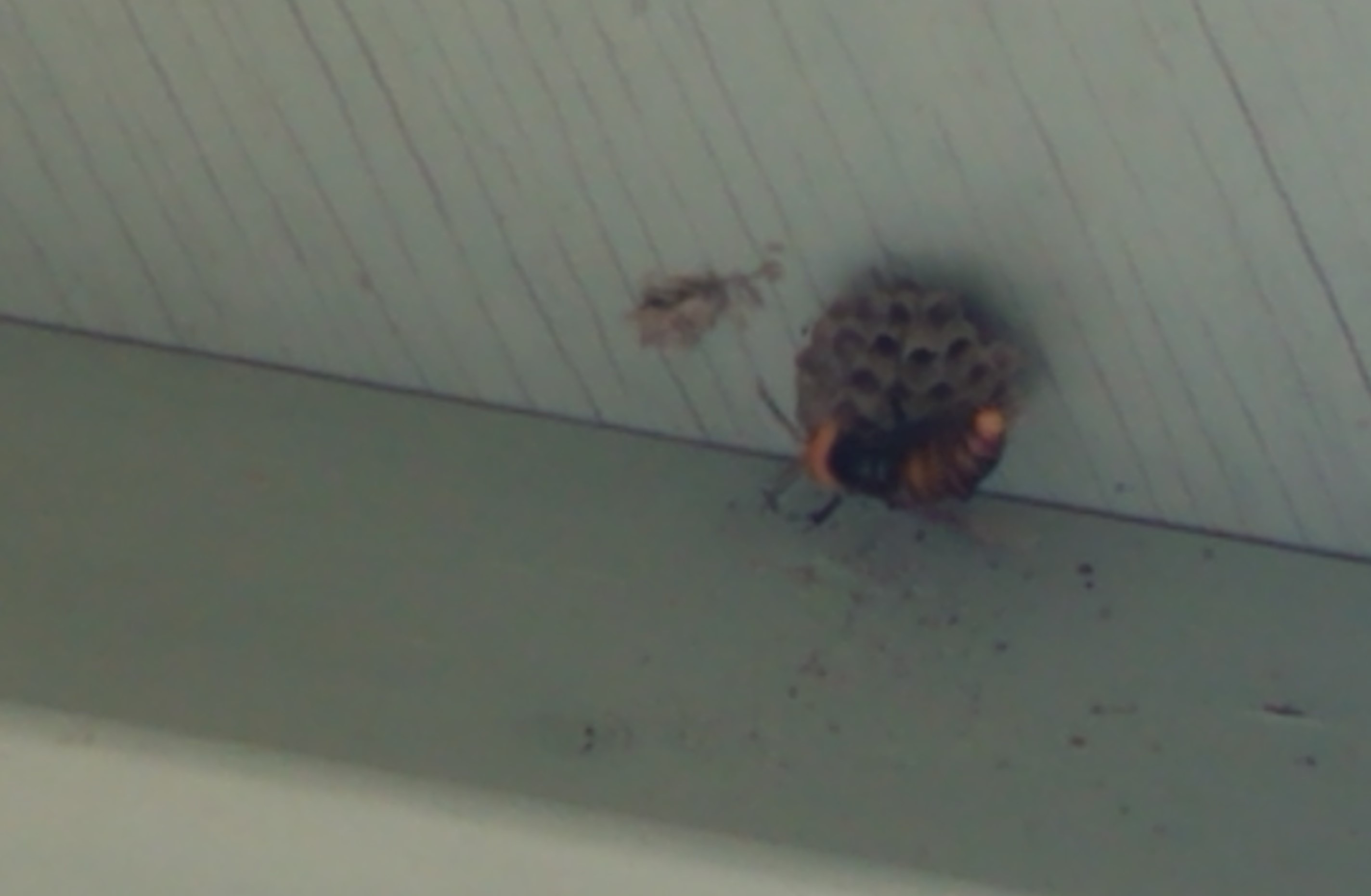
Paper wasp on a nest in Washington State

Did you know you can help protect Washington from invasive species just by taking a walk around your house or barn once a week? 

Over the last few years, residents of Whatcom County and WSDA staff have noticed hornets attacking paper wasp nests. In 2021, WSDA tracked a hornet and observed it repeatedly visiting the same paper wasp nest. Each visit lasted five to ten minutes and the hornet removed paper wasp larvae.  

WSDA invites you to help watch for northern giant hornets (Vespa mandarinia). Join our community science project to locate active paper wasp nests, watch the nests weekly, and record your observations from June through October. WSDA will continue to invite residents to participate in public scientist trapping too.

Northern giant hornet attacking a 
paper wasp nest on a house in Whatcom County

Paper wasps (Polistes dominula) can grow to about three-quarters of an inch long and have a well-defined “wasp waist” that makes them easy to identify. Paper wasps are typically not aggressive and do not readily attack people, but they can sting if threatened. They form small colonies and build hanging, open-comb nests on building eaves, frames, abandoned cars, or branches of trees and shrubs. Paper wasp nests vary in size and are usually gray to brown in color. They are made up of many exposed cells that are less than an inch deep. Nests typically range from the size of a quarter to a coffee can lid, but can be larger.

Although we invite anyone in Washington to participate in adopting a paper wasp nest, we are particularly interested in observations from Whatcom, Skagit, Island, San Juan, Snohomish, King, Jefferson, and Clallam counties.

Paper wasps tending their nest
LOCATE

Starting in June, locate active paper wasp nests that you have access to and can monitor through October. Log the nest locations using the Watch a Wasp Nest Registration Form. After submission, you’ll receive an email confirmation which will include a unique Nest ID assigned to your nest location. You will need to save this Nest ID to use during weekly check-ins. Access the registration form.

MONITOR

Each week visit the nests. Watch for any hornet or wasp activity happening at the nest. WSDA asks you to monitor the nests for at least five minutes during the day once per week, but you can check the nests as long and often as you would like.

REPORT

After monitoring you will need to report each of your observations on the Watch a Wasp Check-in form. You will also need your Nest ID which was received in a confirmation email. Click here to access the check-in form.

However, if you think you spot a northern giant hornet (it will be significantly larger than the paper wasps), safely take a photo and report it at agr.wa.gov/hornets or by emailing hornets@agr.wa.gov.

Stay Connected

WSDA is dedicated to working with the public and to providing information on northern giant hornets.

Thursday, April 13, 2023

Sign up to help WSDA watch for high-priority invasive pests

Karla Salp
Communications

Image: spotted lanternfly. Text: Sign up to join the WSDA pest pathway project
Is tomato fruit borer lurking in your garden? Or is Scots pine blister rust on your tree? Early detection is critical for protecting the state’s forests, parks, farms, and gardens from invasive pests and diseases.

That’s why WSDA’s Pest Program has a new project to be on the lookout for some of the nation’s highest-priority pests and plant diseases that are not yet known to be in the state.

The program will look for national high-priority pests including pests like spotted lanternfly, which has rapidly spread and decimated vineyards in the Eastern U.S.; apple proliferation phytoplasma, a type of bacteria that inhabits, impedes, and kills orchards; and the tomato brown rugose virus, which stunts tomatoes making their fruits unpalatable.

To look for these and other* pests, the WSDA Pest Program needs your help. They are asking farms, community gardens, parks, and even private property owners to sign up to participate in the project this summer. There are two ways to participate:

  • Summer trapping – WSDA trappers will place traps early in the summer and check them several times throughout the season. The traps will be removed in the fall.
  • Single site visit – WSDA staff will visit the site once to perform a visual inspection for pests. 

Specifically, the team is looking for properties that will have one or more of the following on-site this summer: 

  • Fruit or nut trees
  • Vegetables
  • Fruiting shrubs/vines
  • Ornamental trees/shrubs

While anyone in Washington is welcome to sign up, the program is especially interested in sites near highways or ports.

If you are willing to participate by offering your property for trapping or a site visit, please sign up to have your location considered. The Pest Program will review your information and contact you by May 15, 2023, to let you know if your property has been selected as a pest survey site for the upcoming season.

WSDA has a long history of looking for invasive pests to prevent them from establishing in the state. For example, the longest-running program is the invasive moth program, which has kept spongy moth (formerly known as gypsy moth) from establishing in Washington (despite numerous introductions) for almost 50 years. Public support and participation have always played a key role in protecting our state from invasive pests and diseases.

With your support and early detection, there is a much higher chance of eradicating or significantly slowing the spread of any new pest. 

*The complete list of pests for this project:

Scientific Name

Common Name

Lycorma delicatula

Spotted lanternfly

Adoxophyes orana

Summer fruit tortrix moth

Anthonomus rubi

Strawberry blossom weevil

Diabrotica speciosa

Cucurbit beetle

Helicoverpa armigera

Old world bollworm

Heteronychus arator

Black maize beetle

Neoleucinodes elegantalis

Tomato fruit borer

Thaumatotibia leucotreta

False codling moth

Phthorimea absoluta

Tomato leafminer

Candidatus Phytoplasma australiense 16SrXII-B

Australian grapevine yellows

Candidatus Phytoplasma mali 16SrX-A

Apple proliferation

Candidatus Phytoplasma phoenicium 16SrIX-B

Almond witches' broom

Candidatus Phytoplasma prunorum 16SrX-F

European stone fruit yellows

Candidatus Phytoplasma solani 16SrXII-A

Bois noir; Stolbur

Candidatus Phytoplasma ziziphi

Jujube witches' broom

Cronartium flaccidum

Scots pine blister rust

Magnaporthiopsis maydis

Late wilt of corn

Orthotospovirus Groundnut bud necrosis virus

Groundnut bud necrosis virus (GBNV)

Hymenoscyphus fraxineus

Ash dieback

Tobamovirus Cucumber green mottle mosaic virus

Cucumber green mottle mosaic virus (CGMMV)

Tobamovirus Tomato brown rugose fruit virus

Tomato brown rugose (ToBRFV)

Alectra vogelii

Yellow witchweed

Onopordum acaulon

Horse thistle


Thursday, August 25, 2022

Pest alert: Everett area residents asked to report sightings of oversized, striped-eyed grasshopper

Cassie Cichorz and Karla Salp
Pest Program and Communications

Close up of the head of an Egyptian grasshopper showing the striped eye
Egyptian grasshoppers have striped eyes
Photo credit: Hectonichus, CC BY-SA 4.0,
via Wikimedia Commons
It is grasshopper season and, if you live near Everett, it is a good time to keep your eyes peeled for an unusually large grasshopper with unusual eyes.

An Everett resident reported one Egyptian grasshopper (Anacridium aegyptium) to Washington State entomologists earlier this year and USDA entomologists recently confirmed it as the first detection of the insect in Washington State. The Washington State Department of Agriculture will conduct visual surveys in the area but is asking the public to also be on the lookout for this large grasshopper with striped eyes.

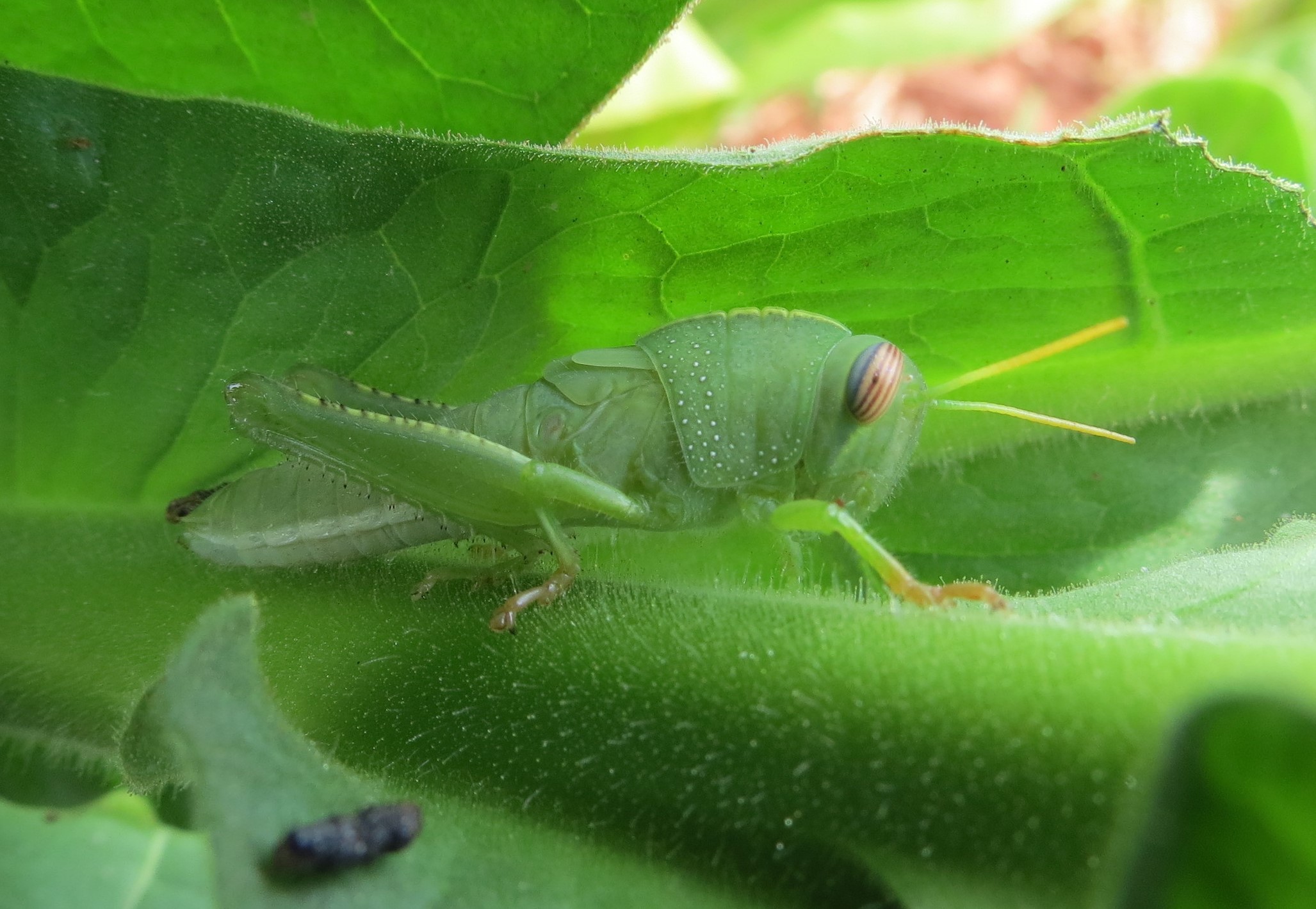
The grasshoppers typically feed on plant leaves. Adults are usually olive, gray, or brown in color and are most likely to be seen toward the end of summer. Young grasshoppers can be green and may blend in with vegetation. Males can grow to over two inches

Green grasshopper with striped eyes on a green leaf
While young Egyptian grasshoppers are green, 
they still have striped eyes.
Photo credit: Metin Gulesci

long and females can be almost three inches long. The key to identifying these insects is their eyes - they have distinct black striping on their eyes that sets them apart from other grasshoppers.

“An overwintering grasshopper could easily hitchhike, so this is another case where we are asking the public to help us figure out if this is just a single specimen,” Sven Spichiger, WSDA managing entomologist, said. Only one living, but sluggish, grasshopper has been confirmed. There is currently no evidence of an established population.

Residents near Everett who believe they have seen this insect should send a photo to pestprogram@agr.wa.gov for identification and include the location where it was spotted. If you believe you have seen one outside of Washington State, please take a picture of it, note the location, and report it to your State Plant Regulatory Official or State Plant Health Director.

Adult Egyptian grasshopper on a green leaf
Adult Egyptian grasshopper
Photo credit: Metin Gulesci
Egyptian grasshoppers are generally regarded as a minor pest of concern in their native habitat but could be an occasional pest to crops, orchards, and vineyards. USDA is gathering available scientific information to help determine the potential risk of this insect.

Monday, August 22, 2022

Cicada killer frequently mistaken as northern giant hornet

Cassie Cichorz
Pest Program

cicada killer side-by-side with a northern giant hornet
With summer here, people are outside enjoying nature and noticing insects! Citizens are on the lookout and reporting suspect giant hornets. WSDA’s team has been hard at work reviewing hundreds of reports of suspect northern giant hornets. Most of the insects reported are not harmful and play an important role in the environment. One insect, the western cicada killer (Sphecius grandis) seems to be trending as the most common native bug mistaken for a northern giant hornet (Vespa mandarina).

If you can familiarize yourself with some features of the look-alike insect in the spotlight, you’ll be able to identify differences. The western cicada killer is a very common native wasp that can be almost as large as a northern giant hornet. Cicada killers can be seen from late spring and throughout the summer.

Cicada killers can be up to two inches long, just like the northern giant hornet. Differences in their head, thorax, or abdomen will help you distinguish between the two species. The heads of cicada killers are narrower than their thorax, while the northern giant hornet has a head as wide as its thorax. The cicada killer has round eyes, unlike the angular eyes of giant hornets.

cicada killer

The thorax on a cicada killer is reddish in color, while the northern giant hornet’s is black. The cicada killer’s thorax and head are about the same color, unlike the contrasting head and thorax of the northern giant hornet. Both wasps have translucent, amber-colored wings.

You can also check the banding on the abdomen for differences. The northern giant hornet has horizontal lateral bands or striping on its abdomen. The cicada killer’s bands will drop down like teardrops, or have dots between the bands.


Female cicada killers are solitary and dig their nests in the ground. You will often find their nests around areas with lots of sunlight, and sometimes you will see a mound of dirt near the entrance. Cicada killers do not actively defend their nests normally. Males can be territorial, but they do not have a stinger.

Northern giant hornet nests can be underground or in tree cavities. Unlike cicada killers, hornets are social and live in large colonies – which they will vigorously defend. Away from the nest, hornets are typically non-aggressive unless provoked.

WSDA has other information on look-alike insects, including a poster guide available for use and download. Click here to learn more about identification. Cicada killers do not need to be reported, but if you suspect you’ve seen a giant hornet in Washington State or are not sure if what you have seen is one or not, get a photo and report it at agr.wa.gov/hornets.


Friday, August 5, 2022

Pest alert: Have you seen this huge moth? It just showed up in Bellevue

Karla Salp
Communications

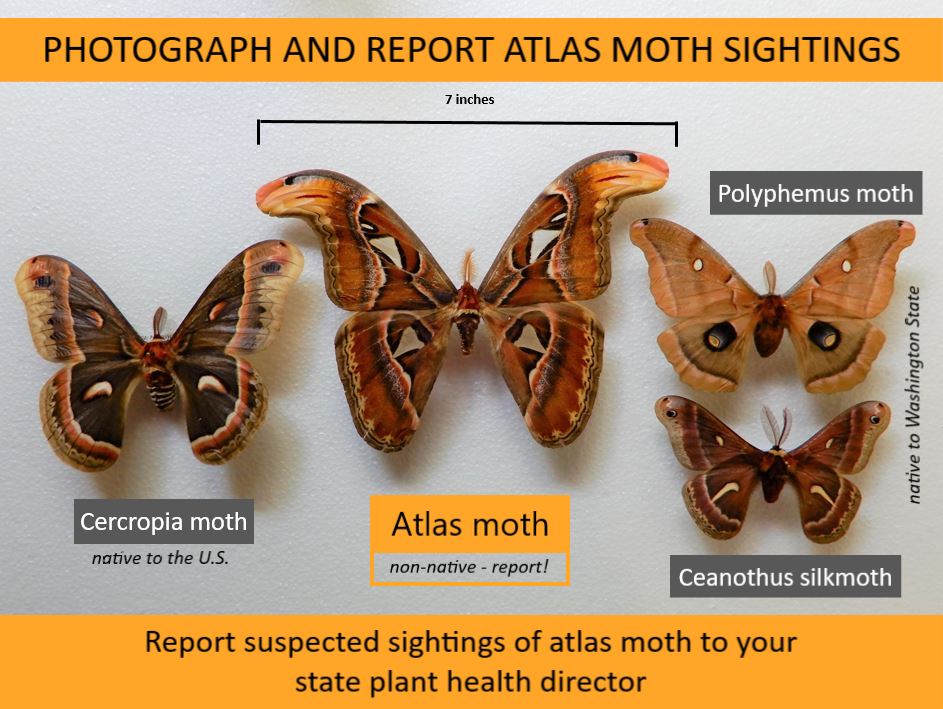
The non-native atlas moth compared with large
moths found in North America. 
Washington State entomologists are asking the public to report sightings of the atlas moth after one was recently discovered in Bellevue. There are no known traps for atlas moths, so WSDA is hoping to determine whether there are additional moths in the area based on public reports. With this single atlas moth detection only, there is no evidence that an atlas moth population is established in Washington.

Residents are encouraged to photograph, collect, and report atlas moths if they are seen. The moths do not pose a public health threat and thus can safely be photographed, handled, and collected.

“This is a ‘gee-whiz’ type of insect because it is so large,” Sven Spichiger, WSDA managing entomologist, said. “Even if you aren’t on the lookout for insects, this is the type that people get their phones out and take a picture of – they are that striking.”

Washington State residents who believe they have seen this moth should send a photo to pestprogram@agr.wa.gov for identification and include the location where it was spotted. While there are no reports of atlas moth anywhere else in the U.S., if you believe you’ve found it outside of Washington State, please take a picture of it, note the location, and report it to the State Plant Regulatory Official or State Plant Health Director in your state.

The atlas moth found on a Bellvue garage
The moth was initially reported to WSDA via a University of Washington professor on July 7. WSDA entomologists identified it as an atlas moth and sent it to USDA for confirmation, which is the standard process for new pest detections. USDA’s Animal and Plant Health Investigation Service confirmed the specimen as an atlas moth on July 27 and it is believed to be the first confirmed detection of the moth in the United States.
Atlas moth compared to a man's hand

One of the world’s largest known moths with a wingspan of up to almost 10 inches, it is also a federally quarantined pest – meaning it is illegal to obtain, harbor, rear, or sell live moths whether adults, eggs, larvae, or pupae without a permit from USDA. USDA has more information about permits on its invertebrate pets web page. While there is minimal research about the moth, entomologists believe host plants may include apple and cherry.

“This is normally a tropical moth. We are not sure it could survive here,” Spichiger said. “USDA is gathering available scientific and technical information about this moth and will provide response recommendations, but in the meantime, we hope residents will help us learn if this was a one-off escapee or whether there might indeed be a population in the area.” 


Note: This blog was updated on August 17 to reflect that rather than being the world's largest moth, it is one of the world's largest moths. 

Thursday, June 30, 2022

With hornet trapping, finding nothing means something

Karla Salp
Communications

Trap contents from a brown-sugar-baited trap in
South Korea, including V. mandarinia and V. crabro
The first of July is a much-anticipated time for Washington’s citizen scientists. It marks the start of the Asian giant hornet (Vespa mandarinia) trapping season. For the past two years, citizen scientists have set hundreds of traps to help look for hornets throughout the state.

Yet very few of those traps have actually caught a hornet. Not catching hornets, however, is good – and provides meaningful information.

WSDA entomologists Sven Spichiger and Chris Looney recently returned from a trip to South Korea where they conducted or began various types of hornet research in partnership with some local collaborators in an area where the hornets are well established.

One of the experiments involved placing five traps - like those WSDA and citizen scientists have been using for the past two years - to look for the hornets. The traps used the brown sugar bait option – an option that was added in 2021 in addition to the orange juice and rice cooking wine bait option.

The mini-experiment suggested that when hornets are around, the traps will catch them. Although the traps were placed several weeks before peak worker hornet season, WSDA was able to trap two Vespa mandarinia and six Vespa crabro (European hornet) specimens from June 9 - 24.

When you run a trap and catch nothing, that is a great result! It suggests that there are no hornets where you live. So, even if you are disappointed that you’ve never caught a hornet, please consider being a citizen scientist again and help us monitor hornet populations in the state. Whether you catch a hornet or not, it provides the data we need to eradicate this invasive hornet.

Not up for trapping hornets? You can also join our Adopt a Wasp program, which only requires five minutes per week watching paper wasp nests on your property. 

Friday, May 20, 2022

This summer, "adopt a wasp" to help monitor for Asian giant hornets

Cassie Cichorz
Pest Program

WSDA invites you to help watch for Asian giant hornets (Vespa mandarinia) this summer. Join our new citizen science project to adopt a structure with paper wasp nests and observe the nests weekly from June through October. If you'd like to do even more, WSDA will continue to invite residents to participate in citizen scientist trapping for hornets too.

Over the last two years, residents of Whatcom County have noticed hornets attacking paper wasp nests. In 2021, WSDA tracked a hornet and observed it repeatedly visiting the same paper wasp nest. Each visit lasted five to ten minutes and the hornet removed paper wasp larvae.  

Paper wasps can grow to about ¾ of an inch long and have a well-defined “wasp waist” that makes them easy to identify. Paper wasps are typically not aggressive and do not readily attack people, but they can sting if threatened. They form small colonies and build hanging, open comb nests on building eaves, frames, abandoned cars, or branches of trees and shrubs. Paper wasp nests vary in size and are usually gray to brown in color. They are made up of many exposed cells that are less than an inch deep. Nests typically range from the size of a quarter to as wide as a coffee can lid, but can be larger.


Although we invite anyone in Washington to participate in adopting a paper wasp nest, we are particularly interested in observations from Whatcom, Skagit, Island, San Juan, Snohomish, King, Jefferson, and Clallam counties.

LOCATE

Starting in June, locate nests that you have access to and can monitor through October. Log the nest locations using the Adopt A Paper Wasp Registration Form. After submission, you’ll receive an email confirmation which will include a unique Site ID assigned to your nest location. You will need to save this Site ID to use during weekly check-ins. (Please do not register any sites before June 1.) Click here to access the registration form. When you register, you’ll have the option to sign up for weekly email reminders to check your wasp nests. You can also sign up for weekly text reminders by texting JOIN WASP to 1-800-443-6684.

MONITOR

Each week visit the nests, observe, and report online if any hornet or wasp activity is happening at the nest. WSDA asks you to monitor the nests for at least five minutes during the day once per week, but you can check the nests for as long and often as you would like. 

REPORT

After monitoring you will need to report each of your observations on the Paper Wasp Nest Check-in form. You will also need your Site ID that was received in a confirmation email. Click here to report and access the Check-in form.

However, if you think you spot an Asian giant hornet (it will be significantly larger than the paper wasps), safely take a photo and report it at agr.wa.gov/hornets or by emailing hornets@agr.wa.gov.

Stay Connected

WSDA is dedicated to working with the public and to providing information on Asian giant hornets.

·        Join the Asian giant hornet Facebook group.

·        Join the Pest Program email listserv.

Follow WSDA on Facebook, Instagram, YouTube, and Twitter

Tuesday, February 22, 2022

Asian giant hornets go to school

Karla Salp
Communications

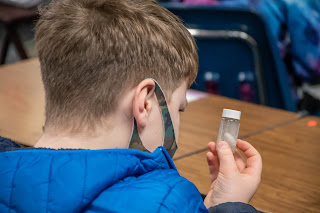
A student examines a hornet larva
While Asian giant hornet queens are still snuggled up for the winter, WSDA’s Pest Program has no time to rest. Winter/early spring is when our entomologists review the previous year’s results and make plans for the coming season.

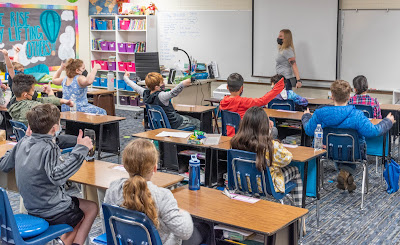
From the start, an important part of WSDA’s approach to ridding the state of this invasive pest has been public education and involvement, which is what brought outreach specialist Cassie Cichorz to visit a third-grade class at Skyline Elementary in Ferndale last Tuesday.

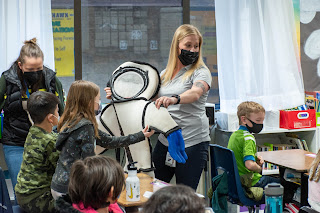
With a wagon full of hornet memorabilia, Cassie has been visiting classrooms around Whatcom County, bringing the hornet to children class by class. Her impressive collection includes hornets in various life stages, combs from nests, a hornet suit she uses during nest eradication, posters, and – always popular with the students – Asian giant hornet temporary tattoos.

Students giving a thumbs-up for their favorite 
Asian giant hornet life stage

Winter is the perfect time for Cassie’s classroom visits – it is a break from our fieldwork that coincides nicely with school schedules – especially those in areas most likely to encounter the world’s largest hornet.  

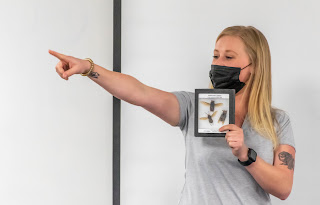
Cassie Cichorz calls on a student in the back
of the class while displaying hornets
A former school teacher, Cassie has the skill to effectively engage with students and share her hornet knowledge with school children, teaching them how hornets live, what they eat, how they develop, and the threat they pose to local honey bees. Students also learn what to do if they think they see one: tell an adult who can get a picture and report it to WSDA.

Cassie spent half an hour with the class. While telling them about the hornets, she passed around vials containing hornets at various life stages. Some of the students displayed an impressive knowledge of insect development, naming all of the life insect stages: egg, larva, pupa, and adult.

She also carried around a piece of comb from one of the nests that WSDA eradicated just a few miles from the school. The nest comb was “look but don’t touch” because of how delicate the paper comb is.

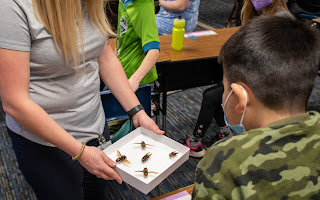
A student looks at pinned hornet specimens

Both students and staff were fascinated by the insects and most are excited about the opportunity to see them up close. One little girl was too excited to stay in her seat and kept sneaking up close to Cassie to better see the specimens she had even before they were passed around the room. And one staff member confessed that teachers who had already hosted Cassie in and her wagon of wonders in their rooms were sure to take a selfie with a hornet.

Cassie Cichorz lets students feel her hornet suit

While most students love the presentation, not everyone is so enthusiastic.

“Thanks, I’ll never sleep again,” one student said as Cassie packed up her wagon to head to the next classroom.

Schools in Whatcom County interested in the presentations can contact Cassie. She isn’t able to visit every school in the state, but there are many Asian giant hornet resources on our website, including math and science lesson plans appropriate for grades 6 – 10 from Scholastic. 

Thursday, November 18, 2021

WSDA Pest Program trapping season wraps up

Karla Salp
Communications

Each year, WSDA’s Pest Program sets thousands of traps throughout the state to catch invasive species that could threaten agriculture. The program surveys for over 130 pests – most of which have not yet been detected in the state.

Japanese beetles

Dozens of Japanese beetles in a ziplock bag
Dozens of Japanese beetles collected from a single trap

It was a record year for Japanese beetle (Popillia japonica) catches - unwelcome news to farmers and homeowners alike. There was one catch in Washington across the river from Portland, a few as usual near Seattle-Tacoma International Airport, but more than 24,000 in the Grandview area. Catching so many in Grandview this year was surprising considering that only three were caught in 2020 between Grandview and Sunnyside combined.
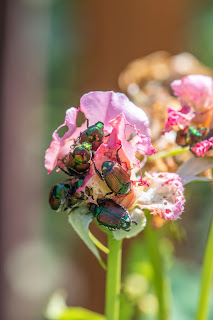
Japanese beetles on rose bud
Japanese beetles devour a 
Grandview resident's roses
The overwhelming number of catches in the Grandview area has many implications. First, WSDA has proposed a 49-square-mile Japanese beetle quarantine to restrict the movement of soil, yard debris, and plant materials that could spread the beetles. Second, WSDA is planning an extensive, multi-year eradication program to try to eradicate the pest – no easy task given the number of beetles already in the area. Finally, WSDA will conduct extensive outreach and trapping in Yakima and Benton counties in 2022. 

Japanese beetles attack over 300 different types of plants including roses, hops, grapes, corn, lawns, and many other crops grown in area gardens and farms.

If there is a silver lining to this beetle infestation, it is that the city, businesses, schools, and people in the vicinity have been open and willing to do what they can to help with WSDA’s response to this invasive pest. Another positive: although nearly 100 traps were placed around area plant nurseries, no beetles were found at the nurseries.

Invasive moths

Male Lymantria dispar
Our trappers set nearly 23,000 traps statewide this year looking for Lymantria dispar – the moth formerly known as the gypsy moth (a new common name has not yet been established.) This moth has devastated forests in the Eastern U.S. where it is established – eating over 300 different types of trees and plants. When there are cycles of large populations, they can strip entire forests from the canopy to the ground, leaving an eerie winter-like scene at the beginning of summer.

This year was a low year for Lymantria dispar catches – only six were found in the entire state. Unfortunately, one of those moths was caught in Eastern Washington just north of Kettle Falls - which is unusual in itself as most moths are normally trapped in Western Washington – and it was also a more concerning variety – Lymantria dispar asiatica, formerly known as the Asian gypsy moth. Lymantria dispar asiatica eats a wider variety of trees (including evergreens) and the females can fly, allowing them to spread more easily.

Apple maggot
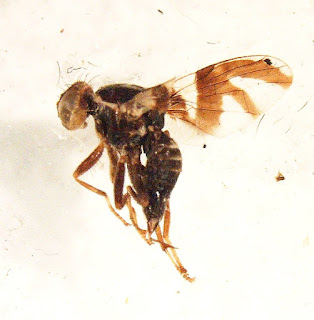
apple maggot fly
Apple maggot fly
Our apple maggot (Rhagoletis pomonella) program continued its work of safeguarding Washington’s global reputation for delicious – and pest-free – apples. The program’s work consists of trapping pest-free areas to ensure they remain pest-free as well as trapping around threatened orchards that are near known apple maggot detection sites.

The good news this year is that many of our main apple-growing regions had no catches at all this year: Adams, Asotin, Benton, Douglas, Franklin, Grant, Lincoln, and Stevens counties. Less encouraging was catching 120 apple maggots in Kittitas County and 843 in Okanogan County.

In areas where apple maggots have been detected outside of the apple maggot quarantine area, the county pest boards are responsible for taking aggressive action. WSDA and the Apple Maggot Working Group (an advisory council composed of state and local government, industry representatives, and researchers) began working last year to examine how best to address the growing apple maggot problem in the unquarantined area of Okanogan County. That effort will continue over the coming months.

Asian giant hornet
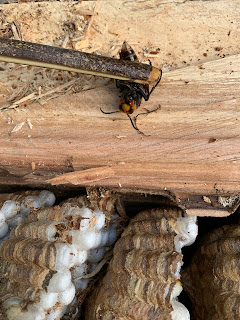
Asian giant hornet queen trapped by chopsticks against tree with combs capped with white silk from the nest in the tree showing
Asian giant hornet queen from the
third nest with part of her nest
Our Asian giant hornet (Vespa mandarinia) team had a busy season – finding and eradicating three hornet nests in August and September. Every nest was in a tree cavity, each demanding a creative approach to remove the nest. The most challenging nest was about 15 feet up a tree.

Public trapping and reporting again played a major role in locating the nests – two of the three were located after reports from area residents. Despite existing research indicating that the hornets predominately nest in the ground in their native range, all four nests eradicated in Washington over the last two years have been in tree cavities.

Our hornet program will continue for at least three more years. In order for the hornets to be considered eradicated, we must have three consecutive years with no detections. The biggest challenge to success is the lack of a highly-effective trap. While the traps we use catch hornets, they do not appear to be irresistible to them. USDA continues to work on a lure that will be more attractive to the hornets and we wish them much success!

Exotic wood-boring insects
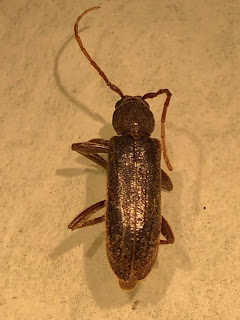
velvet longhorn beetle
Velvet longhorn beetle
Many of the pests we look for are never found. Such is usually the case with our exotic wood-boring insect survey. Imagine trapping for years and never finding what you are looking for. As disappointing as it may be not to find anything, that’s exactly what we hope the results will be as we look for potentially harmful new pests.

This year, WSDA put out over 400 exotic wood-boring insect traps at high-risk sites such as ports, shipping distribution sites, and transfer stations. Trapped areas and other high-risk areas are visually surveyed for signs of wood boring insect activity. One day, they found one.

“This is the first time in all of these years I have trapped a target species,” Don Kitchen, one of the members of the beetle survey team, said.

This past summer, the velvet longhorn beetle (Trichoferus campestris) was detected for the first time in the state in King County near Kent. WSDA responded by setting more traps and conducting visual surveys of the area, although no additional beetles were found. WSDA will continue to put out additional traps, conduct visual surveys of the area, and conduct outreach about the beetle in 2022.

The work continues

WSDA’s Pest Program has had a busy year – and this roundup covers just a handful of the pests they monitor. With their continued work and the help of the public looking for and reporting suspected invasive species, our state should be protected from harmful pests for years to come.