
Showing posts with label apple maggot. Show all posts

Thursday, November 18, 2021

WSDA Pest Program trapping season wraps up

Karla Salp
Communications

Each year, WSDA’s Pest Program sets thousands of traps throughout the state to catch invasive species that could threaten agriculture. The program surveys for over 130 pests – most of which have not yet been detected in the state.

Japanese beetles

Dozens of Japanese beetles in a ziplock bag
Dozens of Japanese beetles collected from a single trap

It was a record year for Japanese beetle (Popillia japonica) catches - unwelcome news to farmers and homeowners alike. There was one catch in Washington across the river from Portland, a few as usual near Seattle-Tacoma International Airport, but more than 24,000 in the Grandview area. Catching so many in Grandview this year was surprising considering that only three were caught in 2020 between Grandview and Sunnyside combined.
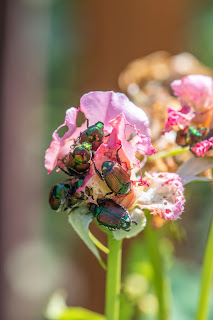
Japanese beetles on rose bud
Japanese beetles devour a 
Grandview resident's roses
The overwhelming number of catches in the Grandview area has many implications. First, WSDA has proposed a 49-square-mile Japanese beetle quarantine to restrict the movement of soil, yard debris, and plant materials that could spread the beetles. Second, WSDA is planning an extensive, multi-year eradication program to try to eradicate the pest – no easy task given the number of beetles already in the area. Finally, WSDA will conduct extensive outreach and trapping in Yakima and Benton counties in 2022. 

Japanese beetles attack over 300 different types of plants including roses, hops, grapes, corn, lawns, and many other crops grown in area gardens and farms.

If there is a silver lining to this beetle infestation, it is that the city, businesses, schools, and people in the vicinity have been open and willing to do what they can to help with WSDA’s response to this invasive pest. Another positive: although nearly 100 traps were placed around area plant nurseries, no beetles were found at the nurseries.

Invasive moths

Male Lymantria dispar
Our trappers set nearly 23,000 traps statewide this year looking for Lymantria dispar – the moth formerly known as the gypsy moth (a new common name has not yet been established.) This moth has devastated forests in the Eastern U.S. where it is established – eating over 300 different types of trees and plants. When there are cycles of large populations, they can strip entire forests from the canopy to the ground, leaving an eerie winter-like scene at the beginning of summer.

This year was a low year for Lymantria dispar catches – only six were found in the entire state. Unfortunately, one of those moths was caught in Eastern Washington just north of Kettle Falls - which is unusual in itself as most moths are normally trapped in Western Washington – and it was also a more concerning variety – Lymantria dispar asiatica, formerly known as the Asian gypsy moth. Lymantria dispar asiatica eats a wider variety of trees (including evergreens) and the females can fly, allowing them to spread more easily.

Apple maggot
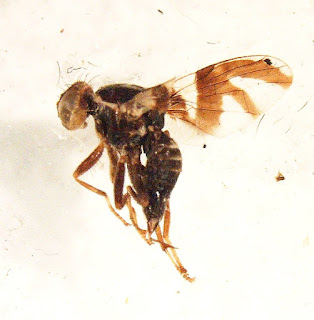
apple maggot fly
Apple maggot fly
Our apple maggot (Rhagoletis pomonella) program continued its work of safeguarding Washington’s global reputation for delicious – and pest-free – apples. The program’s work consists of trapping pest-free areas to ensure they remain pest-free as well as trapping around threatened orchards that are near known apple maggot detection sites.

The good news this year is that many of our main apple-growing regions had no catches at all this year: Adams, Asotin, Benton, Douglas, Franklin, Grant, Lincoln, and Stevens counties. Less encouraging was catching 120 apple maggots in Kittitas County and 843 in Okanogan County.

In areas where apple maggots have been detected outside of the apple maggot quarantine area, the county pest boards are responsible for taking aggressive action. WSDA and the Apple Maggot Working Group (an advisory council composed of state and local government, industry representatives, and researchers) began working last year to examine how best to address the growing apple maggot problem in the unquarantined area of Okanogan County. That effort will continue over the coming months.

Asian giant hornet
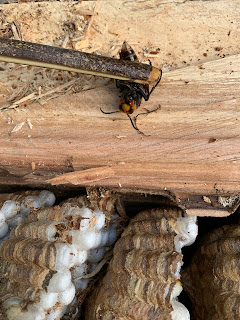
Asian giant hornet queen trapped by chopsticks against tree with combs capped with white silk from the nest in the tree showing
Asian giant hornet queen from the
third nest with part of her nest
Our Asian giant hornet (Vespa mandarinia) team had a busy season – finding and eradicating three hornet nests in August and September. Every nest was in a tree cavity, each demanding a creative approach to remove the nest. The most challenging nest was about 15 feet up a tree.

Public trapping and reporting again played a major role in locating the nests – two of the three were located after reports from area residents. Despite existing research indicating that the hornets predominately nest in the ground in their native range, all four nests eradicated in Washington over the last two years have been in tree cavities.

Our hornet program will continue for at least three more years. In order for the hornets to be considered eradicated, we must have three consecutive years with no detections. The biggest challenge to success is the lack of a highly-effective trap. While the traps we use catch hornets, they do not appear to be irresistible to them. USDA continues to work on a lure that will be more attractive to the hornets and we wish them much success!

Exotic wood-boring insects
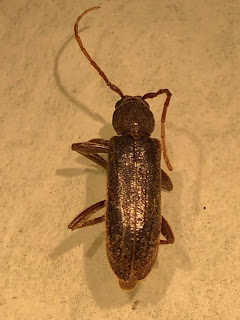
velvet longhorn beetle
Velvet longhorn beetle
Many of the pests we look for are never found. Such is usually the case with our exotic wood-boring insect survey. Imagine trapping for years and never finding what you are looking for. As disappointing as it may be not to find anything, that’s exactly what we hope the results will be as we look for potentially harmful new pests.

This year, WSDA put out over 400 exotic wood-boring insect traps at high-risk sites such as ports, shipping distribution sites, and transfer stations. Trapped areas and other high-risk areas are visually surveyed for signs of wood boring insect activity. One day, they found one.

“This is the first time in all of these years I have trapped a target species,” Don Kitchen, one of the members of the beetle survey team, said.

This past summer, the velvet longhorn beetle (Trichoferus campestris) was detected for the first time in the state in King County near Kent. WSDA responded by setting more traps and conducting visual surveys of the area, although no additional beetles were found. WSDA will continue to put out additional traps, conduct visual surveys of the area, and conduct outreach about the beetle in 2022.

The work continues

WSDA’s Pest Program has had a busy year – and this roundup covers just a handful of the pests they monitor. With their continued work and the help of the public looking for and reporting suspected invasive species, our state should be protected from harmful pests for years to come. 

Thursday, December 5, 2019

The scoop on adding soil to the apple maggot quarantine

Amy Clow
Pest program

Washington has long had an apple maggot quarantine in place in several counties to control the spread of apple maggot into pest-free areas of the state. After months of meetings and consultation with numerous partners in the tree fruit industry, the Washington State Department of Agriculture (WSDA) is proposing to add soil and growing medium to the list of apple maggot quarantine regulated materials. 

The rule change would regulate the movement of soil and growing medium, in pots or root balls of both plants that can host apple maggot and some non-host plants. 

Under the proposal, plants with soil that originate from a quarantined area must have a phytosanitary certificate stating the following if they will be moved out of the quarantined area: 

Host Plants (Apple, crabapple, hawthorn, cherry, pear, plum, prune, and quince)  
  • Have not produced fruit and were not located in the drip line of host plants that have fruited or
  • Originated in an area where apple maggot is not considered established based on official  trapping surveys or
  • Had soil or growing medium treated with an appropriate pesticide treatment just prior to shipping.
Click on the image for a larger version.


Non-host plants grown within the drip line of fruiting host plants in the quarantine area
  • Originated in an area where apple maggot is not considered established based on official  trapping surveys or
  • Had soil or growing medium treated with an appropriate pesticide treatment just prior to shipping.
Click on the image for a larger version.
As a reminder, moving fruit attached to host plants is already prohibited under the apple maggot quarantine. 

The following remain unregulated, even under the proposed rule change: 
  • Bare root plants (host and non-host) – host plants cannot have fruit attached
  • Plants (host and non-host) originating from the WSDA pest-free area
  • Non-host plants that were not grown in the drip line of fruiting host plants
In addition to adding soil and growing media to the list of regulated materials, WSDA is also proposing to change the rule to reflect how plants may enter the pest-free area if the risk is mitigated.

The rule change was first suggested by the Washington State Tree Fruit Association after WSDA trapping discovered that apple maggot had likely been moved into the pest-free area in the soil of a potted nursery fruit tree. WSDA identified soil on nursery plants as a probable pathway for the introduction of apple maggot into pest-free areas. 

Public hearings for the rule change are expected to take place sometime in January, with exact dates to be determined. 

WSDA is currently developing a Small Business Economic Impact Statement (SBEIS) to determine what economic impact this rule change may have on small businesses. The results of the SBEIS will be made public with the filing of the CR-102. Visit agr.wa.gov/Services/Rulemaking for more information on WSDA rulemaking activity or to view the CR-101. 

Visit agr.wa.gov/applemaggot to stay informed about this rule change and other apple maggot quarantine issues. 

Tuesday, January 10, 2017

Don’t Cross the Line: WSDA Expands Apple Maggot Quarantine

Karla Salp
Pest Program 

Apple damaged by apple maggots
As the old saying goes, don’t let a bad apple spoil the barrel. In an effort to protect Washington’s many barrels of apples, WSDA expanded the apple maggot quarantine area effective Jan. 1.

Recently, WSDA found apple maggot in the southeastern corner of Lincoln County. The expanded quarantine now includes a portion of Lincoln County to prevent further spread of the pest. The quarantine prohibits the movement of homegrown or foraged fruit from the quarantined area into a pest-free area.

WSDA has held public meetings in the process of changing the quarantine boundaries and mailed postcards to residents in or near the new quarantine area to alert them to the change.

Apple Maggot Quarantine
Apple maggot quarantine effective Jan. 1, 2017
The apple maggot larva looks like a tiny white worm that eats its way through an apple, leaving behind a brown mush that is not fit for human consumption.
Apple maggot quickly spread through Western Washington after its introduction, but state and local efforts have so far prevented it from becoming established in the main apple growing regions of the state.

Searchable Map

WSDA has updated its apple maggot webpage with lots of information for commercial growers, home owners, and more. One of the features of the new website is that it now contains a searchable map. The new map allows anyone to enter an address and find out whether the address is inside or outside the quarantine area.

Apple Maggot and Garbage
Adult apple maggot fly

WSDA also clarified a rule that prohibited the transport of municipal and green waste from quarantined areas into pest-free areas. For the homeowner in a quarantine area, this means they cannot take yard waste or garbage to dumps or transfer stations in the pest-free area. Waste from a quarantined area can be taken to any waste facility that is also in the quarantine area.

More than apples - What to do with your fruit

Apple maggot can spread quickly when humans move fruit (including apples, crab apples, hawthorn, cherries, pears, plums, and apricots) into pest-free areas. That is why WSDA prohibits the movement of fruit from inside the quarantine to outside of the quarantined area.

So what can you do with your fruit if you live in a quarantine area? Here are some ideas for managing your fruit and yard waste.

  • Process (cook, can, juice, dry, etc.) homegrown fruit before transporting outside the quarantine area.
  • Compost or destroy yard waste at home.
  • Take yard waste to a green waste disposal area inside the quarantine area.
If you have more questions about Washington’s apple maggot quarantine, visit agr.wa.gov/PlantsInsects/InsectPests/AppleMaggot/ to learn more.