Showing posts with label northern giant hornet. Show all posts

Wednesday, July 5, 2023

Summer is here - time to put your Hornet Hunter hat back on

Karla Salp
Communications

man wearing sunglasses putting on a tan hat with a hornet on it
Gov. Inslee dons a hornet hunter hat while 
touring the hornet detection area in 2022. Gov.
Inslee and the Washington Legislature have been
very supportive of the hornet eradication efforts.
July is finally here and you know what that means around WSDA: time to start trapping for hornets! Our hornet trappers are already out in the field setting hornet traps in Whatcom County.

Since the first confirmed detection of the northern giant hornet (Vespa mandarina, also known as the Asian giant hornet) in 2019, there has been overwhelming interest from the public to help eradicate this invasive pest.

WSDA has welcomed this community support, leading to a hybrid government-public response that has been revolutionary – and effective. More than half of the confirmed hornet detections in the state have come from public reports. Three of the four nests eradicated in the state were found as the direct result of public reports.

The community has played a game-changing role in WSDA’s efforts to eradicate the hornets from our state. Although we had no detections last year, we’re not out of the woods yet.

We still need you.

northern giant hornet on paper plates
Hornet sighting reported
to WSDA via social media
in 2020.
Your eyes, ears, and traps are still needed to detect any hornets that might still be lurking in the state. Here are three ways that you can help.

  1. Trapping. WSDA has established a Public Hornet Trapping project, which provides community members with information on how to build and check hornet traps and report any hornets that are caught. The traps are placed in July and are left up through November.
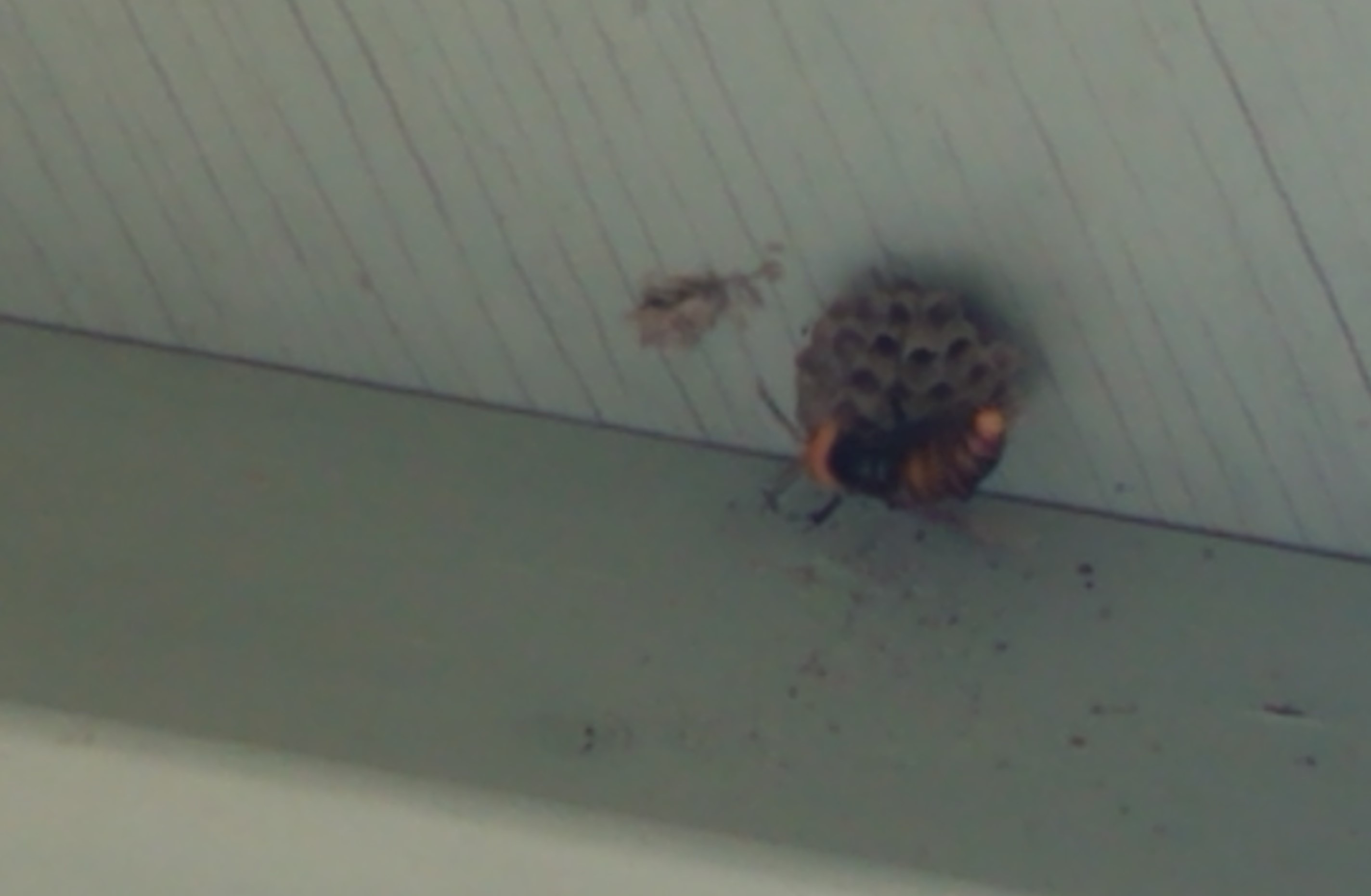
  2. Watch a Wasp Nest. The public and WSDA staff have witnessed northern giant hornets repeatedly attacking paper wasp nests. These nests can easily be found under the eaves of many buildings. By joining the “Watch a Wasp Nest” program, you commit to spending five minutes a week observing paper wasp nests on your property and logging activity, including whether you notice hornets at the nest.
  3. Report sightings. Helping detect northern giant hornets can be as simple as being aware of your surroundings. If you think you spot one, get a photo if you safely can. Report suspected sightings with as much detail as possible, including where the insect was spotted, what it was doing, and if it flew off, the direction in which it headed.

EVERY hornet report matters. Whether found while trapping, watching paper wasp nests, or just being observant when you are out and about, it is critical to report each and every suspect hornet sighting. We get hundreds – if not thousands – of false reports each year, but we gladly accept them because it means you are on the lookout and that means we receive the few but critical confirmed detections we need to eradicate the hornets for good. 

Wednesday, May 31, 2023

Watch a wasp nest to help detect northern giant hornets

Cassie Cichorz
Pest Program

Paper wasp on a nest in Washington State

Did you know you can help protect Washington from invasive species just by taking a walk around your house or barn once a week? 

Over the last few years, residents of Whatcom County and WSDA staff have noticed hornets attacking paper wasp nests. In 2021, WSDA tracked a hornet and observed it repeatedly visiting the same paper wasp nest. Each visit lasted five to ten minutes and the hornet removed paper wasp larvae.  

WSDA invites you to help watch for northern giant hornets (Vespa mandarinia). Join our community science project to locate active paper wasp nests, watch the nests weekly, and record your observations from June through October. WSDA will continue to invite residents to participate in public scientist trapping too.

Northern giant hornet attacking a 
paper wasp nest on a house in Whatcom County

Paper wasps (Polistes dominula) can grow to about three-quarters of an inch long and have a well-defined “wasp waist” that makes them easy to identify. Paper wasps are typically not aggressive and do not readily attack people, but they can sting if threatened. They form small colonies and build hanging, open-comb nests on building eaves, frames, abandoned cars, or branches of trees and shrubs. Paper wasp nests vary in size and are usually gray to brown in color. They are made up of many exposed cells that are less than an inch deep. Nests typically range from the size of a quarter to a coffee can lid, but can be larger.

Although we invite anyone in Washington to participate in adopting a paper wasp nest, we are particularly interested in observations from Whatcom, Skagit, Island, San Juan, Snohomish, King, Jefferson, and Clallam counties.

Paper wasps tending their nest
LOCATE

Starting in June, locate active paper wasp nests that you have access to and can monitor through October. Log the nest locations using the Watch a Wasp Nest Registration Form. After submission, you’ll receive an email confirmation which will include a unique Nest ID assigned to your nest location. You will need to save this Nest ID to use during weekly check-ins. Access the registration form.

MONITOR

Each week visit the nests. Watch for any hornet or wasp activity happening at the nest. WSDA asks you to monitor the nests for at least five minutes during the day once per week, but you can check the nests as long and often as you would like.

REPORT

After monitoring you will need to report each of your observations on the Watch a Wasp Check-in form. You will also need your Nest ID which was received in a confirmation email. Click here to access the check-in form.

However, if you think you spot a northern giant hornet (it will be significantly larger than the paper wasps), safely take a photo and report it at agr.wa.gov/hornets or by emailing hornets@agr.wa.gov.

Stay Connected

WSDA is dedicated to working with the public and to providing information on northern giant hornets.

Monday, August 22, 2022

Cicada killer frequently mistaken as northern giant hornet

Cassie Cichorz
Pest Program

cicada killer side-by-side with a northern giant hornet
With summer here, people are outside enjoying nature and noticing insects! Citizens are on the lookout and reporting suspect giant hornets. WSDA’s team has been hard at work reviewing hundreds of reports of suspect northern giant hornets. Most of the insects reported are not harmful and play an important role in the environment. One insect, the western cicada killer (Sphecius grandis) seems to be trending as the most common native bug mistaken for a northern giant hornet (Vespa mandarina).

If you can familiarize yourself with some features of the look-alike insect in the spotlight, you’ll be able to identify differences. The western cicada killer is a very common native wasp that can be almost as large as a northern giant hornet. Cicada killers can be seen from late spring and throughout the summer.

Cicada killers can be up to two inches long, just like the northern giant hornet. Differences in their head, thorax, or abdomen will help you distinguish between the two species. The heads of cicada killers are narrower than their thorax, while the northern giant hornet has a head as wide as its thorax. The cicada killer has round eyes, unlike the angular eyes of giant hornets.

cicada killer

The thorax on a cicada killer is reddish in color, while the northern giant hornet’s is black. The cicada killer’s thorax and head are about the same color, unlike the contrasting head and thorax of the northern giant hornet. Both wasps have translucent, amber-colored wings.

You can also check the banding on the abdomen for differences. The northern giant hornet has horizontal lateral bands or striping on its abdomen. The cicada killer’s bands will drop down like teardrops, or have dots between the bands.


Female cicada killers are solitary and dig their nests in the ground. You will often find their nests around areas with lots of sunlight, and sometimes you will see a mound of dirt near the entrance. Cicada killers do not actively defend their nests normally. Males can be territorial, but they do not have a stinger.

Northern giant hornet nests can be underground or in tree cavities. Unlike cicada killers, hornets are social and live in large colonies – which they will vigorously defend. Away from the nest, hornets are typically non-aggressive unless provoked.

WSDA has other information on look-alike insects, including a poster guide available for use and download. Click here to learn more about identification. Cicada killers do not need to be reported, but if you suspect you’ve seen a giant hornet in Washington State or are not sure if what you have seen is one or not, get a photo and report it at agr.wa.gov/hornets.


Thursday, June 30, 2022

With hornet trapping, finding nothing means something

Karla Salp
Communications

Trap contents from a brown-sugar-baited trap in
South Korea, including V. mandarinia and V. crabro
The first of July is a much-anticipated time for Washington’s citizen scientists. It marks the start of the Asian giant hornet (Vespa mandarinia) trapping season. For the past two years, citizen scientists have set hundreds of traps to help look for hornets throughout the state.

Yet very few of those traps have actually caught a hornet. Not catching hornets, however, is good – and provides meaningful information.

WSDA entomologists Sven Spichiger and Chris Looney recently returned from a trip to South Korea where they conducted or began various types of hornet research in partnership with some local collaborators in an area where the hornets are well established.

One of the experiments involved placing five traps - like those WSDA and citizen scientists have been using for the past two years - to look for the hornets. The traps used the brown sugar bait option – an option that was added in 2021 in addition to the orange juice and rice cooking wine bait option.

The mini-experiment suggested that when hornets are around, the traps will catch them. Although the traps were placed several weeks before peak worker hornet season, WSDA was able to trap two Vespa mandarinia and six Vespa crabro (European hornet) specimens from June 9 - 24.

When you run a trap and catch nothing, that is a great result! It suggests that there are no hornets where you live. So, even if you are disappointed that you’ve never caught a hornet, please consider being a citizen scientist again and help us monitor hornet populations in the state. Whether you catch a hornet or not, it provides the data we need to eradicate this invasive hornet.

Not up for trapping hornets? You can also join our Adopt a Wasp program, which only requires five minutes per week watching paper wasp nests on your property.