Showing posts with label murder hornets. Show all posts

Wednesday, July 5, 2023

Summer is here - time to put your Hornet Hunter hat back on

Karla Salp
Communications

man wearing sunglasses putting on a tan hat with a hornet on it
Gov. Inslee dons a hornet hunter hat while 
touring the hornet detection area in 2022. Gov.
Inslee and the Washington Legislature have been
very supportive of the hornet eradication efforts.
July is finally here and you know what that means around WSDA: time to start trapping for hornets! Our hornet trappers are already out in the field setting hornet traps in Whatcom County.

Since the first confirmed detection of the northern giant hornet (Vespa mandarina, also known as the Asian giant hornet) in 2019, there has been overwhelming interest from the public to help eradicate this invasive pest.

WSDA has welcomed this community support, leading to a hybrid government-public response that has been revolutionary – and effective. More than half of the confirmed hornet detections in the state have come from public reports. Three of the four nests eradicated in the state were found as the direct result of public reports.

The community has played a game-changing role in WSDA’s efforts to eradicate the hornets from our state. Although we had no detections last year, we’re not out of the woods yet.

We still need you.

northern giant hornet on paper plates
Hornet sighting reported
to WSDA via social media
in 2020.
Your eyes, ears, and traps are still needed to detect any hornets that might still be lurking in the state. Here are three ways that you can help.

  1. Trapping. WSDA has established a Public Hornet Trapping project, which provides community members with information on how to build and check hornet traps and report any hornets that are caught. The traps are placed in July and are left up through November.
  2. Watch a Wasp Nest. The public and WSDA staff have witnessed northern giant hornets repeatedly attacking paper wasp nests. These nests can easily be found under the eaves of many buildings. By joining the “Watch a Wasp Nest” program, you commit to spending five minutes a week observing paper wasp nests on your property and logging activity, including whether you notice hornets at the nest.
  3. Report sightings. Helping detect northern giant hornets can be as simple as being aware of your surroundings. If you think you spot one, get a photo if you safely can. Report suspected sightings with as much detail as possible, including where the insect was spotted, what it was doing, and if it flew off, the direction in which it headed.

EVERY hornet report matters. Whether found while trapping, watching paper wasp nests, or just being observant when you are out and about, it is critical to report each and every suspect hornet sighting. We get hundreds – if not thousands – of false reports each year, but we gladly accept them because it means you are on the lookout and that means we receive the few but critical confirmed detections we need to eradicate the hornets for good. 

Wednesday, May 31, 2023

Watch a wasp nest to help detect northern giant hornets

Cassie Cichorz
Pest Program

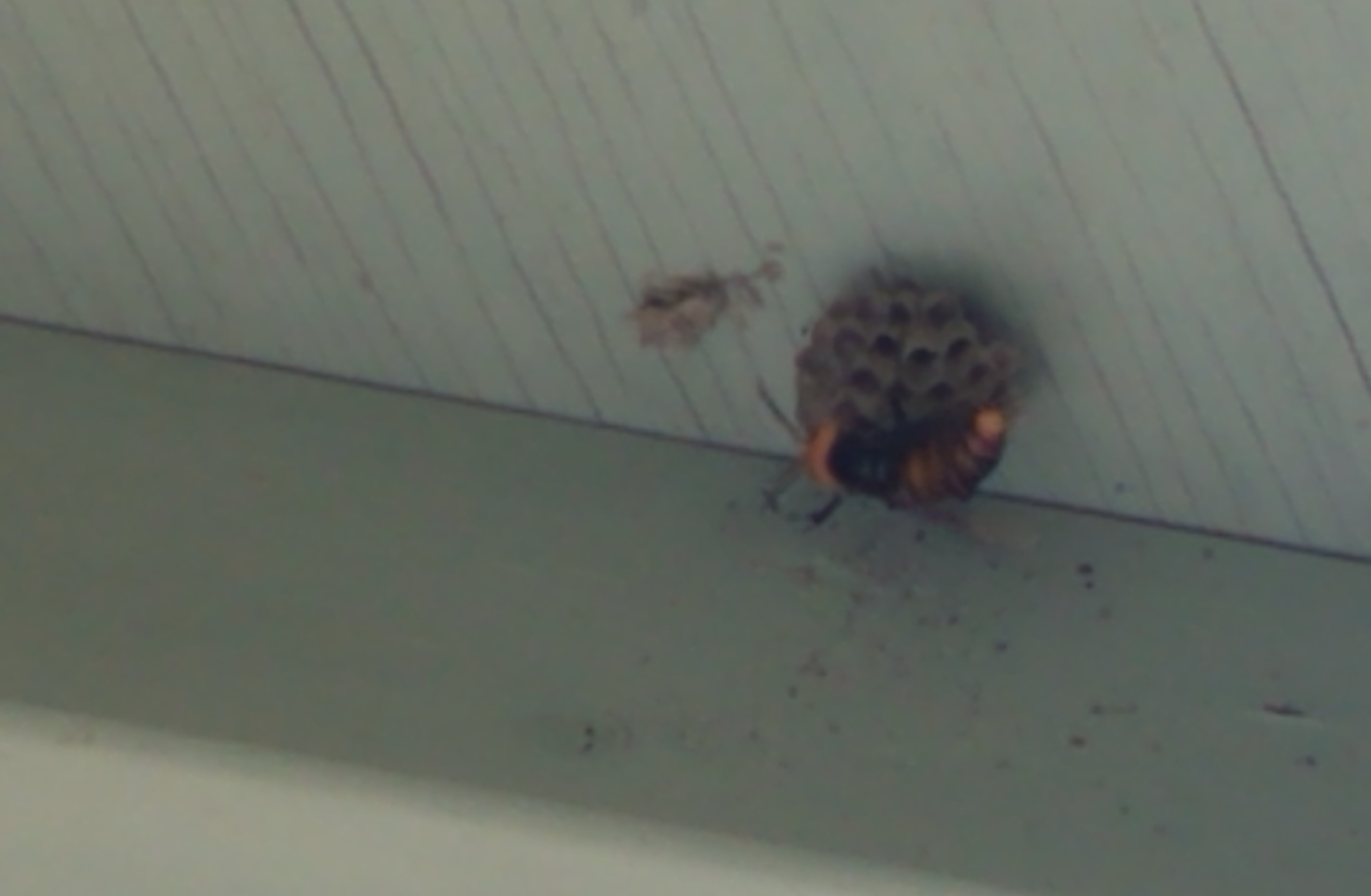
Paper wasp on a nest in Washington State

Did you know you can help protect Washington from invasive species just by taking a walk around your house or barn once a week? 

Over the last few years, residents of Whatcom County and WSDA staff have noticed hornets attacking paper wasp nests. In 2021, WSDA tracked a hornet and observed it repeatedly visiting the same paper wasp nest. Each visit lasted five to ten minutes and the hornet removed paper wasp larvae.  

WSDA invites you to help watch for northern giant hornets (Vespa mandarinia). Join our community science project to locate active paper wasp nests, watch the nests weekly, and record your observations from June through October. WSDA will continue to invite residents to participate in public scientist trapping too.

Northern giant hornet attacking a 
paper wasp nest on a house in Whatcom County

Paper wasps (Polistes dominula) can grow to about three-quarters of an inch long and have a well-defined “wasp waist” that makes them easy to identify. Paper wasps are typically not aggressive and do not readily attack people, but they can sting if threatened. They form small colonies and build hanging, open-comb nests on building eaves, frames, abandoned cars, or branches of trees and shrubs. Paper wasp nests vary in size and are usually gray to brown in color. They are made up of many exposed cells that are less than an inch deep. Nests typically range from the size of a quarter to a coffee can lid, but can be larger.

Although we invite anyone in Washington to participate in adopting a paper wasp nest, we are particularly interested in observations from Whatcom, Skagit, Island, San Juan, Snohomish, King, Jefferson, and Clallam counties.

Paper wasps tending their nest
LOCATE

Starting in June, locate active paper wasp nests that you have access to and can monitor through October. Log the nest locations using the Watch a Wasp Nest Registration Form. After submission, you’ll receive an email confirmation which will include a unique Nest ID assigned to your nest location. You will need to save this Nest ID to use during weekly check-ins. Access the registration form.

MONITOR

Each week visit the nests. Watch for any hornet or wasp activity happening at the nest. WSDA asks you to monitor the nests for at least five minutes during the day once per week, but you can check the nests as long and often as you would like.

REPORT

After monitoring you will need to report each of your observations on the Watch a Wasp Check-in form. You will also need your Nest ID which was received in a confirmation email. Click here to access the check-in form.

However, if you think you spot a northern giant hornet (it will be significantly larger than the paper wasps), safely take a photo and report it at agr.wa.gov/hornets or by emailing hornets@agr.wa.gov.

Stay Connected

WSDA is dedicated to working with the public and to providing information on northern giant hornets.

Monday, August 22, 2022

Cicada killer frequently mistaken as northern giant hornet

Cassie Cichorz
Pest Program

cicada killer side-by-side with a northern giant hornet
With summer here, people are outside enjoying nature and noticing insects! Citizens are on the lookout and reporting suspect giant hornets. WSDA’s team has been hard at work reviewing hundreds of reports of suspect northern giant hornets. Most of the insects reported are not harmful and play an important role in the environment. One insect, the western cicada killer (Sphecius grandis) seems to be trending as the most common native bug mistaken for a northern giant hornet (Vespa mandarina).

If you can familiarize yourself with some features of the look-alike insect in the spotlight, you’ll be able to identify differences. The western cicada killer is a very common native wasp that can be almost as large as a northern giant hornet. Cicada killers can be seen from late spring and throughout the summer.

Cicada killers can be up to two inches long, just like the northern giant hornet. Differences in their head, thorax, or abdomen will help you distinguish between the two species. The heads of cicada killers are narrower than their thorax, while the northern giant hornet has a head as wide as its thorax. The cicada killer has round eyes, unlike the angular eyes of giant hornets.

cicada killer

The thorax on a cicada killer is reddish in color, while the northern giant hornet’s is black. The cicada killer’s thorax and head are about the same color, unlike the contrasting head and thorax of the northern giant hornet. Both wasps have translucent, amber-colored wings.

You can also check the banding on the abdomen for differences. The northern giant hornet has horizontal lateral bands or striping on its abdomen. The cicada killer’s bands will drop down like teardrops, or have dots between the bands.


Female cicada killers are solitary and dig their nests in the ground. You will often find their nests around areas with lots of sunlight, and sometimes you will see a mound of dirt near the entrance. Cicada killers do not actively defend their nests normally. Males can be territorial, but they do not have a stinger.

Northern giant hornet nests can be underground or in tree cavities. Unlike cicada killers, hornets are social and live in large colonies – which they will vigorously defend. Away from the nest, hornets are typically non-aggressive unless provoked.

WSDA has other information on look-alike insects, including a poster guide available for use and download. Click here to learn more about identification. Cicada killers do not need to be reported, but if you suspect you’ve seen a giant hornet in Washington State or are not sure if what you have seen is one or not, get a photo and report it at agr.wa.gov/hornets.


Monday, June 15, 2020

Don't squish me! Local insects, Asian giant hornets, and the case of mistaken identities

Quin Baine and Chris Looney
WSDA Entomology Lab

With the worldwide attention that Vespa mandarinia (Asian giant hornets) have received over the last few weeks, our entomology lab has been busy reviewing hundreds of reports of suspected Asian giant hornets. Despite the deluge of reports, only two so far have been confirmed as an Asian giant hornet. 

Unfortunately, while their intentions are good, many people have killed and submitted many insects that are NOT Asian giant hornets. Not only are most of these insects not harmful, they play an important role in the environment. We want to compare some of these insects with Asian giant hornet so you can become better a citizen scientist and let insects that are not Asian giant hornets buzz along their way.

Not sure where a thorax is on an insect? How about an abdomen? See the Asian giant hornet diagram at the end of this blog. It will help you identify different body parts of the insects discussed below. 

Bumble bees   


Bumble bees are covered with dense hair
Photo credit: Mary Asche

Asian giant hornets have very few hairs
Photo credit: I, KENPEI / CC BY-SA (http://creativecommons.org/licenses/by-sa/3.0/)


These native pollinators can be colored black, yellow, and orange, and are most easily distinguished from the Asian giant hornet by their round, stout bodies and very fuzzy appearance. A queen bumble bee can be large, almost an inch in length, and they make a noticeably loud buzzing when they fly. However, there is little reason for alarm! Bumble bees are non-aggressive regardless of size. Bumble bees are important pollinators in Washington’s farms and wild ecosystems. You can often see the bumble bee’s collected pollen carried in yellow and orange lumps on its back legs.

Sawflies


Cimbex sawfly antennae are distinctly clubbed
Photo credit: Stu Adams 

Giant hornet antennae remain narrow through the entire length
Alpsdake / CC BY-SA (https://creativecommons.org/licenses/by-sa/3.0)


Sawflies can have a very bee-like or wasp-like appearance, but there’s good news – they are all are non-venomous and can’t sting! The Cimbex sawflies are some of the largest sawflies in the state and can be up to 1.25 inches in length. The elm sawfly (Cimbex americana) and the Pacific sawfly (Cimbex pacifica) can be black and yellow, or black, yellow, and reddish-orange, with darkened wings. Their stripes can seem very similar to Asian giant hornets. The easy way to tell these sawflies from wasps is their clubbed bright orange or yellow antennae. Clubbed means they are expanded at the ends, kind of like a Q-tip. Sawflies are plant-eaters – the young feed on leaves, while the adults can sometimes be found chewing on wood or feeding on the sap of trees.

Yellowjackets and paper wasps


Our native yellowjackets and paper wasps are smaller and distinctly patterned with white or yellow markings, not orange!
Photo credit: Megan Asche


Asian giant hornets have orange markings


Most of Washington’s yellowjackets are native species that are common during much of the year. Unlike Asian giant hornet, Washington’s Vespula and Dolichovespula are clearly yellow (or white) and black, but not orange. They have distinctive patterning across the head and thorax, while Asian giant hornet is completely orange on the head (except for its black eyes) and almost completely black on the thorax. Yellowjackets can sting, especially when swatted or stepped on. However, these insects are beneficial to the ecosystem as pest control– they feed on many common agricultural plant pests.

Cicada Killer Wasp


Western cicada killer species lack extensive black markings, and have a rusty orange thorax.
Photo credit: Jason R Eckberg via Bugguide - Attribution-NoDerivs-NonCommercial 1.0 Generic (CC BY-ND-NC 1.0)

Asian giant hornets have obvious black markings and a black thorax.


This common, native wasp can be very large, sometimes reaching over an inch and a half in length. The western cicada killer (Sphecius grandis) and the Pacific cicada killer (Sphecius convallis) are both mostly rusty-orange in color with yellow and black markings on the face and abdomen. They are more orange, more slender, and have longer antennae than Asian giant hornets. Though “killer” is in the name, this wasp feeds on other insects, like the cicada, and is typically non-aggressive towards humans. Predatory insects, like the cicada killer, help maintain a balanced ecosystem.

Great Golden Digger Wasp


Golden digger wasps have an apparent thin waist. The abdomen is not striped but is distinctly orange in the front and black towards the end. 
Photo credit: Megan Asche

The abdomen of the Asian giant hornet has alternating black and orange striping. 


The digger wasps can also be large, with the largest in Washington about 1.25 inches long. A solitary wasp that feeds on insects, they are generally non-aggressive and it is very uncommon for them to sting humans. Sphex ichneumoneus can be most easily recognized by the long constriction at the base of the abdomen, forming a thin, thread-like “waist”. At rest, the long antennae are slightly curled. Instead of striped, like Asian giant hornets, the abdomen of the great golden digger wasp is bi-colored, with orange on the first part and black towards the end. Other Sphex species are often completely black. These wasps are another example of predatory insects that play an important role in our natural and agricultural ecosystems as pest control.

Learning more


The above images are of insects alive and in nature. A similar comparison of preserved specimens can be found on the USDA APHIS Asian giant hornet webpage. 

Getting to know the insects around you can be fascinating. If you’d like to learn more about local insects, some great resources include the Washington State Master Gardener program, iNaturalist, and Bugguide.com. And of course, if you do suspect you have seen an Asian giant hornet, get a photo if you can safely do so, collect the specimen if it is dead, and report it at agr.wa.gov/hornets.

Asian giant hornet diagram


Asian giant hornet diagram


Thursday, April 2, 2020

Trapping for Asian giant hornets - 8 things to know

Karla Salp
Communications

Please note - if you are not in Washington State, please DO NOT trap for Asian giant hornets. You have virtually no chance of catching an Asian giant hornet but can kill local insects. If you live outside of Washington and believe you have seen Asian giant hornets, please report to your state's invasive species managers, not to WSDA. 

Since the first report of Asian giant hornets in Washington last December, the Washington State Department of Agriculture’s (WSDA) Pest Program has been doing extensive research and planning to find and, if possible, eradicate Asian giant hornets from Washington this summer.

The first step to eradicating this invasive pest - which threatens honeybees and all the crops they pollinate - is to locate the existing Asian giant hornet colonies. To do that, WSDA is enlisting the help of beekeepers and the public to trap and report Asian giant hornets in Washington. But helping out has risks and takes time, so read our list below before you decide to trap.

Here are the top eight things to know about trapping for Asian giant hornets:

  1. You can help trap for Asian giant hornets. WSDA is especially looking for people in Whatcom, Skagit, Island, San Juan, Jefferson, and Clallam counties to trap for Asian giant hornets.
  2. Trapping is a commitment. If you participate in trapping, it will require that you check traps and change the bait once per week for 17 weeks (if you start in July) or up to 34 weeks (if you start in April). You’ll also need to purchase the materials for the trap and bait, as well as mail any specimens you collect to WSDA.
  3. The best time to trap is from July through October. The most likely time to catch Asian giant hornets is from July through October - when colonies are established and workers are out foraging. Traps can be hung as early as April if attempting to trap queens, but since there are significantly fewer queens than workers, catching a queen isn’t very likely.
  4. You could get stung. Trapping for Asian giant hornets could increase your chances of being stung by one. While Asian giant hornets don’t typically bother people, they will sting if they feel threatened. Don’t trap for Asian giant hornets if you are allergic to bee or wasp stings. The venom of the Asian giant hornet is more toxic than that of local bees and wasps.
  5. Hornet traps from the store won’t work. Hornet traps currently on the market in the United States won’t work for Asian giant hornets because their holes are too small. WSDA has researched numerous trapping options and has provided instructions on how to make and monitor homemade traps that will be effective for Asian giant hornets.
  6. Reporting your trap location and catches is very important. Knowing where hornet traps are located and promptly reporting any Asian giant hornet catches will be critical to WSDA’s ability to find and remove Asian giant hornet nests. Failing to do so could thwart WSDA’s attempts to locate Asian giant hornets in Washington.
  7. Do not approach or attempt to remove an Asian giant hornet nest. When trapping, you could come across an Asian giant hornet nest. They typically nest in the ground. Take care when placing traps and if you locate one, do not approach it. Contact WSDA immediately at 1-800-443-6684. WSDA has obtained special equipment for the removal of Asian giant hornet nests.
  8. Beekeepers are helping WSDA evaluate experimental spring “sap traps.” Volunteers from the Mt. Baker Beekeeper Association are working with WSDA to test an experimental “sap trap” which uses tree sap as the bait to attract Asian giant hornets. This experimental trap is for use in the spring when queens emerge.

Trapping for Asian giant hornets is just the first step in locating and eradicating nests. WSDA is still finalizing plans for tracking live, trapped hornets back to their nests. To learn more about Asian giant hornets and WSDA’s program to eradicate them, visit agr.wa.gov/hornets.

Update: this blog was updated on April 27, 2020 to add Jefferson County to the list of targeted counties. 

Update: this blog was updated on May 8, 2020 to add information for people outside of Washington State. 

Monday, January 13, 2020

WSDA asks beekeepers to look for and report Asian giant hornet

Karla Salp
Communications

This year when beekeepers receive their annual reminder to register their hives, they will receive something else as well – a call to action to report Asian giant hornet sightings and attacks.

Asian giant hornets are the world’s largest hornet. While they will eat various types of insects, they have a favorite: honey bees. A handful of Asian giant hornets can kill an entire hive of bees in just a few short hours. They then take over the hive and defend it as their own, taking the brood and feeding them to their own young.

In December, WSDA received and confirmed two reports of Asian giant hornet in the areas of Blaine and Bellingham.

Identifying Asian giant hornet


You can spot an Asian giant hornet by a few characteristics:

  • Usually 1.5 - 2 inches long
  • Large orange/yellow heads with prominent eyes
  • Black and yellow striped abdomen
  • Form large colonies that usually nest in the ground

Asian giant hornet attacks


You may not see Asian giant hornets themselves, but you may see the aftermath of an Asian giant hornet attack. These hornets will leave piles of dead bees, most of them headless, outside their beehive, as shown in the photos below.


Bee kill photos courtesy of Teddy McFall

Reporting sightings/attacks


If you believe you have seen an Asian giant hornet or if a beekeeper has noticed the aftermath of an attack, we want to hear about it. There are several ways to report:


When reporting a sighting, please provide as much of the following details as possible:

  • Photos of the hornet or beehive damage.
  • Your name and contact information.
  • The location where the hornet was spotted or the location of the impacted hives.
  • Description of the loss or damage to a hive (if photos are not available.) 
  • Date or approximate date observed.
  • Direction of flight when the hornet flew away. 

Asian giant hornet imposters


Don’t be fooled! Several native species can be mistaken for the Asian giant hornet.

Paper wasp 


Paper wasps are more slender and smaller overall compared to the Asian giant hornet. They also do not have an orange/yellow head.

Bald-faced hornets 


Bald-faced hornets are about an inch long and are mostly black with white stripes and spots.

Yellow jacket  

Photo credit: M. Asche

Yellow jackets are less than an inch long. They have distinctly yellow faces with a black area near the top of the head.

Elm sawfly 

Photo credit: Neil Boyle

The elm sawfly can be as large, or larger, than the Asian giant hornet. They have a black face and yellow stripes, but they lack a stinger.

Use extreme caution near Asian giant hornets


Asian giant hornet abdomen and stinger
Asian giant hornets have a much longer stinger than honeybees. Typical beekeeping attire will not protect you from Asian giant hornet stings. Additionally, their venom is more toxic than that of local honeybees and wasps and they have a comparatively greater supply of the venom as well.

Asian giant hornets can sting repeatedly. Those who are allergic to bee or wasp stings should never approach an Asian giant hornet.

Never try to remove an Asian giant hornet nest. If you find an Asian giant hornet nest, report it immediately to WSDA.

Asian giant hornets are not generally aggressive towards humans, pets, or other mammals, but they can attack if they feel threatened. Asian giant hornet stings – especially repeated stings – can require medical attention, even in those who are not normally allergic to bee or wasp stings. Several hornet-related deaths occur each year where they are native in Asia. 

Updated on May 22, 2020 to correct the number of confirmed sightings. 

Thursday, December 19, 2019

Pest Alert: Asian giant hornet

Chris McGann
Communications

The Asian giant hornet found near the Canadian border earlier this month.
 Its enormous size and yellow head are unique to this invasive species. 
This month, WSDA entomologists identified a large hornet found near the Canadian border as an
Asian giant hornet (Vespa mandarinia), an invasive species not previously found in Washington State.

Although it is not typically aggressive toward humans, this unwelcome pest can inflict a powerful sting and also represents a threat to honeybees, for which they have a voracious appetite.

On Dec. 8, a resident in Blaine near the Canadian border reported an unusually large hornet they found on their property. Two days later, WSDA visited the site, collected the specimen, which was dead, and confirmed its identity a short time later.

The resident also reported seeing a live giant hornet at a hummingbird feeder before it retreated into a nearby forest.

WSDA and Washington State Department of Health (DOH) officials ask people in the area to be on the lookout for and take precautions to avoid contact with these large bugs.

Adults can be nearly two inches long, have a distinctly light-orange head with
prominent black eyes, a black thorax and a black/yellow striped abdomen. 
The invasive hornets are typically almost an inch and a half long and are distinguished by their large yellow heads.

Asian giant hornets nest in the ground. Though they are typically not interested in humans, pets or large animals, they can inflict a nasty sting if threatened or their nest is disturbed.

Asian giant hornets are typically dormant over the winter, and are most often seen from July through October.

Health advice 

DOH advises individuals to take preventative measures in the outdoors by keeping food and drink covered or under screens, and cleaning up by disposing food and garbage properly. People should avoid swatting at the hornets, which may cause these insects to sting.

If you are stung, DOH recommends washing the site thoroughly with soap and water and applying ice or a cold compress to reduce swelling. The agency also recommends an antihistamine or use of an anti-itch cream to reduce itching if necessary. If you are stung multiple times or have symptoms of a severe reaction following a sting, call 911 or seek medical care immediately.
Asian giant hornets are not usually aggressive, but because
of their size and stinger, it's best to avoid them.  

Additional information about bee and wasp stings and prevention measures can be found on the DOH website.

A threat to bees

Asian giant hornets feed on insects and are of particular concern to beekeepers because they are capable of quickly destroying honeybee hives.

This is the first time this invasive species has been detected in Washington State. In August, a large colony of Asian giant hornets was discovered and subsequently destroyed in British Columbia. The BC Ministry of Agriculture issued a pest alert about the detection in September.

Responding to the Asian giant hornet 

In 2020, WSDA will conduct outreach to generate public assistance in looking out for the Asian giant hornet and reporting any detections to the WSDA Pest Program.

Additionally, WSDA is preparing plans to set traps in the Blaine area to monitor for Asian giant hornets.

If you think you may have spotted an Asian giant hornet, report it to WSDA’s Pest Program and, if possible, include a photo.