Showing posts with label soil health. Show all posts

Monday, January 8, 2024

Take the Climate Resilience Producer Survey

Kim Vaughn
Communications

Navigating climate challenges in Washington's agricultural landscape

Rich soils, diverse climates, and large-scale irrigation infrastructure make Washington one of the most productive agricultural regions in the world. Washington farmlands and farmers are of global importance, moving more than $17 billion per year in food and agricultural products through Washington's ports, producing over 300 different crops, and generating $12.8 billion per year in agricultural production value for the state economy.

These activities are critical to urban and rural communities alike, providing food security, nutrition, and thriving livelihoods in Washington and beyond.

Extreme weather, invasive pests and disease, and declining water availability are daily impacting agricultural production in Washington. Managing the wide range of potential climate risks and costs moving forward has made livestock and crop production—already challenging and volatile industries—even more challenging. However, with the right support and innovation, Washington farmers are poised to lead the way in building a more economically viable and climate-resilient future. 

The Washington State Department of Agriculture, Climate Resilience Plan, is one important step towards that goal. 

Climate Resilience Plan

To support the continued viability and vitality of Washington agriculture, WSDA has launched an 18-month climate resilience planning process, in partnership with Washington State University. The Climate Resilience Plan will summarize recent climate science, identify vulnerabilities, highlight opportunities, and include newly developed resources. We intend for this work to be informed by the needs and experiences of Washington producers. It is essential that your voice is heard.

Take the survey

Your responses will help us understand the on-farm impacts of climate change, resources in use, and current agricultural needs.

We want to hear from small and large producers from every crop and animal operation in every part of the state.

This information will help us communicate the nuances of climate change in agriculture to industry stakeholders and policymakers, and to build programs that are in direct response to your feedback. Your input is valued and appreciated.

Survey participants will be entered into a drawing to win a $100 VISA gift card.

The survey is available in English and Spanish. 

Please take a few minutes to fill out this short, anonymous survey by February 23, 2024.

We thank you for your participation in this effort.

Tuesday, September 12, 2023

Natural Resources Assessment Section gets a new identity: Welcome to "Natural Resources and Agricultural Sciences"

Kim Vaughn
Communications

We have some exciting news to share! The Washington State Department of Agriculture (WSDA) is undergoing a transformation that reflects our commitment to innovation, expansion, and adapting to the changing landscape of natural resource management. Our esteemed Natural Resources Assessment Section (NRAS) is now evolving into the more encompassing "Natural Resources and Agricultural Sciences." This rebranding marks a significant step forward in our mission and objectives.

Embracing a new identity

The decision to rebrand our Natural Resources Assessment Section to "Natural Resources and Agricultural Sciences" comes after careful consideration. We believe this updated name better represents the diverse spectrum of activities, research, and initiatives we engage in. Our work extends beyond traditional assessment, encompassing cutting-edge agricultural sciences. This shift mirrors our dedication to excellence, sustainability, and a holistic approach to resource management

What is NRAS?

The NRAS has been diligently working at the interface between agricultural production and environmental quality. Our research spans various critical areas, including:

    1. Agricultural land use practices:   NRAS specialists map and inventory crop acreage through visual surveys, aerial/satellite surveys, and federal data. This data helps us review current crop production and evaluate changes in land use through the years, including land removed from production.
    2. Pesticide usage: We meet with grower groups, consultants, and industry representatives to compile anonymized information about pesticides used, application rates and dates, and modes of application on different crops. This helps us understand changes in pesticide usage and pest pressure.
    3. Water quality: NRAS works to understand how pesticides and fertilizers might affect Washinton State’s water resources. We monitor water for pesticides and work with other programs at WSDA, the agricultural community, and regulators on education and outreach about our findings and good management practices for pesticide use.
    4. Water quantity: A reliable water supply is essential for Washington’s agricultural production. We study water supply issues throughout the state to see how things like increased drought frequency may affect agriculture. We also work to make sure needs and challenges specific to agricultural producers are addressed in water supply projects throughout the state. .
    5. Soil health: Soil serves as the fundamental basis for agriculture, and it is of utmost importance to ensure its well-being. We work with partners at the Washington State Conservation Commission and Washington State University in the Washington Soil Health Initiative (WaSHI). Through research, outreach and education, funding, and policy support, WaSHI improves soil health in Washington for increased agricultural resilience and economic viability.  

Our ongoing commitment

The programs under the NRAS umbrella have a shared goal: to protect public health, preserve the environment, and support the viability of agriculture in Washington. Our dedication to excellence remains steadfast as we continue to work tirelessly to achieve these objectives.

For more information about our programs and the important work we do, we invite you to visit the main NRAS webpage. There, you can delve deeper into our research, initiatives, and the ways in which we are contributing to the sustainable future of agriculture and the environment in Washington state. We are excited about the possibilities that lie ahead and are grateful for your continued support as we embrace this new identity and all the opportunities it brings. Together, we will make a positive impact on the future of agriculture and natural resource management.


Friday, June 23, 2023

Budget highlights: WSDA secures funding to expand programs through 2025

Daniel Schafer
Communications
Director Sandison stands with team members in front of the  Emergency Food Network van.
Director Sandison visits the Emergency Food Network.

The Washington State Legislature approved the state’s two-year operating budget April 23, and Governor Jay Inslee approved May 16. The new budget will fund the state’s government through June 30, 2025.

Along with other state agencies, the Washington State Department of Agriculture (WSDA) has received funding that will allow us to continue providing the services we already offer our partners. But over the next two years, we’ll also have the resources we need to expand some important programs. In this article, we’ll highlight three areas where WSDA will be growing.


Improving food systems while advancing equity

Since the onset of the global pandemic, WSDA has been at the leading edge ensuring Washington’s food systems are strong and effective while decreasing food insecurity within the state.

As part of this effort, WSDA uses grant opportunities to provide a safety net for many producers. To support us in this effort, WSDA received $8 million dollars for local food system and infrastructure grants, $1 million for meat and poultry assistance grants, $30 million for food assistance programs, and $10.6 million in Coronavirus State Fiscal Recovery Funding to provide supplemental flexibility in spending to continue supporting our Washington farmers and their families.

Additionally, funding for our We Feed Washington initiative and related programs totaled $63 million in the 2023 budget. These funds will be used to decrease food insecurity for hungry Washington families.

What’s more, WSDA is committed to advancing equity and environmental justice in our state, with the goal of ensuring every Washingtonian has access to healthy, safe, and culturally relevant food. To contribute to these goals, WSDA was awarded $180,000 to continue working with communities while responding to recommendations we made to the state legislature in 2022.

Continuing collaboration efforts

From invasive pests to water availability, Washington’s food producers face a slew of challenges. The 20232025 budget includes funds designed to increase collaboration across that state, equipping producers to face these challenges. These funds include $400,000 that will allow WSDA to partner with WSU’s IMPACT Center to conduct an Ag competitiveness study that will analyze producers' challenges and identify tools to address them. WSDA also received $581,000 to enhance the WA Soil Health Initiative and implement a voluntary program that provides producers with tools to track soil health, providing the state with information that will be critical to improving farming viability in the future.

Responding to the threat of invasive pests


WSDA works to maintain and improve the health of Washington’s farms, but eradicating and containing invasive pests – including insects, noxious weeds, and more – benefits the entire state. We have already made significant progress in detecting, trapping, and eradicating many invasive pests, but the effort is ongoing. Thanks to funding from the Washington State Legislature, we can continue our efforts of detecting and eradicating invasive pests that pose the greatest threats in our state: northern giant hornets, spotted lanternfly, popillia japonica (Japanese beetle), and invasive moths.


Looking ahead


With WSDA’s budget set for another two-year cycle, we are excited to continue our mission to protect consumers, ensure public health, and serve as stewards of the environment in Washington state through service, regulation, and advocacy.

To learn more about the 20232025 budget, visit the
State budgets page on the Washington State Office of Financial Management’s website.

Tuesday, November 22, 2022

Get the dirt on soil health; SoilCon 2023 registration opens

Danielle Gelardi
WSDA Soil Health Scientist 

soil probe taking soil sample in young potato plants
Taking soil sample with a soil probe
in young potato field
If soil microbiomes, water conservation, and plant health are your jam, you’ll want to register for SoilCon, a conference covering the latest research in soil health. SoilCon is next February during Washington Soil Health Week, though registration is already open for this virtual opportunity.  

The annual conference is organized by the Washington Soil Health Initiative, a joint effort of WSDA, Washington State University, and the Washington State Conservation Commission to improve soil health in our state. Soil health focuses on how well soils support plants, animals, and people. It also recognizes the living nature of soils and the importance of soil microorganisms. 

Soil sampling in grain stubble
SoilCon is a free, virtual event and will be held on Tuesday, Feb. 14, and Wednesday, Feb. 15. But don’t worry, it shouldn’t interrupt your Valentine’s Day plans; the conference is only held from 8 a.m. to noon each day from the comfort of your home, office, barn, or tractor seat. The theme this year is “Soil Health: Taking Principles to Practice.” Topics will be relevant to agriculture or natural resource professionals, producers, consultants, university faculty and students, gardeners, and anyone interested in soil health.   

Register on the SoilCon website and view the complete agenda, which is being updated as plans develop. Speakers include professors from WSU and universities around the country as well as graduate students and postdocs providing short, lightning talks. 

Join us at the conference to learn more about Washington state soil health and visit WSDA’s soil health page to learn more about our work.


Friday, March 18, 2022

Drought and soil survey for Washington’s dryland wheat farmers

Are you a dryland wheat farmer affected by the 2021 drought? If you are, the Washington State Department of Agriculture needs your help. 

As part of its continuing work addressing soil health, WSDA is looking for information from dryland wheat farmers about soil management practices, particularly relating to drought. This information will be critical for the researchers involved in the Washington Soil Health Initiative as they learn ways to support agricultural operations enduring drought conditions in the future.

The Drought and Soil Survey will be open until May 1. The survey is detailed, but can be completed over multiple sessions and does not have to be filled out all at once. 

Questions will cover how you manage your soils, the cost of implementing different soil management practices, and the effects of the 2021 drought on your operations.

Results will increase our understanding of dryland production and help us communicate with decision makers so we can better support you. Survey takers will be anonymous, but we will make a summary of the responses available to the agricultural community. 

This survey is being conducted on behalf of the Washington Soil Health Initiative, a joint effort of WSDA, Washington State University, and the Washington State Conservation Commission to study soil health in our state and explore ways to improve it.

Soil health focuses on how well a soil system supports plants, animals, and people. It also recognizes the living nature of soils and the importance of soil microorganisms. Visit agr.wa.gov/AgScience to find our soil health page.

Thursday, January 20, 2022

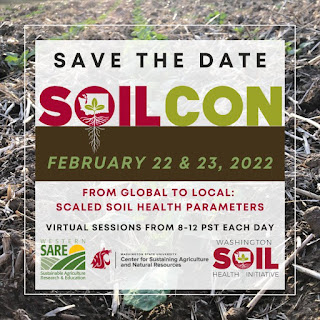
Save the date for SoilCon, the soil health conference

SoilCon, a conference about soil health and the latest research on soil, is coming next month during Washington Soil Health Week.  

The annual conference is organized by the Washington Soil Health Initiative, a joint effort of WSDA, Washington State University, and the Washington State Conservation Commission to study soil health in our state and explore ways to improve it.

Soil health focuses on how well a soil system supports plants, animals, and people. It also recognizes the living nature of soils and the importance of soil microorganisms. 

SoilCon is a free, virtual event and will be held on Tuesday, February 22 and Wednesday, February 23 from 8 a.m. to noon each day. The theme this year is “From Global to Local: Scaled Soil Health Parameters.” 

Visit the SoilCon website to register for the conference or view the complete agenda. 

Topics covered at this year’s conference will include:

  • Global soil challenges.
  • How to interpret soil health tests.
  • The cost and savings growers experience when implementing soil health practices.
  • What role soil microbes do (or don’t!) play in soil health and farm productivity. 

Growers, agricultural professionals, soil enthusiasts, and soil scientists are all invited to attend.

Speakers will include professors from WSU and from universities around the country, as well as graduate students and postdocs providing short, lightning talks. 

Join us at the conference and learn more about soil health in Washington state. Visit agr.wa.gov/AgScience to find our soil health page. 

Tuesday, November 30, 2021

Soil Health Initiative and WSDA looking for samples, participants

Dani Gelardi
WSDA Soil Health Scientist

Healthy soil is the key to success in farming. With healthy soil, farms are more successful, our environment is cleaner, and Washington can keep growing nutritious food for generations to come. With more than 300 different commodities grown in the state, healthy soil looks different from place to place and from crop to crop. 

Background

Soil sampling. 

In the fall of 2019, the U.S. Department of Agriculture (UDSA) awarded a $500,000 specialty crop block grant to WSDA’s Natural Resources Assessment Section (NRAS) that funded a soil health survey project in partnership with Washington State University (WSU). In spring of 2020 the state Legislature passed Substitute Senate Bill 6306 that created the Washington Soil Health Initiative (WaSHI), which provided $200,000 of additional funding to NRAS for more soil health research and outreach.

WSDA looking for more soil samples

Researchers have already been collecting soil samples as part of this initiative. But as the program begins to launch, coordinators are looking for Washingtonians who may be interested in contributing soils data to the WaSHI State of the Soils Assessment

If you’re a grower, an agricultural professional, a graduate student, or a conservation district staff member who wants to soil sample, we want to hear from you. 

Beginning in March of 2022, WSDA will pay for a laboratory soil health analysis for eligible projects, in exchange for support in collecting soil samples and grower management surveys. WSDA will also provide training and individualized soil health reports for participating growers. 

Soils data will be used to measure soil health across different regions and crops in Washington. This information will help WSDA protect grower livelihoods, environmental sustainability, and food security in Washington.

The deadline to apply to participate is 5 p.m., Tuesday, Jan. 25, 2022. For more information or to apply, visit the NRAS Partnerships in Soil Health webpage

WSDA will also be hosting a virtual Q&A on Tuesday, Dec. 14 at 1 p.m.

Tuesday, June 8, 2021

Washington Soil Health Initiative: Protecting the future of agriculture in Washington

Jadey Ryan
WSDA environmental specialist

One of our partners in the field taking soil samples.
Healthy soil is the key to success in farming. With healthy soil, farms are more successful, our environment is cleaner, and Washington can keep growing nutritious food for generations to come. With more than 300 different crops in the state, healthy soil looks different from place to place and from crop to crop. The Washington State Department of Agriculture’s Natural Resources Assessment Section (NRAS) partnered with Washington State University (WSU) to launch a baseline assessment of soil health across Washington. This research will help us better understand the role of soil health in our diverse agricultural landscape.

The beginning of the Washington Soil Health Initiative

In the fall of 2019, the U.S. Department of Agriculture (UDSA) awarded a $500,000 specialty crop block grant to NRAS that funded a soil health survey project in partnership with WSU. Then in the spring of 2020, the state Legislature passed Substitute Senate Bill 6306 that created the Washington Soil Health Initiative, which provided $200,000 of additional funding to NRAS for more soil health research and outreach. 

Partnerships are key

The Soil Health Initiative aims to identify and promote soil health stewardship practices that are grounded in sound science and promote economic prosperity for farmers. 

Soil sampling kits
prepared to send off.

This soil health research brings together many partners including NRAS, WSU, Washington State Conservation Commission, the non-profit Soil Health Institute, 11 conservation districts throughout Central and Eastern Washington, three soil health laboratories, and all of the participating farmers.

NRAS and WSU work with the conservation districts to find farmers who are willing to provide management histories and volunteer their fields for soil sampling. Once fields are identified, soil samples are collected and sent to SoilTest Farm Consultants, Inc., Dr. Deirdre Griffin LaHue’s lab at the WSU Northwestern Washington Research and Extension Center, or the Soil Health Lab at Oregon State University.

The original project: Focus on specialty crops

The project that was funded by the specialty crop block grant began in fall 2019 and continues through summer 2022. The goal is to understand the current soil health status and key soil challenges of major specialty crops in Washington. Specialty crops of interest include potato, wine grape, sweet corn, onion, tree fruit, hops, and pulses. 

The project uses a survey approach by sampling sites with similar soil types that farmers identify as their “best” and “worst” fields.  Farmers choose these fields based on their perception of yield, disease pressure, and the need for additional soil amendments such as fertilizer or lime. Samples taken from these sites are tested for a variety of chemical, physical, and biological soil health indicators, which collectively provide a snapshot of overall soil health. Farmers also provide data about their farming practices through a management survey, so that soil health status can be linked with management practices across soil types, crops, and regions.

Project expansion: More crops are included

A close look at the process of soil sampling. 
The Soil Health Initiative provided funding to expand upon the grant project to achieve a broader soil health monitoring program that includes more than just the major specialty crops. With this project expansion, NRAS and WSU can collect soil samples from all crop and grazing lands that currently have or plan to implement conservation management practices. By comparing soil sample results from similar locations that have or have not implemented conservation practices, NRAS and WSU can learn more about which practices are best at improving soil health for the many different crops across Washington.

Additionally, NRAS and WSU are working with the Soil Health Institute to sample from uncultivated sites such as native grasslands or rangeland. Data from these samples will be compared with those from conventionally farmed soil samples of similar soil types to understand how native and perennial grassland soil health differs from that of cultivated soils. 

Outcomes: More data, outreach, and improved soil health 

Participating farmers will receive a personalized soil health report with data and an interpretation of the results. NRAS, WSU, and conservation districts will share the findings from these projects with the agricultural community and the public. 

The Soil Health Initiative brings together stakeholders interested in practices that improve soil health without compromising farmers’ success. The outcomes from these projects are baseline soil health data specific to Washington, better tools to monitor and manage soil health, increased adoption of soil health stewardship practices, and continued engagement from stakeholders and participating farmers. 

Each outcome contributes to improved agricultural viability, farm profitability, nutrition, and environmental function across Washington. If you are interested in participating or have questions, please email our soil scientist for the project, Dani Gelardi, or call 360-791-3903. You can also visit agr.wa.gov/agscience to learn more about NRAS and the Soil Health Initiative.