Showing posts with label farming. Show all posts

Tuesday, October 10, 2023

Washington’s sweet corn surprise

Daniel Schafer
Communications


You might think of corn as a distinctly midwestern crop. Drive through Illinois or Iowa and you’ll see  field after field of it. But corn is an ancient grain with roots in the western hemisphere. According to the Smithsonian Institute, “Humans first started selectively breeding corn’s wild ancestor teosinte around 9,000 years ago in Mexico.” The story of corn is a fascinating one, especially because it has become a central crop for the United States. In fact, it is grown in every state. In this blog, we’ll explore corn’s role in Washington agriculture.

Sweet corn and field corn

The reason you might see so much corn on a road trip across the United States is that it’s the number one field crop in the country in terms of production. But there are two main types of corn: sweet corn and field corn, and each has its own uses. Sweet corn is eaten fresh, and it’s the type you get at the grocery store in the can or from the freezer section. Meanwhile, field corn is used to produce products like cornmeal. It’s also used for cattle feed and ethanol.

It’s primarily field corn that is grown in the fields of Illinois and Iowa. Meanwhile, Minnesota, Washington, and Wisconsin are the top three states for sweet corn production.

Washington's sweet corn

Grant County leads the way in sweet corn production in Washington, but farms across the state grow it. In fact, in 2022 Washington farmers harvested 69,500 acres of sweet corn on the way to a total production of 14,565,800 CWT and a total production value of $114,173,000, according to USDA.

But it’s not just the production value that makes sweet corn important to Washington farms. That’s because it’s a rotation crop — one that’s used to give soil time to regenerate after growing other crops. In Washington, those crops are often potatoes or wheat.

Much of the sweet corn grown in Washington — about 87% — is processed. That is, it’s canned or frozen. You can learn more about how corn is processed by watching this clip from Washington Grown:


Try Washington sweet corn this season — or enjoy it later!

We said earlier that there are two main types of corn, but there are many specific varieties. One thing they all have in common, though, is that they’re a great source of vitamin C. One of the great things about Washington sweet corn is that, even though its flavor is unbeatable when fresh, it still tastes great (and is good for you) from the can or out of the freezer. So whether you enjoy it fresh (we’re in the tail end of harvest season now) or you store it away in your freezer to enjoy this winter, Washington sweet corn is always a great choice!


Monday, September 11, 2023

Innovation and commitment: How WSDA Food Assistance is reshaping hunger relief

Daniel Schafer
Communications

“Our job is to feed people.” 

The WSDA Food Assistance team.

It sounds like a simple objective, but the act of feeding hungry people across Washington State is nothing short of a herculean effort involving hundreds of dedicated people and dozens of community and state organizations. At the center of this effort is the Food Assistance Program at Washington State Department of Agriculture (WSDA).  

In Washington’s hunger relief landscape, WSDA’s role is multi-faceted. The Food Assistance Program manages and distributes funds and food that comes from the Federal government as well as the state. It’s a world full of acronyms, where one program may serve a particular niche while another attempts to cover a broad swathe of needs. The funds dedicated to hunger relief in Washington provide some idea of the scale of the need. Food banks and pantries received just under $5 million in funding from the state of Washington’s Emergency Food Assistance Program (EFAP) in 2019, according to the WSDA website. To put that into perspective, EFAP alone provided a staggering 148 million pounds of food to 1.12 million Washingtonians struggling with food insecurity. That’s on top of food provided by the Federal government, an amount that totaled $32 million last year. 

It’s easy to see why Kim Eads, the program manager for WSDA’s Food Assistance Program, and her team take their work so seriously. “If we don’t do our job, hunger relief organizations don’t get funding and we can’t feed people,” she says. 

Eads has worked for various agencies in Washington as the state’s hunger relief efforts have evolved, and in August 2023, she celebrated 35 years on the job. Today, Eads is highly respected in the emergency food assistance community, developing new programs and directing WSDA’s efforts to address food insecurity in the state. But Eads is quick to point out that none of the work going on at Food Assistance would be possible without the dedication of her team, and those across the state working in the hunger relief sector.  

“I could not have had a better team of committed people,” says Eads. “They do this work for the same reasons. We sometimes disagree, but we remember why we’re here and we work hard. Whatever we do, we are mindful of why we’re doing it.” 

A dedicated staff leads this important work 

WSDA’s Food Assistance program serves as the conduit for state and federal dollars and food that must be distributed to food banks, food pantries, and similar organizations throughout Washington. The work is important, and the program’s 16 employees are acutely aware of this. 

“If Food Assistance stopped functioning, a lot of people would go hungry,” says logistics specialist James Scovel, who has worked with the program his entire career, since 1997. Without Food Assistance, “people wouldn’t get the food they need to survive day to day,” he continues. “That means something. This is a meaningful job, and not a lot of people get to say that.” 

Jeff Mathias, the Food Assistance farm to community specialist lead, adds that “it’s all about feeding hungry people.” Mathias goes on to say that the results of the work being done in the Food Assistance program is tangible. “When it comes to getting work done, we know why we’re doing it, there’s no disconnect. Because of the work that we do today, someone is going to get fed.” 

Scovel and Mathias’ outlook is common among their colleagues, and this dedication and understanding of the gravity of the program’s work has led to a high degree of retention and engagement in the program. 

“You get hooked,” says Kyle Merlich, the program’s lead food assistance specialist and a ten-year Food Assistance veteran. Part of the reason people working in the Food Assistance Program are so dedicated is because government guidelines and community needs are always changing, adding a layer of challenge to the work, but also providing opportunities. “I have always felt there’s an upward trajectory with our work,” says Merlich. “There’s always more to learn. Our programs don’t have a ceiling.” 

Building the Food Assistance team 

Kim Eads has played a central role in building this dedicated, high-functioning team. “Kim pulls the best out of all of us,” says Lisa White, the program’s business operations administrator. White, has worked in Food Assistance for ten years and attributes much of her professional growth to Eads. “She saw something in me that I didn’t see in myself,” says White. “Kim asked if I would like to try a new project, and over time she gave me more and more responsibility,” she continues. “Little by little, she taught me things. And when I was able, I took those projects over.” White attributes Eads’ mentoring abilities to the fact that she cares for the people on her team. “It’s not just about her program, it’s about her people as well.” 

Kyle Merlich adds that Eads is adept in helping everyone on the team to move toward common goals. “Kim makes sure everyone knows they have a part to play in achieving our goals,” he says. But a key component is also valuing colleagues as people. Even though the Food Assistance team works hard, Merlich is quick to add that Eads ensures “there is time to get to know coworkers and value them as people, too.” 

Improving hunger relief in Washington 

WSDA’s Food Assistance program is dedicated to serving hungry people in Washington. This means understanding what people in communities across the  state need — and these needs are as diverse as the communities themselves.  

“The emergency food system is always evolving so our programs have to evolve,” says Kyle Merlich. “Food banks and food pantries are in the same situation — needing to adjust to a changing food system.” But the changing needs of communities also mean that Food Assistance must constantly evaluate their approach to make sure it’s effective. 

One innovation that the program has led in recent years is to empower food banks in smaller, and often rural, communities to make more decisions. This has allowed hunger relief organizations to serve the unique needs of their clients. “We are trying to give smaller organizations a say in how their dollars are spent, how the food is distributed, and how local matters in terms of food banks,” says logistics specialist, James Scovel. “Having decisions made on a smaller level provides local buy-in and allows for better facilities in smaller areas, and sometimes means more people can be employed there,” he adds. Hiring more people can be a game-changer for rural food banks, because it means the facilities can be open for longer hours or more days during the week, which in turn means they can serve more people. 

Seeing food as a system 

WSDA's Food Assistance Program is working to
connect farmers with local food banks.
In addition to empowering smaller food banks, WSDA’s Food Assistance Program has made it a
priority to approach hunger relief as a component of the larger food system. Hunger relief intersects with local food and agriculture, and the program has worked to leverage these intersections in a way that will better serve individuals and families in need. 

State and Federal programs have made it possible for food banks and food pantries to purchase food directly from farmers. This not only brings more fresh fruits and vegetables to food-insecure people in Washington, but it also supports local agriculture. What’s more, by helping get local produce into the hands of their clients, hunger relief organizations have the ability to provide culturally relevant and healthier foods that may not otherwise be available. 

This approach has been successful in Washington State, and the timing couldn’t have been better. Hunger relief has always been an uphill battle because the need almost always outpaces the ability to provide relief. But there are signs that Food Assistance and the hunger relief organizations they support are making a difference. Preliminary data shows nearly 10.8 million clients (including repeat clients) visited food banks and food pantries in Washington State during the 2023 fiscal year, which runs from July 1st to June 30th. If these figures hold, it would mean an increase of over 2.4 million visits from the previous year.

Need is increasing across Washington 

With more people visiting food banks than ever before, there is a need for more food to be distributed. In 2022, 181.4 million pounds of food were distributed in Washington. That figure will increase this year, with preliminary figures totaling just over 202 million pounds. For almost every metric, the need for hunger relief is increasing in Washington. The number of families served increased by almost 136,000 this year, while 1.7 million people visited a food bank or food pantry for the first time. 

With such a need, Washington requires the dedicated and capable team at Food Assistance, as well as their partners throughout the hunger relief ecosystem, including food bank and food pantry employees, farmers, and more.

“All the people who work here are all super important,” says James Scovel. “It’s the team that does it and it couldn’t be done without everyone.” 

Luisa Castro, the assistant director of Food Safety and Consumer Services – within which the Food Safety Program is housed – agrees. She also explains how Program Manager Kim Eads helps the team thrive through her example and leadership. “Kim Eads is a unique leader whose natural inclination is to serve and serve first,” she says. “This includes serving her team and serving the greater Washington community in need. It is obvious in everything that Kim does.” 

Tuesday, December 20, 2022

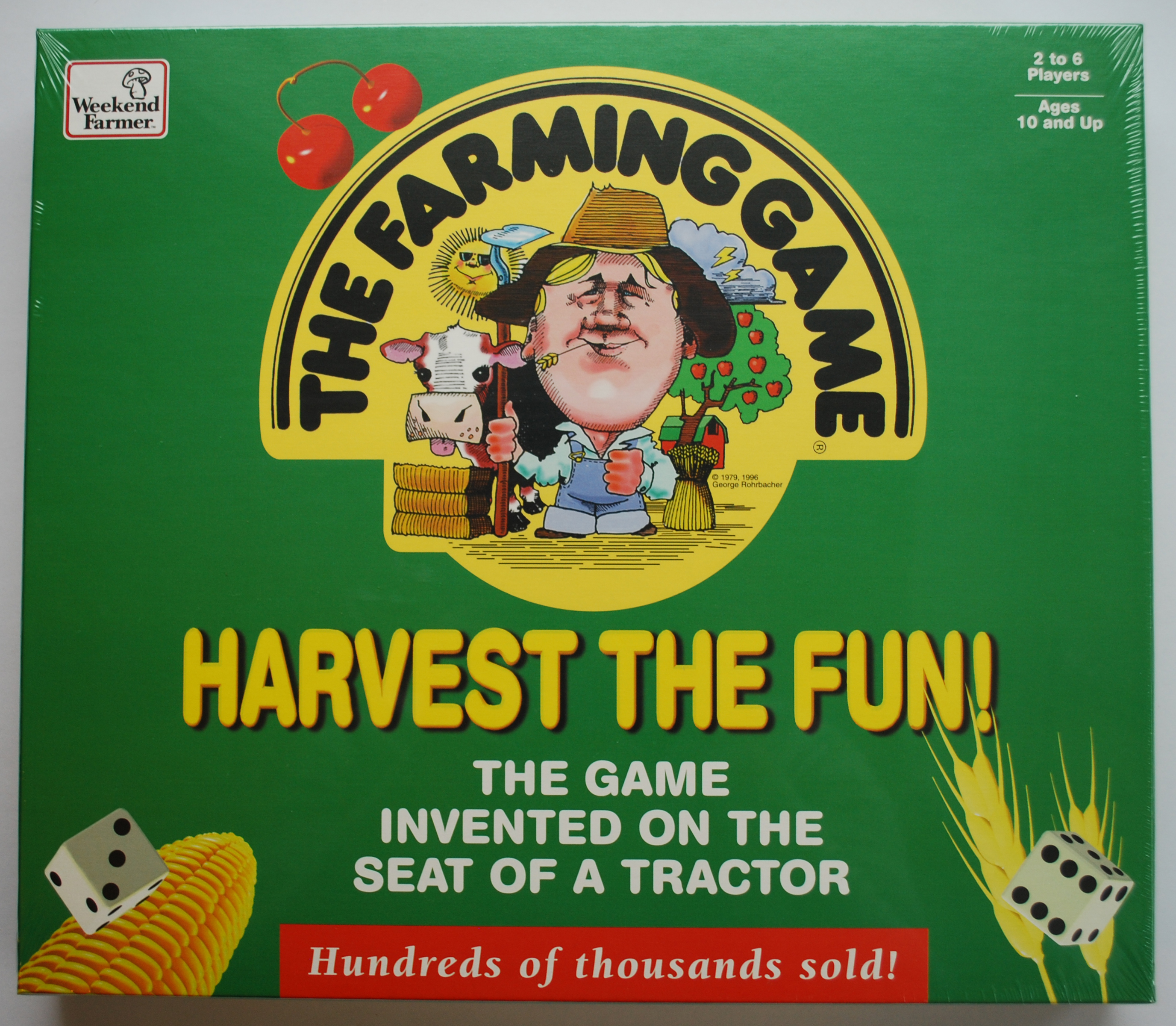
A Washington board game, the holidays, and Paul Harvey

How the true-to-farm-life game saved a family farm and continues to entertain and teach about the trials and rewards of agriculture around the world

Karla Salp
Communications

Original version of The Farming Game
Photo credit: Marylou Krautscheid
Mom picked up our family’s copy of The Farming Game at Cenex in Quincy. I always wanted to be “Roza Ray” or “Sunnyside Sidney” – two of the six Central Washington-themed names of the farmers in the game. The beat-up box and the odd missing piece testify to the fact that playing the board game was a popular pastime in our household. Only during the winter, of course, when the relentless list of farm and garden tasks took a seasonal reprieve.   

Apparently, we are gluttons for punishment.

Unlike Farmville, where there is almost no way to lose and the cows will wait until you come home, The Farming Game keeps it real. The cows get out. Hail ruins your crops. It’s 114 degrees in the shade.

While you can get rangeland, but there is a limit to how much cattle it can hold. High-priced fruit crops are high value but also high risk. Fate throws unexpected twists at the farm dream.

At least the way we played, it also never ended. Like real farmers, we played until we just got tired of it, or we went broke. Whichever came first.  

Hard times

The game itself really was invented on the seat of a tractor – just like it says on the box. After several years of initial success when they started farming in Central Washington, the Rohrbacher family was struggling to keep the farm afloat when their Goldendale ranch, which normally received over 20 inches of rain a year, received only five inches one year. The next, less than three.

With a third child on the way, the Rohrbacher family’s dream of returning to the land to farm was drying up in the summer of 1979. But that July, an idea sprung up in George Rohrbacher’s mind, cultivated by the smell of fresh-cut hay as he cut alfalfa in the pre-dawn hours.

George Rohrbacher, creator of The Farming Game
The idea – “the crazy idea” his wife Ann said – was to create a Monopoly-like board game about farming to save the family farm. Knowing that the most likely time for board game sales would be the holidays, the family set to work sourcing and assembling the game in time for the holiday sales rush. They literally bet the farm to do it – selling off half of their cows to pay for the board game materials and putting every penny they had into amassing 10,000 games.

Had George not been a natural marketer, that may have been the end of their farm, the game, and their life savings. He did everything from taking the game to farm shows and small-town shops to writing President Jimmy Carter and Paul Harvey, a radio show host popular in many rural communities at the time.

While the President returned a mimeographed “thanks for your letter” note, Paul Harvey did mention the game on his nationally-syndicated radio program. Although the Rohrbacher family never heard it themselves, there was a sudden uptick in sales and customers reporting they heard about the game on the radio.

The Paul Harvey push came just in time. By Christmas, they had a newborn, sold 7,000 games, and had earned enough to keep the farm afloat. Income from game sales continued to support the farm for years.

Beyond the farm

Current look of The Farming Game
The game was an immediate hit in farming communities where George peddled it. The farm families enjoyed the game but also appreciated how it accurately reflected the struggles of real farm life. Soon, teachers also saw the value in the game as a fun way to demonstrate to students how economics and real-world businesses work.

The Rohrbacher family was not the only farm hit by hard times. Increased prices and interest rates – much like today – made farming difficult to sustain, even for families who had been farming for generations. Tractors took to the streets in D.C. At one point, the game was given to every member of Congress to help them understand American farmers’ challenges at the time. George himself would even eventually become a Washington State Senator.

The game has also spread beyond America’s own borders. In 1994, the World Bank flew George to Russia after the fall of the Soviet Union to oversee the translation of the game into Russian. There, the game was used to help farmers understand farm privatization after the end of socialism.

The Farming Game today

The Farming Game has been available for over forty years, now sporting an updated green box as opposed to the original tan. It was adapted for Windows and Macs but the electronic versions appear to no longer be available.

Interest in the game continues, having sold over 350,000 copies. Hard times seem to increase sales according to George – with increases in times of economic downturn and during the COVID-19 pandemic. The Rohrbacher family was even featured on The Last Archive podcast recently, discussing the game and the impact it has had. (Please note: The podcast contains a small amount of language or subjects that some listeners may find objectionable.)

The Farming Game brings up nostalgic memories for many a farm kid and anyone else lucky enough to have played the game, even though they knew nothing of the hard times that inspired the game, how it saved a family, or just how widespread the game’s impact has been. But now you know…the rest of the story. 

Friday, March 18, 2022

Drought and soil survey for Washington’s dryland wheat farmers

Are you a dryland wheat farmer affected by the 2021 drought? If you are, the Washington State Department of Agriculture needs your help. 

As part of its continuing work addressing soil health, WSDA is looking for information from dryland wheat farmers about soil management practices, particularly relating to drought. This information will be critical for the researchers involved in the Washington Soil Health Initiative as they learn ways to support agricultural operations enduring drought conditions in the future.

The Drought and Soil Survey will be open until May 1. The survey is detailed, but can be completed over multiple sessions and does not have to be filled out all at once. 

Questions will cover how you manage your soils, the cost of implementing different soil management practices, and the effects of the 2021 drought on your operations.

Results will increase our understanding of dryland production and help us communicate with decision makers so we can better support you. Survey takers will be anonymous, but we will make a summary of the responses available to the agricultural community. 

This survey is being conducted on behalf of the Washington Soil Health Initiative, a joint effort of WSDA, Washington State University, and the Washington State Conservation Commission to study soil health in our state and explore ways to improve it.

Soil health focuses on how well a soil system supports plants, animals, and people. It also recognizes the living nature of soils and the importance of soil microorganisms. Visit agr.wa.gov/AgScience to find our soil health page.

Thursday, January 20, 2022

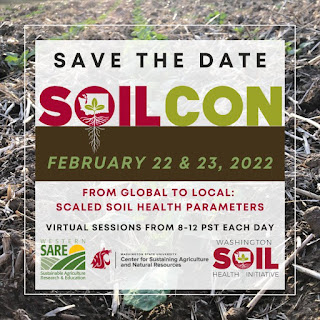
Save the date for SoilCon, the soil health conference

SoilCon, a conference about soil health and the latest research on soil, is coming next month during Washington Soil Health Week.  

The annual conference is organized by the Washington Soil Health Initiative, a joint effort of WSDA, Washington State University, and the Washington State Conservation Commission to study soil health in our state and explore ways to improve it.

Soil health focuses on how well a soil system supports plants, animals, and people. It also recognizes the living nature of soils and the importance of soil microorganisms. 

SoilCon is a free, virtual event and will be held on Tuesday, February 22 and Wednesday, February 23 from 8 a.m. to noon each day. The theme this year is “From Global to Local: Scaled Soil Health Parameters.” 

Visit the SoilCon website to register for the conference or view the complete agenda. 

Topics covered at this year’s conference will include:

  • Global soil challenges.
  • How to interpret soil health tests.
  • The cost and savings growers experience when implementing soil health practices.
  • What role soil microbes do (or don’t!) play in soil health and farm productivity. 

Growers, agricultural professionals, soil enthusiasts, and soil scientists are all invited to attend.

Speakers will include professors from WSU and from universities around the country, as well as graduate students and postdocs providing short, lightning talks. 

Join us at the conference and learn more about soil health in Washington state. Visit agr.wa.gov/AgScience to find our soil health page. 

Thursday, December 16, 2021

Grant applications now open for Farm to Food Bank, a program to reduce food waste and feed Washingtonians


Nichole Garden
WSDA Food Assistance Program 

Photo Courtesy of Maddie Price,
Harvest Against Hunger.
A food bank client in Kitsap County visited a local restaurant to thank the chef, who made soup they received at a local food bank during the pandemic shutdown.

The soup the client’s family received—made from scratch using locally grown, donated produce—was just a fraction of the 680 quarts of soup processed and distributed in the area from September 2020 to March 2021 through The Emergency Food Assistance Program (TEFAP) Farm to Food Bank grant. 

The soup project was run by Kitsap Conservation District with support from the Olympic Community Action Program. They worked with local chefs who processed more than one ton of gleaned and donated vegetables into 25 different types of soups, which were frozen before distribution to food pantry clients. 

The project provided access to healthy, ready-to-eat meals to food pantry clients, helped reduce on-farm food waste, and even kept a restaurant’s staff employed during the worst part of the shutdown.

TEFAP Farm to Food Bank projects, funded by the U.S. Department of Agriculture (USDA) through the 2018 Farm Bill, helps capture food from agricultural producers to distribute to food pantry clients, while also reducing food waste through partnerships with farms, gleaning operations, and others. 

Another round of Farm to Food Bank grants opened on December 10 for public agencies, tribes, and nonprofit organizations for services provided from April 1 – October 31, 2022.

About the Farm to Food Bank program

With USDA’s TEFAP Farm to Food Bank funding, WSDA is able to support projects across the state that—like the one in Kitsap County—help with the harvest, processing, packaging, or transportation of unharvested, unprocessed, or unpackaged foods that are donated by agricultural producers, processors, or distributors. The food is then distributed by TEFAP emergency feeding organizations to food-insecure Washingtonians. These projects help build relationships between agricultural producers, processors, and distributors.

Year 1 results

In 2020, with little time to implement the program, WSDA prioritized projects with Farm to Food Pantry subcontractors who were already gleaning a tremendous amount of produce for food pantries and meal programs in rural areas, as well as areas identified as food deserts by the USDA. 

In addition to the production of ready-to-eat soups in Kitsap County, Farm to Food Bank funded these activities in its first year.


  • Gleaning: Harvest Against Hunger, our Farm to Food Pantry partner, purchased and distributed harvesting materials, including collapsible produce crates, compostable produce bags, twist-ties, and electronic scales, to aid gleaning organizations that provide food to TEFAP food pantries and meal programs across the state.
  • Refrigeration: Chelan Douglas Community Action Council purchased a refrigerated container and supported the installation of a walk-in refrigerator at Upper Valley MEND, a nonprofit that runs a food pantry and vibrant gleaning program in the heart of orchard country. These investments expanded access to freshly gleaned produce from just a few families to recipients across two counties. 
  • Weekly deliveries and centralized storage: The North East Washington Hunger Coalition made weekly produce deliveries to 15 food pantries across 260 miles. In partnership with Rural Resources Community Action Council they were able to purchase a refrigerated container along the delivery route to safely store donated produce between pickups or transfers to food pantries, reducing the time it takes to deliver perishable foods in this large service area. The funding also employed a dedicated gleaning coordinator. 

Together, these projects captured more than 82,000 pounds of donated produce and aided the production of 1,400 pounds of processed soups that were distributed through TEFAP food pantries. Investments in building refrigerated capacity will help reduce waste for years to come.

Year 2 projects

In the program’s second year, 2021, WSDA opened a grant application period that was open to all of our current contractors. Year 2 projects include:

  • Gleaning: WSDA continued to collaborate with Harvest Against Hunger to fund harvest supplies for qualified gleaning organizations. New items included produce washing stations, tree fruit harvesting bags, and more.
  • Value-added processing support: Chelan Douglas Community Action provided harvesting supplies and funded gleaning coordinator salaries for their subcontractor, Upper Valley MEND. Due to staffing shortages, they were unable to pursue value-added processing by restaurants to the extent they had hoped. Instead, they purchased equipment to support in-house processing in the future.
  • Pantry on the Go: Central Kitsap Conservation District was able to support a portion of their Pantry on the Go Program, a mobile food pantry that supplements TEFAP commodities with donated produce. The program provides food for seniors and people living in low-income housing in rural, underserved areas. They also partnered with Kitsap Conservation District to continue the soup project from Year 1.

Year 3 grant applications 

The application period for the next round of Farm to Food Bank grants are open until January 31 for services that will be provided between April 1 – October 31, 2022. Grants will be a minimum of $30,000 with the total amount allocated $140,000. 

The application is open to public agencies, tribes, and nonprofit organizations. For more details on qualifications and to apply, visit the TEFAP Farm to Food Bank Grants webpage. Email Nichole Garden at ngarden@agr.wa.gov for any questions about the TEFAP Farm to Food Bank grant.

Friday, December 3, 2021

Small farms succeed with assistance from WSDA’s Regional Markets team

Laura Raymond
WSDA Regional Markets Program Manager 

If you run a small or midsize direct-marketing farm in Washington state, you know it takes a lot for your business to succeed.

You need to understand the local, state, and federal rules, regulations, and standards and know how to comply with them. You need an effective distribution infrastructure and relationships to ensure that the products you grow or raise can reach customers. If you want to sell in a different marketplace—such as wholesale instead of retail—you need information and guidance to decide whether that market is a good fit and how to be successful within it. You might even need to learn to farm differently. 

WSDA’s Regional Markets team helps small and mid-scale farms in Washington state with all of this—and much more. Their central objective is to help these farms succeed and strengthen local food systems. 

What Regional Markets does

Small farms, which make up 89% of the state’s 39,000 farms, have unique needs when it comes to selling their products on a local or regional scale. Planning, planting, tending, harvesting, storage, processing, and distribution all require different systems than those that are set up for larger producers. 

To help these farms succeed, Regional Markets offers wide range of support, including efforts to:

  • Increase small farm access to local markets.
  • Increase the availability of Washington-grown products in schools and institutions.
  • Encourage connections and infrastructure to boost regional food economies. 
  • Provide farms and food buyers with technical assistance.
  • Provide farms with marketing support and guidance.
  • Facilitate farmer-buyer connections.
  • Support and regulatory guidance for good food safety practices.
  • Advocate for small farms at the national and local levels.
  • Create resources and publications to help farms strengthen local market connections.
  • Provide opportunities to grow or strengthen their businesses through state grant programs. 

Regional Markets is often the first stop for farmers and local food businesses searching for information and resources to sell in their chosen markets. The program also helps buyers such as school districts that want to include local farm products in their menus. They might attend a Farm to School Institute, participate in a Farmer-Buyer Meeting, take part in regularly scheduled Community of Practice calls to connect with others in their sector, or download The Handbook for Small and Direct Marketing Farms (“The Green Book”), the Regional Market's complete guide to direct marketing strategies and regulations. 

By giving small and mid-scale farms the support they need, Regional Markets functions as a key program under the Focus on Food Initiative, which works to connect Washington farmers and food producers with buyers and to ensure that everyone in our state has access to good food.

Learn more about Regional Markets

To learn more about how this program supports small farms, visit the Regional Markets webpage or agr.wa.gov/FarmFoodBiz where you can find information about these grants, and more:

  • Small Meat Processor Capacity Grants
  • COVID-19 Relief and Recovery Grants
  • Farm to School Purchasing Grants
  • Profiting From Your Pivot Program
  • Local Food System Infrastructure Capacity Grants

Tuesday, November 30, 2021

Soil Health Initiative and WSDA looking for samples, participants

Dani Gelardi
WSDA Soil Health Scientist

Healthy soil is the key to success in farming. With healthy soil, farms are more successful, our environment is cleaner, and Washington can keep growing nutritious food for generations to come. With more than 300 different commodities grown in the state, healthy soil looks different from place to place and from crop to crop. 

Background

Soil sampling. 

In the fall of 2019, the U.S. Department of Agriculture (UDSA) awarded a $500,000 specialty crop block grant to WSDA’s Natural Resources Assessment Section (NRAS) that funded a soil health survey project in partnership with Washington State University (WSU). In spring of 2020 the state Legislature passed Substitute Senate Bill 6306 that created the Washington Soil Health Initiative (WaSHI), which provided $200,000 of additional funding to NRAS for more soil health research and outreach.

WSDA looking for more soil samples

Researchers have already been collecting soil samples as part of this initiative. But as the program begins to launch, coordinators are looking for Washingtonians who may be interested in contributing soils data to the WaSHI State of the Soils Assessment. 

If you’re a grower, an agricultural professional, a graduate student, or a conservation district staff member who wants to soil sample, we want to hear from you. 

Beginning in March of 2022, WSDA will pay for a laboratory soil health analysis for eligible projects, in exchange for support in collecting soil samples and grower management surveys. WSDA will also provide training and individualized soil health reports for participating growers. 

Soils data will be used to measure soil health across different regions and crops in Washington. This information will help WSDA protect grower livelihoods, environmental sustainability, and food security in Washington.

The deadline to apply to participate is 5 p.m., Tuesday, Jan. 25, 2022. For more information or to apply, visit the NRAS Partnerships in Soil Health webpage. 

WSDA will also be hosting a virtual Q&A on Tuesday, Dec. 14 at 1 p.m.

Monday, November 22, 2021

WSDA Works – Plant services team keeps plants safe and healthy

Amber Betts
WSDA Communications

A nursery. 

Have you ever wondered why we don’t see more plants with disease and pests in our nurseries? It’s in large part thanks to the folks in the WSDA Plant Services Program (to name a few).

Early Beginnings

The work of the Plant Services Program began in the 1890s, well before WSDA formed in 1913. Back then, there were about 250 licensees that needed inspection to ensure plants offered for sale were free of harmful pests and plant diseases. Now, there are more than 5,600 licensed nurseries and 11 environmental specialists (also known as nursery and export inspectors) statewide. 

The daily life of plant services inspectors

WSDA inspectors like Sherry and Sue monitor nursery plants for diseases, pests, and overall health. Sherry inspects nurseries, monitors areas like Grandview for Japanese beetles, and assists local nurseries and other plant-related businesses with licensing requirements.

Sherry checks a trap for
Japanese beetle at outside
of a local nursery.

Sherry completes export inspections for hay, straw, hops, fruit trees, pollen, irises, lumber, potatoes, and logs. She says she loves learning more about agriculture in Washington State.

Since the outbreak of Japanese beetle in Grandview, Washington last year, Sherry has been busy keeping an eye out when inspecting the local nurseries. She also sets traps in the surrounding area, regularly checking and reporting her findings. In 2021, she found no Japanese beetles in her traps that surround all the nurseries in the Sunnyside and Grandview areas. Pest program coworkers set traps within city limits, and their catch totaled more than 24,000, but Sherry focused on nurseries, and making sure we weren’t transporting these pesky beetles across county or state lines with the sale of plants.  

Right now teams at WSDA are considering expanding the current quarantine to include moving soil and plants outside of the infestation. Sherry and her team will be a big part of that work, too. The variety of work she does is what keeps her job exciting and enjoyable.

“Coming from Illinois, the land of corn and soybeans, it’s amazing to see the variety of crops in the Yakima Valley and the whole state,” she said.

Poinsettias in a greenhouse. 

During nursery inspections, our plant services inspectors perform quarantine enforcement, ensuring protocols are being followed to ensure plants aren’t carrying pests when they travel, and when new pests arrive, they assist with the detection and subsequent quarantine steps.

The division’s mission statement says it all:

“The Plant Services Program is committed to facilitating agricultural trade and ensuring consumer protection by providing accurate and reliable inspection, testing and certification of agricultural plant products, and serving on the front line of defense against the introduction and spread of pests.”

Between our 11 inspectors, we certify more than $2 billion in agricultural products for export annually, and conduct hundreds of inspections. They inspect thousands of bare-root fruit trees for export to Canada each spring, they certify log and lumber exports, hay exports from Kittitas County, and provide planting stock, tree fruit, and grapevine certification. 

Sue inspects the ground where the trees are
shaken to rid them of pests before export.

Right now, our inspector Sue is making the rounds to inspect and certify Christmas trees pest-free for export. In order to prevent spreading pests, Sue and other inspectors visit tree farms during harvest. The trees are mechanically shaken to rid the tree of any potential pest. Then the trees are baled and shipped. Sue closely looks at a percentage of the trees during the process, and even inspects the needles that fall in the shaking process. If there are no pests found, the trees are certified and ready to ship.

Sue also inspects the many varieties of poinsettias growing in greenhouses in Mossyrock, set to hit holiday centerpieces next month.

Washington is fourth in the nation for Christmas tree production, and produces holiday greens used for a variety of celebrations at this time of the year.

There are nearly 400 Christmas tree farms statewide, the top-producing counties are Lewis, Mason, Clark, Pierce, and Thurston for cut trees. Noble and Douglas fir trees are the most popular Christmas trees sold in Washington, accounting for 90 percent of all sales.

Many of Washington's Christmas trees are exported to Hawaii, California, Canada, Mexico, Asia and U.S. military bases worldwide.

What the future holds

Close-up inspection of
Christmas tree needles. 

The Plant Services Program has some exciting plans for the future. They are currently exploring whether they can employ drones to inspect remote sites or utilize dog teams to sniff out plant viruses and fungal pathogens. They also plan to increase online enforcement efforts, facilitate the movement of hemp plant products, and build a planting stock certification center in Prosser, including labs, offices, and meeting space.


Ensuring that Washington plants are exported pest free will require an ongoing partnership between our Plant Services inspectors and those in the plant industry continuing to follow best practices and quarantine rules. Visit our website agr.wa.gov to learn more about Plant Services.


Tuesday, December 8, 2020

WSDA joins UW and WSU to learn more about COVID-19 impacts to agriculture

Hector Castro
Communications

The COVID-19 pandemic has not only taken a toll in lives, but has also led to significant economic hardship for many in our state, including those working in agriculture. Now, WSDA has joined with the University of Washington and Washington State University in an effort to survey Washington’s farms and ranches to learn how they have been weathering this deadly pandemic.


The hope is to learn more about the economic resiliency of our state’s farm operations and how they adapt, or recover, from an unforeseen event like the COVID-19 pandemic. Some farm businesses have seen little disruption to their operations, but others have suffered greatly during these past several months.

The Washington Farm COVID-19 End-of-Season Survey is open until Dec. 31 and is available in both English and Spanish. Any farm or ranch is invited to take part in the survey and all participants will remain anonymous.

There are about 80 questions in the survey, covering the type of agriculture operation as well as questions about finances before the pandemic and during this past year, including questions about how the two years compare to one another.  

Raspberry harvesting.

The survey questions are an effort to understand:

  • What the major impacts were.
  • Whether farms or ranches were able to adapt or transform their farm practices, and how.
  • Which adaptations were the most successful.
  • Why specific decisions were made.
  • What barriers were encountered.
  • What are the hopes and concerns of farmers and ranchers for the coming year.

The information WSDA, UW and WSU learn through the survey will help provide information for academic research and to government decision makers as they strive to develop policies to help businesses, including those in agriculture, recover from this crisis. 

The survey results will also be available to the public, though participants will remain anonymous. Visit the UW’s Center for Public Health Nutrition at nutr.uw.edu/cphn/wafarm to learn more about the survey project.

Friday, October 16, 2020

2019 sees dip in revenues for Washington crops with onions joining the Top 10

Hector Castro
WSDA Communications

Washington’s agricultural production dipped slightly in 2019 to $9.49 billion, down 2 percent from the previous year, according to the annual value of Washington agriculture production report from the U.S. Department of Agriculture, National Agriculture Statistics Service (USDA-NASS).

The Value of Washington’s 2019 Agricultural Production announcement was released this week. Among notable developments, a two percent increase in the value of onion production boosted it into the top ten, with a value of $181 million in 2019.

“Onions have always been right on the cusp of the Top 10, they’ve usually been in that 11th through 14th range for some time,” said Dennis Koong, deputy director of the USDA-NASS Northwest Regional Field Office. 

Apples remained Washington’s leading agriculture commodity, despite an 8 percent decrease in production value, followed by milk, which was up 13 percent from the previous year, and potatoes, which saw an increase of 19 percent. 

No data is yet available on how production has fared during 2020 and the financial impact of the coronavirus pandemic. All figures in this week’s report are for 2019. Also, USDA-NASS does not include data on marijuana production, as it is not a federally recognized agriculture crop. 

The 2019 Washington State Top Ten list of agriculture commodities 

  1. Apples -- $1.95 billion
  2. Milk -- $1.28 billion
  3. Potatoes -- $934 million
  4. Wheat, all -- $792.5 million
  5. Cattle and Calves -- $698.7 million
  6. Hops -- $475.6 million
  7. Hay, all -- $$468 million
  8. Cherries, sweet -- $393.5 million
  9. Grapes, all -- $308 million
  10. Onions, all -- $180.5 million

Several crops that did not make the top 10 list still had good years in 2019. These included blueberries, which reached a record high value of $153 million in 2019, a 10 percent increase from the previous year, barley, with a 39 percent increase in value of $29.9 million in 2019, and canola which, at $22.3 million, saw a fourth consecutive year of increasing values.

The USDA-NASS report also lists commodities that Washington leads the nation in growing, including hops, spearmint oil, apples, sweet cherries, pears and cultivated blueberries.

Visit www.nass.usda.gov for more agriculture statistics. 

Tuesday, September 17, 2019

Lessons shared on goat dairy farm walk

Kathy Davis
Communications


Matthew Tuller and Rachael Taylor-Tuller kick
off the farm walk on their goat dairy, Lost Peacock
Creamery, in Thurston County.
Farmers share a natural affiliation – and maybe none more so than those who raise goats. Goats have an undeniable charm with their floppy ears, expressive eyes, and craving for human attention. Plus, they produce milk and delicious cheese!

No wonder a recent farm walk at the Lost Peacock Creamery in Thurston County was a big draw. The walk’s title was “How not to start a goat dairy; Lessons learned and models for success from a veteran, female farmer.” 

About 30 people attended. Most were small farmers and most were women. Some were exploring farming and raising goats. Some were military veterans or about to be honorably discharged from service. Others had links to food systems or sustainable farming organizations. 

Rachael Taylor-Tuller and her husband, Matthew Tuller, led the tour of their Lost Peacock Creamery. While they shared insights about how they got into the business and currently manage their farm, the event was definitely interactive. 

Along with asking questions, many on the tour offered advice and resources based on their own experiences. Everyone was learning and sharing. And that is the purpose of these Farm Walks, sponsored by Washington State University Food Systems and Tilth Alliance. 
Farm walk attendees get up-close and personal
 with the goat herd.


Goat yoga pays for feed

In just three years since they got their WSDA dairy license, Rachael and Matthew said Lost Peacock now provides them with a living wage without off-farm employment. Statewide, more than half of all farmers have a second job. 

“It’s possible because we don’t live beyond our means,” Rachael said. 

They have avoided taking on debt, she said, expanding as they had the resources. For instance, by adding one barn at a time as they could afford it. 

They also rely on agritourism, including an interesting blend of fitness and farming that has been featured in the news. 

“We do yoga every day, but I wasn’t sure if anyone would want to come to the farm to do yoga with goats,” she said. “But now goat yoga pays our feed bill.”

Another unique event on the farm is called “Cheese and Cuddles.” For $20, visitors can cuddle with the springtime baby goats and sample the farm’s cheese. 

Their event space - decorated with goat art and featuring a climbing wall - is available to rent for birthday parties or other private occasions. 
Mindy Ross enjoys some goat love.


Marketing is key to success

Rachael is a natural and enthusiastic pitch person for her farm.

“The most important way to make a farm successful is with marketing,” she said. “You need to tell your story. Your farm has its story, and you have a personal story – your background, family, struggles -- that goes with that.”

Lost Peacock has a farm website, where Rachel regularly posts on a blog, and are active on social media. 

Rachael shared with the group that she bought the farm after serving in the Air Force. When she got divorced, she had a young child and a fulltime corporate job, but she hung on to the farm determined to make it work. That’s the “how not to start a goat dairy” part of the story. 

After meeting and marrying Matthew, Rachael’s dream started becoming reality. Now she had a partner who was as excited about building that farming dream as she was. 

“Rachael is great at marketing,” Matthew said. “Farms make for great storytelling; there’s the cycle of birth, life, mating…” he trailed off as a male goat mounted a female in the background to illustrate. 

Fences, feed, and people food

As the group watched our hosts and an able volunteer demonstrate a fence repair, the topic turned to feeding practices. We watched the goats nibble on tree bark as Matthew pointed out a lush green patch planted just for them. 


Rachael and a volunteer demonstrate how to
repair a bent fence.
Susan Kerr, education and outreach specialist with WSDA’s State Veterinarians Office, explained that goats are curious and will explore for things to eat. And those may not be what you want them to eat. She suggested planting edible bushes or climbing vines along the fence line, since goats also tend to eat at face level. 

While they encourage natural foraging, Rachael said they also provide feed that does not contain any corn, soy or wheat, due to customers with allergies. 

“We only sell what we want to feed our own family,” she said. 

The whole afternoon was packed with practical tips about farming and goats, and with personal stories about the rewards and struggles of farming. The day wrapped up with samples of Lost Peacock goat cheeses. 


So, what’s with the peacocks? Rachael and Matthew got married on the farm and she wanted peacocks for atmosphere. They got one pair and now several roam their property and perch on rooftops. 

“Apparently, they really like it here,” she commented. 

To learn more about their farm and their story, visit the Lost Peacock Creamery website (and read Rachael’s blog posts for their story) or follow them on social media.

Monday, July 22, 2019

“Loyal to soil” – Farm walks provide farmer-to-farmer learning

Spoon Full Farm shows a map of their property 
by the Yakima River, which borders it.
Karla Salp
Communications

When learning something new, there is no more effective way than getting your hands – or your feet – dirty. That’s where the Washington State University Food Systems and the Tilth Alliance come in.

 Phoebe Autry, garden manager, talks about no-till gardening
WSU has been coordinating educational farm walks for over 15 years. The goal is to provide a venue for farmers to learn from one another about organic, sustainable, and innovative farm and food businesses throughout the state. While farmers are the primary audience, attendees also include researchers, agricultural professionals, and even gardeners.

This month’s first farm walk, for example, was a visit to Spoon Full Farm at Thorp, near Interstate 90 just west of Ellensburg.

Spoon Full Farm is a relatively new diversified farm. They are transforming land which had been a hay farm for decades. Their motto is “loyal to soil” and they see themselves primarily as “soil farmers.” They grow vegetables, fruit, and flowers as well as graze cattle and raise chickens for eggs. But their guiding principle is to choose farming methods – such as no-till – which have been shown to improve soil quality and which they hope will grow better produce.

Anna Brown talks about Spoon Full Farm's rotational grazing
Two dozen attendees walked the 100-acre property to learn more about how Spoon Full Farm operates, ask questions, and see first-hand the benefits and challenges that can accompany no-till practices. During the walk, topics discussed included:
  • Dealing with weeds in a no-till garden
  • Addressing high winds on the farm
  • Rotational intensive grazing of cattle
  • Raising chickens for eggs on pasture
WSDA staff members frequently attend the farm walks to provide resources and ask questions. On this walk, for example, our Regional Markets team brought the hot-off-the-press new Small Farm and Direct Marketing Handbook, or the “green book.” The handbook has fact sheets on a wide variety of topics of interest to new farmers. And our produce safety team provided feedback about good produce safety practices that were being used on the farm as well on the walk.

Mericos Rhodes talks about raising pastured chickens for eggs
If you missed this farm walk, don’t worry – there are several more scheduled throughout the summer on a variety of topics:

You can also find booklets from past farm walks on the Tilth Alliance website. In addition to the WSU Food Systems/Tilth Alliance farm walks, other agricultural organizations also host these valuable experiences. Follow WSDA’s Facebook page and check out our Facebook events calendar to stay informed when they occur.

Monday, September 18, 2017

Sharing wheat country with the media

Hector Castro
Communications 

Wheat farming, like much of agriculture, is a tough business. Pests and weather can damage crops, prices fluctuate, and equipment must be constantly maintained. On top of all this, at a time when more and more people want to know where their food comes from, fewer members of the public, including reporters, have ever worked a farm.
Reporters and others gather at Green View Farm for
a tour of farms and farm equipment.

So the Washington Association of Wheat Growers hosted amedia day this past summer, taking a few reporters for a tour of some Spokane area wheat fields on a warm, sunny day in late August.

A reporter gets an inside view of a combine at
Green View Farm.
The goal was to strengthen relationships with agriculture industry reporters and help those new to the field. For everyone on the tour, it was a day to learn what it takes to cultivate wheat and get it to market, WAWG president Ben Adams said.

“We want to showcase the full process,” he said before the start of the media tour.

Reporters with the Capital Press, the Spokesman Review, the Washington State Wire website and a local weekly newspaper participated. I joined Jason Ferrante, assistant director for WSDA’s Commodity Inspection Division, and Philip Garcia, manager of the Grain Inspection Program, as part of the WSDA group attending the tour.

Planting, harvest and storage
Piling into a waiting bus, the group of a dozen people first travelled to the wheat farm of WAWG Vice President Marci Green, a sixth-generation wheat farmer.

Lonnie Green explains wheat, with wife, Marci Green,
vice-president of Washington Asoociation of Wheat Growers. 
In a cavernous barn and on a wide open field, reporters got up close to the planting and harvesting equipment used to grow wheat. In the barn, Lonnie Green, Marci’s husband, explained the workings of a massive vehicle that can dig a furrow, fertilize it and deliver seed – all at the same time, employing technology unheard of when Marci’s family first began to farm.

On the tailgate of a pickup truck, Lonnie had several dry stalks of wheat. He threshed the stalks of soft white wheat and winter wheat between his hands so the grain would fall loose onto the tailgate of a pickup, showing in their size and quantity the differences between the two.
Barley harvest at Rattlers Run Farm. 

But the field at the Green View Farm wasn’t prime for harvest, so the group travelled to nearby Rattlers Run Farm, where barley harvest was underway. The reporters on the tour each had a chance to climb aboard the towering combine for a harvest-time ride.

In between, they snapped photos of the machine in action as it churned its way through acres of golden barely.

After planting and harvest, the grain has to get to market. For growers who don’t store their grain on site, their grain is hauled to a storage facility, like the McCoy Grain Terminal near Rosalia. The facility can hold 11 million bushels of grain in piles like small hills and inside towering grain bins. Trucks and rail cars both deliver grain to the terminal, where their loads are weighed and sampled for grading.

Viewing grain pile at McCoy Grain Terminal.
In Washington, wheat consistently ranks among the state’s top commodities, with 90 percent of it bound for markets in Japan, South Korea and the Philippines. So grading the grain is critical and has a direct impact on the price wheat growers can get for their crops. WSDA’s own Grain Inspection Program grades and processes grain from an annual average of 25 to 30 million metric tons bound for export. The program also processes an average of 32,000 samples each year at its three domestic inspection offices.

WAWG’s media tour this past summer mirrored other similar outreach efforts farmers and ranchers in Washington and across the country have made in recent years, as they continue seeking ways to reach out and tell the story of agriculture.