Karla Salp
Communications
 |
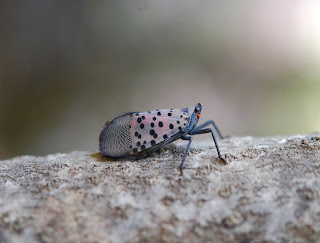
| Photo submitted with suspected spotted lanternfly report |
Spotted lanternfly (SLF), a
native to Asia, attacks primarily grapes, but also has been sighted in other
crops such as hops, apples, peach, and other fruit trees. Should it become
established in Washington, spotted lanternfly could threaten many Washington
iconic crops and result in costly quarantines and increased pesticide use to
manage the pest.
Last week, the Washington
Invasive Species Council (WISC) received a possible sighting of the pest in the
Omak area and informed WSDA and the U.S. Department of Agriculture. The
possible sighting included a photograph and also mentioned seeing five live
specimens. Despite a search of the area, WSDA entomologists could not confirm
the report. WSDA is asking the public, especially those in Okanogan County, to
examine their trees and other outdoor surfaces for spotted lanternfly adults
and egg masses.
“Our search revealed abundant
host material in the area,” Sven Spichiger, WSDA managing entomologist said. “For
the next several weeks, we ask people to look for both adults and egg masses.
If they think they found any suspected life stage of the pest, they should
report it.”
The unconfirmed report comes
during a month when WISC, WSDA, and other state agencies have been requesting
that the public report tree-of-heaven locations as part of an effort to
proactively locate and remove this preferred host of the spotted lanternfly. The
outreach also encouraged the public to look for and report possible SLF sightings,
although SLF populations are not known to be in the state at this time. SLF
poses no threat to human or animal health.
“This is another example of
the important role everyone plays in stopping invasive species,” said Justin
Bush, the council’s executive coordinator. “If you spot a suspected invasive
species, immediately notify the council through our website or phone app called
Washington Invasives. You may be reporting a new invasive species and help
prevent millions, if not billions, of dollars in damage and loss.”
Although the unconfirmed
report does not indicate that an SLF population exists in Washington at this
time, WSDA plans to survey the area for the pest in 2022. Because it is too
late to survey this year, public aid in looking for and reporting possible sightings
now could provide critical information about the pest’s whereabouts. A rapid
response is required to successfully eradicate SLF if a population exists.
When reporting possible SLF sightings,
include a photograph, date, and location of the sighting and most importantly –
collect the specimens. Reports can be made using WISC’s
online reporting form or mobile app or by emailing WSDA at pestprogram@agr.wa.gov or calling
1-800-443-6684. After reporting, suspect specimens and egg masses can be taken
to WSU Extension offices. More information
about spotted lanternfly can be found on WSDA’s website. Report
tree-of-heaven locations to WISC.
Spotted lanternfly first
arrived in the U.S. in 2014 in Pennsylvania. Since then, it has been spreading
through several eastern states while popping up in other places throughout the
country. When established in an area, it can cause potential problems for growers
as well as homeowners.
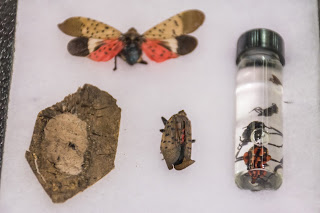
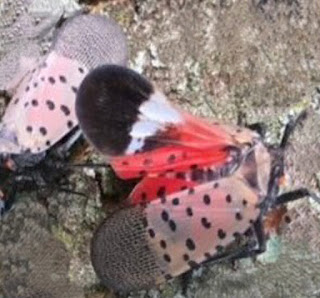
Additional
photos
- Adult
spotted lanternfly (Credit: Pennsylvania Department of Agriculture)
- Spotted
lanternfly egg masses (Credit: Pennsylvania Department of Agriculture)
- Spotted
lanternfly egg mass close up (Credit: Pennsylvania Department of
Agriculture)