Tuesday, October 12, 2021

WSDA considers taking field work to new heights

Amber Betts
WSDA Communications

WSDA Staff watch as DFW officers
demonstrate how to operate a drone. 
Peeling back the wrapping paper revealing what was inside, my little brother’s eyes lit up as he realized his gift. He wasted little time taking his brand new mini drone outside to give it a try, he launched the inaugural flight, and everyone had a fun time watching has he ran the mini aircraft into trees and onto the roof of my garage.

I felt that same excitement last month and may have done a little dance after flying a giant and much more sophisticated version of my brother’s gift. I met a group of my colleagues in an open field in Prosser, Washington, to watch a demonstration led by officers of the Washington State Department of Fish and Wildlife (DFW). As WSDA considers whether drones would make some field work easier to accomplish, we learned about the various types of Unmanned Aircraft System (UAS) drones, what it takes to implement a drone program at a state agency, and what qualifications drone pilots may need.

The Matrice 300, one of
the drones demonstrated,
waits to take flight. 

Every head turned to the sky as the DFW officer launched the Matrice 300, one of the types of drones used by the officers. As we watched what the aircraft could do, WSDA staff discussed the possible ways we could use a drone. From our dairy inspectors, to our safety officers, and our pesticide inspectors all of my coworkers had ideas on how this aircraft could make their job more efficient.  

For dairy nutrient inspectors, a drone’s birds-eye view could give a bigger picture of pasture conditions, potentially cutting inspection time significantly.

A drone could help entomologists follow a pest or invasive species like the Asian giant hornet to its nest with thermal sensors. Drones could also be fitted with chemical sensors that could detect evidence of pesticide drift.

A staff member operating
the drone controls. 

As a professional communicator, I can see countless uses for video footage and photos to better highlight the work we do.

In addition to learning what the drones could offer our agency, we also learned some of the regulations and licenses our staff would have to abide by and obtain in order to operate the drones as part of agency business. Those operating the aircraft must have a pilot’s license, and maintain a number of flight hours each year in order to keep that license. While flying, the aircraft must stay under 400 feet above the ground and all flight plans must be logged.

Some state agencies are already using drones for their work, including the Department of Fish and Wildlife, the Department of Labor & Industries, and the Department of Ecology.

At WSDA, the recent demo was a first step in a longer process to consider whether drones are right for our agency. Next, an internal group will consider the policies or training that use of drones would require.

A final decision could still be some months away. Stay tuned to our blog to see what’s next. 

Staff looks to the skies as the first drone takes flight. 

Monday, October 11, 2021

Tree-of-heaven reports safeguard state from another invasive pest

Cassie Cichorz
Pest Program Outreach Coordinator

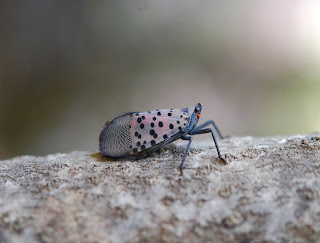
Adult spotted lanternfly
Photo credit: Pennsylvania Dept. of Agriculture
The reports of tree-of-heaven are rolling in now that the Washington Invasive Species Council has launched a month-long effort to identify where this invasive tree is located. This is the first step in an effort to proactively prepare for the arrival of another dread invasive species that prefers tree-of-heaven: the spotted lanternfly.

Spotted lanternfly (SLF) is an invasive piercing-sucking insect. It feeds on a wide variety of plants including apples, grapes, cherries, hops, plums, walnut and many more species.

Damage incurred by spotted lanternfly includes oozing sap, wilting, leaf curling, and tree dieback. SLF also secretes large amounts of honeydew (feces), which enables the growth of sooty mold on vegetation and fruit.

Currently, it has only become established the northeastern United States, although it has been found dead in Oregon as a hitchhiker on goods shipped from the northeast. More alarmingly, more than fifty spotted lanternflies have been found both alive and dead in California at state border agricultural inspection stations as well as on air cargo flights.

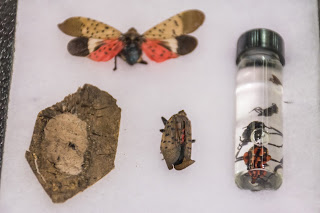
Display showing various
life stages of spotted lanternfly
Most adults are bad fliers and will be found with their wings closed. Adults begin to lay grey-brown egg clusters in September on tree bark and outdoor surfaces. They will cover the egg masses with a wax coating that resembles mud. When performing a survey for spotted lanternfly, check items in the area such as outdoor furniture, stonework, firewood piles, and rusty items.

Adult ID

  • 1’’ long, ½’’ wide at rest
  • Yellow abdomen with black bands
  • Black head and legs
  • Light gray forewings with black spots and a rear speckled band
  • Scarlet hindwings with black spots and rear black and white bars

Spotted lanternfly is likely to infest tree-of-heaven if it arrives. Tree-of-heaven is rapid-growing and its bark is often compared to cantaloupe skin. Mapping known tree-of-heaven populations allows Washington to plan control efforts, keeping our state safe from this invasive pest.

Report spotted lanternfly sightings to the Washington State Department of Agriculture by e-mailing PestProgram@agr.wa.gov or calling (800) 443-6684. You can also report known tree-of-heaven locations by visiting the Washington Invasive Species Council’s website

Thursday, September 30, 2021

Taking hornet nest removal to new heights

Karla Salp
Communications

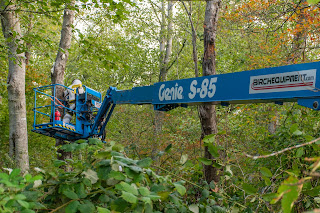
WSDA's Pest Program uses a buck lift to access
the nest 15 feet up in an alder tree

Last week, WSDA’s Pest Program removed the third Asian giant hornet (Vespa mandarinia) nest of 2021, making it the fourth nest removed since the invasive hornet was first detected in Washington in December 2019. All of the nests have been in the same general area east of Blaine.

Most research on these hornets suggests that they normally nest in the ground and more rarely in trees. But so far, 100 percent of nests found in Washington have been in tree cavities. The entrance to this latest nest was over 15 feet above the ground. A thermal-imaging camera showed the nest itself was below the nest entrance.

The challenge posed by working on a nest so high up was compounded by the fact that the nest was also surrounded by dense trees and vegetation – especially blackberry patches as much as eight feet tall. The team of entomologists and others from the pest program had to use some new tools to eradicate this nest, including a rented bucket lift to raise them over the bulk of the vegetation so they could work safely at the nest entrance.

Just as in the other nest removals, once at the entrance, the team sealed up the tree and vacuumed most of the hornets out before sealing the entrance.

Inspiring Halloween costumes everywhere -
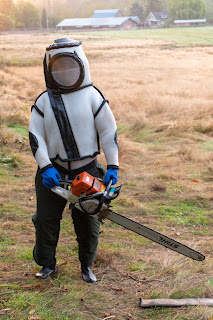
Dan DeVoe prepares to take down the tree with the nest

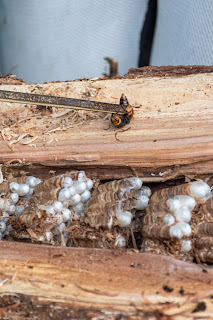
In addition to the height of the nest, it was also in a decaying alder tree. This made it risky to safely cut the tree down. A trail steward from the Department of Natural Resources was able to help. Wearing a bulky hornet suit, he cut the tree so it dropped right on target. Once the tree was down, he cut it into sections and split the tree open so the team could finish collecting the remaining hornets and the nest.

Queen and the nest
Here is what was found in the latest nest: 

  • 10 combs
  • 674 total cells
  • 86 empty cells
  • 128 eggs
  • 202 larvae
  • 261 capped cells
  • 185 workers
  • 0 males
  • 1 queens
  • TOTAL LIFE STAGES – 777

Luckily, none of the three nests eradicated this year have had new queens, meaning the nest was found and removed before the queens could emerge, mate, and left to start new nests next year.

Two of the three nests this year were found from reports made by local residents, and this is the critical time to find nests before creating new queens. If you think you see an Asian giant hornet, take a photo and submit a report at agr.wa.gov/hornets.

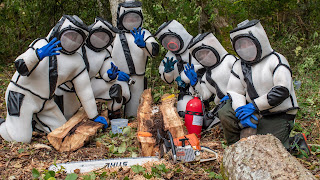
WSDA/DNR/USDA team that removed the 
third nest of 2021, fourth nest total

Video of activity at the nest as well as the nest removal is available on WSDA's YouTube channel

Monday, September 27, 2021

Taste Washington Day 2021 – celebrating the farm to school connection

WSDA Farm to School 
Purchasing Grant Specialist

 Each year, soon after students return to school, the annual Taste Washington Day is held as a way to promote both the farm to school movement serving local foods in school meals and Washington agriculture.

Yakima School District, Taste Washington Day 2020.
This year, Taste Washington Day 2021 will be held on Oct. 6. Schools from around the state have been encouraged to share their farm to school efforts, whether those activities are year-round, or once-a-year on this special day. Eighteen school districts and more than 20 farms have signed up to celebrate local foods in Washington. Visit agr.wa.gov/FarmtoSchool to see the growing list of participating schools and farms.

To celebrate Taste Washington Day, schools are planning a range of fun and engaging activities, such as serving a Washington-grown food as part of breakfast or lunch, highlighting farm sources on menus, doing a “Washington Apple Crunch” at noon, sending students home with a “Taste Washington Day Recipe,” teaching lessons in school gardens, hosting a pop-up Farmers Market, and more!

Still time to join

Valley School District, local lettuce and tomatoes, 
Taste Washington Day 2020
School districts and farmers can still sign up online to be part of the event and share their plans with WSDA by the Taste Washington Day page on our website.

Local Washington-grown foods are a part of school meals in many school districts across the state as farmers support schools with products ranging from apples and pears to local cheese and yogurt, Washington-raised beef, seasonal veggies, grains, and legumes.

Washington is a major farming state with farms in every county, so Taste Washington Day is also an opportunity to teach students about agriculture by learning about what is being grown and produced in their own communities. 

Everett School District, 
Taste Washington Day 2020

WSDA partners with the Washington School Nutrition Association to organize Taste Washington Day, with support from Office of Superintendent of Public Instruction Child Nutrition. Local nonprofits, parents, volunteers, and community partners also work to support Taste Washington Day.

Where to learn more

If you are a farmer or work at a school and would like more information about participating in Taste Washington Day, contact WSDA Farm to School Purchasing Grant Specialist, Annette Slonim at aslonim@agr.wa.gov or 206-593-6953. You can also visit agr.wa.gov/FarmtoSchool to learn more about WSDA’s Farm to School program.

Tuesday, September 21, 2021

Business accelerator for women in ag begins this November


Applications are being accepted now through October 15 for the second round of a training and networking program for women in Washington and Oregon who are in the food and agriculture business.

Hard apples at Stratton Farm in La Center. 
The Women’s Farm2Food Accelerator is set to launch in November and is a partnership with WSDA, the National Association of State Departments of Agriculture (NASDA) Foundation and the Oregon Department of Agriculture (ODA). Participants in this 15-week program receive training on a host of business-related skills, from marketing and product development, to food safety and packaging. There is also opportunity for networking with others in the food and ag industry.

Virtual information sessions
For those who want to learn more about the Farm2Food Accelerator, how it works, and whether it can help them develop their business, organizers are hosting two virtual information sessions for potential applicants. Both sessions are one hour long and will be held on:
  • Sept. 29, 2021
  • Oct. 6, 2021
Each information session begins at 4 p.m. PDT with the first 30 minutes providing an overview of the Farm2Food Accelerator followed by a question and answer session.
Diane Fish and a vanload of donated produce
for the Kitsap Farm to Freezer operation. 

Past participant feedback
Participants from the first Farm2Food Accelerator said the experience gave them valuable tools to grow their business operations.

“The Farm2Food Business Accelerator Program has been a game changer for me,” said Rose Smith, whose Stratton Brothers Cider Co. produces hard cider from apples grown on Stratton Farm in La Center, one of the oldest farms in Washington’s southwest region. “Having knowledgeable consultants to answer my questions, keeping me on the right track, has been instrumental to me and my product.”

Another participant, Diane Fish, runs the Kitsap Farm to Freezer operation in Kitsap County, turning food donated from restaurants or gleaned from fields into ready-to-eat meals for hunger relief organizations. The tools she gained from the Farm2Food Accelerator helped her grow her work from pilot project to a socially beneficial program, she said.

Growing greens at Kitsap Farms.
Angela Cordiano operates Kitsap Farms in Hansville producing salad mix. The business accelerator program not only provided her with constructive feedback on her business ideas, she said, but also equipped her with practical tools.

“One of the things I struggled with the most with was what to charge for the different types of buyers,” Angela said. “The spreadsheet provided in the pricing module is a great tool that I will keep handy for a long time.”

Visit F2FAccelerator.org to learn more about the Women's Farm2Food Accelerator or to register for one of the coming information sessions.