Showing posts with label plant services program. Show all posts

Wednesday, April 6, 2022

Risky business: New WSDA program protects gardens, farms, and environment from prohibited plant sales

Karla Salp
Communications

Illegal plant sales can introduce or spread new pests, 
such as this lily leaf beetle which was found
in gardens near Bellevue. 
Skyrocketing online sales since the start of the pandemic put further pressure on a known potential pathway for invasive plants and plant diseases to enter our state: illegal plant sales.

The problematic issue came into the public eye in July of 2020 when reports of seed packets from China and other countries – some solicited and some not – became widespread both in the U.S. and abroad.

The WSDA Plant Services Program had long been grappling with this challenge – occasionally receiving reports from Washington consumers about illegal plant sales on social media and through online retailers but not having a clear path forward on how to effectively respond to complaints. 

Fast forward to 2021 when WSDA started a first-of-its-kind program to directly address the issue of illegal online sales of prohibited plants: the Online Enforcement Program. With funding from the U.S. Department of Agriculture, the Plant Services Program was able to dedicate the majority of one inspector’s time – Tristan Carette-Meyers – to work with vendors to stop these illegal sales. 

The problem – illegal plants threaten gardens, farms, and the environment

Blueberry scorch virus is one of the diseases
WSDA is trying to prevent in Washington
Photo credit: WSU Whatcom County Extension
While it may seem that selling plants should be helping, rather than harming, the environment, that is not always the case.

The sale of certain plants has been prohibited in Washington because their invasive nature can overwhelm and out-compete native plants. This has a downstream effect that impacts not only local plants but animals, food sources, habitat, and more.

Secondly, the movement of some uncertified plants into Washington has been prohibited because they pose a risk to the existing plants and the agriculture industry. For example, blueberry plants cannot be shipped into Washington unless certified disease-free. Washington is currently the top producer of blueberries in the country. If diseased or infested plants were to enter the state through unauthorized sales, it could decimate an entire industry to the tune of millions of dollars annually.

But it is not only farmers who would suffer. Gardeners and others who try to eat locally sourced food would soon be forced to look elsewhere for blueberries that would otherwise grow quite readily throughout the state.

The consumer-awareness solution

Protecting the state from the threat that illegal plant sales pose requires both the public and the state to take action.

Whether the plant itself may be invasive or might introduce a plant pest, consumers would be wise to protect their own gardens as well farms and the environment by educating themselves about the state’s plant quarantines.

Also, be discerning about where you purchase plants. Sales through social media or online are the riskiest – there are just too many for WSDA to monitor and many are not official businesses, making them difficult to track or contact. The few dollars you may save will rapidly evaporate should the plant you buy take over your garden or introduce a new pest or disease.

Buying from reputable, licensed, local nurseries familiar with the state plant and pest quarantines dramatically reduces the risk that the plant you buy will turn out to be Pandora’s box of problems.

While buying local does decrease your risk, you don’t have to stop shopping online altogether. Just be sure to ask the online vendor questions about the plant and their knowledge of Washington plant quarantines. A reputable vendor will be familiar with them; you may want to shop elsewhere if they can't answer your questions satisfactorily.

The vendor-awareness solution

Amazon is one vendor that has taken steps to prevent
the shipment of quarantined plants into Washington.
While consumers can take steps to protect themselves by ensuring they purchase from reputable distributors, WSDA’s new program has already been hard at work. Since it started last October, the Online Enforcement Program has contacted over 1,200 vendors about over 1,600 potential plant sale violations.

The program has focused its efforts on both big and small businesses – everything from eBay to Etsy. For example, due to the program’s efforts, Amazon and eBay have now established filters to prevent the sale of prohibited plants and other products from being available for shipment to Washington. WSDA has also provided materials to these companies to provide to their vendors to prevent future violations.

Because of their size, these platforms not only have the potential to sell the most plants illegally, but correcting those problems also has the potential to have the greatest benefit in protecting our state’s nursery and agriculture industry.

On Etsy, the program reaches out to individual sellers about potential violations. Etsy vendors have been particularly responsive.

When buying plants, safety first

Buying plants is one of the simple pleasures in life that can help people create their dream gardens. By working together, WSDA and consumers can prevent those dreams from turning into the nightmare of unexpected invasive plants, pests, and diseases. If you notice illegal plant sales – whether in-person or online – email nursery@agr.wa.gov to provide details (including links if it is online) about the incident.


3/21/23 Update: Since it started in July 2021, the Online Enforcement Program has contacted nearly 1,500 vendors about over 2,200 potential plant sale violations.


Friday, February 14, 2020

Potato certification tests find success in Hawaii

Kathy Davis
Communications 


Kay Oakley inspecting seed potato grow fields in Hawaii.
A business trip to Hawaii may sound luxurious. But maybe not so much if what you’re there to do is plant and inspect potato fields. 

Benita Matheson and Kay Oakley with WSDA’s Plant Services Program traveled to Oahu, Hawaii in November and January to help ensure Washington’s seed potato growers have disease-free planting stock. Their trips were completely funded by grower fees paid into the seed potato certification program. 

Seed potato growers can volunteer to have WSDA certify their seed stock. It requires that some of their seed potatoes be grown out during the winter months and inspected for viruses. 

In the past, these post-harvest grows and testing were done indoors in greenhouses. This is the first year that WSDA collaborated with the Canadian Food Inspection Agency to try outdoor planting. 
The team from Washington, Canada and Hawaii planting
post-harvest seed potato trial field.

“Hawaii has the perfect climate for grow out,” said Matheson, plant inspection supervisor. “Almost all the major seed potato producing states and Canada have been taking their potatoes to be tested there. This puts Washington State’s growing protocol in line with other seed producing states in the nation.”

Seven participating Washington growers provided several pallets of seed potato samples, which were sent to Hawaii by ship, along with the Canadian potato samples. 

In late November, Matheson and Oakley met up with three Canadian growers and staff from E.S. Cropconsult at Twin Bridge Farms on the north shore of Oahu to plant two fields of samples. 

The farm and the Canada-based consulting firm are working with WSDA to understand the unique growing conditions of Hawaii.
Checking paperwork for seed potatoes
ready for shipping to Hawaii. 


“Their knowledge of how quickly the plants would grow helped us figure out when to plant and when to come back to do our visual inspections,” Matheson said. 

WSDA plant inspectors returned to Hawaii in January to inspect and test the seed potato field grow-outs. The outcomes have been positive. 

“Growers were happy with the results from this year’s post-harvest testing,” Matheson noted. “They received their test results earlier than previous years, which allows them to make adjustments to their inventory if needed.”
Benita Matheson with a jar of snakes
while visiting Hawaii ag department offices

The success confirms that WSDA will continue to use the Hawaiian field location for future post-harvest testing. 

“We hope to strengthen our seed potato program and provide healthy planting stock,” Matheson concluded. 

Monday, June 25, 2018

Growing healthy potato crops through seed potato certification

Cindy Cooper
Plant Services Program 

WSDA’s Plant Services Program works with the potato industry year round to grow seed potatoes, certifying they are inspected and tested for harmful diseases or pests that could ruin a crop. Each year, Washington farmers produce thousands of acres of commercial potatoes, and it all starts with certified seed.

Farmers don’t plant traditional seeds to grow potatoes, they plant a part of the potato itself and it’s critical that these seed potatoes be healthy to ensure a healthy crop.

Visiting the annual seed potato lot trials in Othello.
Last week, several specialists with our Plant Services Program participated in the annual seed potato lot trials near Othello. For these trials, potato growers submit potato seed in lots to be planted and 'read' for virus and fungal disease symptoms. The reading results are then published so they are available for potential buyers.

These trials are a collaboration involving researchers with Washington State University, Oregon State University, University of Idaho, the U.S. Department of Agriculture, the Washington Potato Commission and other potato industry groups.

This year's trials included a USDA-sponsored demonstration planting of seed potatoes inoculated with different strains of the PVY virus, or Potato Virus Y. This plant disease has varying effects on different potato varieties, sometimes showing disease symptoms, like spots, on the foliage and, in some cases, remaining latent with no visual symptoms at all. The virus only affects plants, not animals, but can be spread through aphid activity.
Examining the demo plot of PVY infected plants. 
The USDA demo and training for seed potato inspectors in Washington and neighboring states is part of a national training effort to combat the spread of PVY.

About 17 states certify seed potatoes for interstate planting. Washington has about 3,500 acres of certified seed this year, with 10 growers participating in the program.

A complete list of all the seed potato lots certified in the past year is available on our website. You can visit our Plant Services Program webpage for more info.

Thanks to Plant Services Program environmental specialist Sue Welch for the photos.

Thursday, March 15, 2018

From timber to hay, inspectors keep busy and keep exports moving

Sue Welch
WSDA Plant Services Program

Keeping out invasive plant pests and diseases is a challenge for every country, especially since so many plants and plant products are shipped around the world every day. Whether it is timber products going to China or Christmas trees to Mexico, hay to Japan or seed potatoes to Uruguay, it must all be inspected and certified before it can be shipped.

Inspection of logs at the
Port of Olympia.
WSDA’s Plant Services Program has 10 environmental specialists who conduct export inspections of Washington plants and plant products bound for market in other states or overseas. These specialists focus on ornamental plants, and fruiting shrubs and trees, which carry a higher risk of moving live pests, as well as agricultural products like timber, hay and grain. WSDA has a separate program, Fruit and Vegetable Inspection, that focuses on inspecting edible produce.

The author training a
new inspector.

Most countries – including the United States - require a phytosanitary certificate, or “phyto,” before plant products are allowed in. An inspector in the country of origin issues the phytos once they have determined a product meets the requirements of the importing country.

While many of the international shipping inspections are done by the United States Department of Agriculture (USDA), a lot of them are done by WSDA inspectors who are trained, tested and licensed by USDA to issue international phytosanitary certificates.

The inspectors with the Plant Services Program work in log yards, vineyards, nurseries, packing warehouses, or out in growing fields. Growing season inspections are timed to match when disease symptoms will be most noticeable. So tulip bulbs are inspected for viruses during flowering, and grape plants are inspected twice, for early spring and late summer viruses. Logs, lumber and grains can be inspected year-round.
A commercial nursery greenhouse in Elma, Wash.

Inspectors examine plants for symptoms of viral, fungal or bacterial infections, or for signs of insect infestation. Sometimes, before they can be certified for export, plants must be tested and found free of specific diseases. Some products, like lumber, may need to be treated with heat or chemicals to ensure that there are no live pests hitching a ride.

From incredibly destructive insects like the Japanese beetle and gypsy moth, to diseases that can wipe out entire crops, the goal is to do all we can to keep intruders from invading new territory.

Every country has their own requirements for the import of plant products, and they vary greatly by the type of plant, and what part of the plant is being shipped. Inspectors refer to the Phytosanitary Export Database, which lists official plant health requirements for all countries, to determine whether the products are in compliance with the importing countries’ rules.
Plant Services supervisor John Wraspir (L) and
inspector Ed Stansbury (R), inspect tulip bulbs
for export.

WSDA Plant Services inspectors issued 29,584 export certificates for foreign countries in 2017. The goal of state inspectors is to help shippers meet all export requirements so the shipping process goes smoothly and Washington plant products continue to enjoy a reputation for high quality and desirability.

If you need help exporting plant products, contact WSDA Plant Services inspectors at PlantServices@agr.wa.gov or 360-902-1874.

Tuesday, December 13, 2016

Four ways to keep unwanted holiday pests from spreading

Mike Louisell
Communications Office

One of the many ways WSDA supports the agricultural community and consumers becomes more obvious during the holiday season. This is when the staff of our Plant Services Program kick into high gear, inspecting licensed retail and wholesale nurseries at a record pace to keep up with demand while ensuring consumers and exporters get healthy wreaths, Christmas trees, and other holiday plants that are free of pests and disease.

We've wrapped up our inspections of Christmas trees bound for consumers in Mexico, Hawaii, China, Japan and U.S. military bases. Christmas trees sold in the U.S. don't require inspection by WSDA. Although we support export and domestic markets for plants and shrubs year-around, it's especially important this time of year because of the high demand for holiday-themed plants.

Consumers can help keep pests out
Consumers play a major role in keeping damaging pests from damaging plants. Our partners at the U.S. Department of Agriculture offer these tips to protect Washington's communities and environment from harmful pests and plant diseases.
  1. Ordering Online: Poinsettias and amaryllis make festive gifts, but be careful when ordering any plant online. To spread holiday cheer instead of invasive pests, only buy or order plants from reputable vendors that comply with federal quarantine restrictions. To be safe, ask the grower if they are aware of and abide by all USDA regulations for that particular plant.
  2. Trees, Wreaths and Greens: When buying your holiday tree, deck the halls with greens and holly, but be sure to buy them from trusted sources.  Established retailers make sure their suppliers follow federal quarantine restrictions that prevent invasive pests from hitchhiking on trees and decorations.
  3. Don't Move Firewood: For a safe and cozy yuletide fire, buy firewood where you plan to burn it.  If burning your own firewood, don’t move it off your property or you may spread invasive tree killers like the emerald ash borer and Asian longhorned beetle.  Instead, buy or responsibly gather firewood near the place you’ll burn it.  Or take certified, heat-treated firewood with you instead.
  4. International Travel: Traveling abroad for the holidays? Declare all agricultural items to customs officials upon your return or you may bring back more than memories.  In addition to fresh produce, declare all spices, grains and packaged foods, which could carry the destructive Khapra beetle.
Visit www.DontPackaPest.com, a website sponsored by USDA and several partner agencies, to learn what is safe to bring back, along with other valuable travel tips.

Thursday, August 25, 2016

Gypsy Moths and National Parks - Not a Good Mix

Karla Salp
Pest Program Outreach Coordinator

Male gypsy moth on branch
On my recent visit to the East Coast to view gypsy moth damage, I realized upon picking up my rental car that taking the brand new Jeep down the best roads to see gypsy moth defoliation could be costly for the State of Washington.

Luckily, I met Dr. Bob Cook – a biologist with the National Park Service on the Cape Cod National Seashore – who had a beat up Ford pickup perfect for going down the roads less traveled.

Roads Less Traveled 

The roads we drove were primarily dirt and maintained by the occasional car driving down them, as evidenced by the not-infrequent fingernail-on-chalkboard branches scraping the side of the pickup and the occasional “tree branch tunnel” through which we passed.

Driving along Highway 6 on my way to meet Bob earlier, it had seemed as though everything was defoliated; I could even see male gypsy moths fluttering near the trees as I drove. However, as we made our way through the lonely roads, we noted that some of the oak trees in the National Park were lucky enough to escape damage.

Soon enough, though, we discovered sites of complete defoliation. It was awe-inspiring to see the sun streaming unhindered through the naked forest, knowing these trees should have been lush, green, and shady at the end of July.


Gypsy Moths Are Smart

We continued to make our way from hollow to ridge (a difference of a mere few hundred feet) as we wove in and out of various levels of defoliation. Where the forest was totally leafless, moths and egg masses were scarce. But upon returning to areas that had only been partially defoliated, moths were fluttering everywhere and egg masses began appearing again on the trees.

The gypsy moths were no fools. They were defoliating entire acres of forest and then moving to new, healthier forests to lay their eggs, enabling the young to hatch out next spring in a stronger, healthier forest.

Oak trees starting put leaves back on at the end of July
Gypsy Moths and the Tourism Problem

Touring the park, I couldn’t help but think of the 15 national parks in Washington that together receive more than 7.6 million visitors a year.

Like our parks, the Cape Cod National Seashore also receives thousands of tourists each year. But tourism in the area had been dampened by the outbreak owing to the nuisance caused by the moths making camping a nightmare.

I saw reports on social media of tents being covered with male moths and even someone who had a female lay eggs in their sleeping bag!

This is the second year of defoliation in the area, which is a major stress for the trees. It could be enough that some of the trees may die. If they are defoliated again next year, entire sections of the forests in the National Park could die. 

Heading back to the National Park headquarters, I reflected with gratitude that our own national parks are safe from the gypsy moth, though it will take continued diligence to protect our forests.

Tuesday, August 9, 2016

Gypsy Moth Outbreak Tour

Karla Salp
Pest Program

Map of Gypsy Moth Tour through Connecticut, Rhode Island, and Massachusetts
Gypsy moth tour route
At the end of July I flew back East to see first-hand the devastation that the gypsy moths had caused in the largest outbreak the area had seen since 1981 – damage so vast it could be seen from space. The tour gave me a good idea of the risk these invasive pests can pose to our own region. Over the next few weeks I’ll be writing in more detail about the trip and what I learned. Here is an overview of where I went and the gypsy moth situations there.

Connecticut
Female gypsy moths and egg masses on oak tree

Connecticut was where I saw my first-ever live gypsy moths. After meeting with the nation’s oldest agriculture research station in New Haven, I continued on Interstate 95. Not far out of New Haven I began to notice defoliation, got off at the next exit and found female gypsy moths laying eggs on trees.

Rhode Island

My meeting with a forestry employee fell through, but that left more time for touring the state. I went up and down the state, which even weeks after the caterpillars were gone still showed massive defoliation mile after mile.

Cape Cod
Gypsy moths mating on tree limb
Gypsy moths mating on tree limb in Cape Cod

Gypsy moths in Cape Cod, Massachusetts, developed well behind Connecticut and Rhode Island owing to its cooler climate. Although the moth peak was the week before I arrived, there were still plenty male and female moths to see and a lot of mating happening. Many of their forests were barely beginning to releaf out after having been completely defoliated. In addition to the defoliation of the oak trees, many pine trees had also been munched on.

Massachusetts 
Partially eaten leaves and new leaves starting to leaf out
Partially eaten leaves and new leaves starting

The last stop on the trip still offered new things to discover. The Shawme-Cromwell State Forest had been nearly completely defoliated not just this year but last year as well. The oak trees showed signs of stress, such as a last-ditch effort at survival by sprouting leaves along the trunk. Many atypical plants were defoliated, such as rose and blueberry bushes. Most dramatic, and foreboding for Washington, were the evergreens. Several had been completely defoliated and stood dead in the forest, awaiting removal by the park service.

The trip allowed me a chance to capture a number of videos and photos of the gypsy moth and the damage it can cause. I’ll share more of that in future posts on this blog.

Wednesday, July 6, 2016

Social Media Outcry from Gypsy Moth Outbreak Back East

by Karla Salp
Pest Program Outreach Coordinator

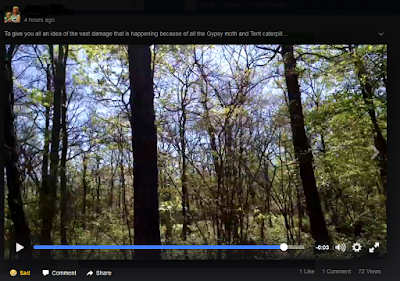
This year the East Coast is experiencing a particularly bad attack of the gypsy moth caterpillars. Anyone looking for reasons to keep the gypsy moth out of Washington need only do a quick search on social media for “gypsy moth” and check out the numerous posts, photos, and videos of the problems this pest is causing.

Here is just some of what you will find:


Photo by Gill Allen:  “A winter's sunset in Summer (the gypsy moths have striped the trees of their leaves)!”


https://www.facebook.com/Bountiful.Blessings.Farm.RI/videos/822582057848570/


News story from Boston:

https://youtu.be/eiguavpDaw8