Showing posts with label Plant Protection. Show all posts

Monday, July 31, 2023

Fun with a purpose - the Washington Bee Atlas trains volunteers to map native bees

Karla Salp
Communications

woman swinging insect net
Dr. Karen Wright demonstrates how to net bees. 
The air was chilly last Saturday as over a dozen people of various ages and backgrounds gave up a weekend to trudge out in hiking boots to a remote meadow near Sequim. The early morning, the fact that it was a weekend, and the distance from home for many of them proved that the group was truly passionate about the day’s work: learning to document the state’s native pollinators.

Oh, did I mention they are also all volunteers?

These dedicated few are some of the first to join and volunteer for a new project at the Washington State Department of Agriculture: the Washington Bee Atlas. The goal of the project is to document the state's native bees under the guidance of the WSDA’s first melittologist, Dr. Karen Wright.

Fun and fascinating – collecting native bees

three people in a meadow pointing
Volunteers scout for bumblebees to catch and 
release with their insect nets.
Half of the volunteers were new to the project, but everyone was in high spirits, chatting about how they came to be involved. The day started by teaching new volunteers how to take and upload pictures of flowers to iNaturalist to record what the bees were pollinating and where.

Next was learning to net specimens. As the morning was cool, only bumble bees were out, which gave the participants an opportunity to practice “catch and release” with the fuzzy fliers, learning the “figure eight swoop” to ensure the specimens stayed in the net.

Now swinging the pros, volunteers next learned how to safely “charge” the collection vials, net a bee, and put it in the vial for euthanization* and preservation. Luckily, as the day warmed, the native bees became more active and the group had luck finding and netting over 20 species from that single location!

two people looking at a cell phone while in a field
Logging plant types and location in iNaturalist
Last on the list was learning how to pin specimens so they could be preserved and later identified to species. The group found this is none too easy as some bees are extremely small. Once the specimens are identified, all of the data will be available on an online public dashboard.

Everyone was quick to pick up the basics needed to collect bees. It was a fun and funky group to be around. Everyone was fascinated by the bees they were finding, sometimes surprised when it came to pinning the bees that bees they thought were the same while collecting proved to be different when they took the time to pin and preserve them. Many stuck around to collect at another location in the area on Sunday.

“Anyone can learn to collect native bees in less than a day. Field work is a fun way to learn about the pollinators around us while improving our collective knowledge about our bees and how they interact with our environment,” Dr. Wright said.

Why native bees?

hands holding a bee on a pin and pointing to its antennae
Dr. Wright shows how to situate the antennae 
when pinning so they don't accidentally
break off later
Very little is known about Washington’s native bees. We aren’t sure how many species are in the state and we can’t say whether they are doing well or declining. It is impossible to say how various changes — from agriculture to changes in climate to urban sprawl — are affecting them.

The map below shows known sightings of what is believed to be about 600 species of native bees in Washington. It amounts to about one dot per species believed to be in the state. In other words, we know almost nothing about native bees as a whole and there are many large areas in the state with no records at all.

The Washington Bee Atlas aims to change all that. Dr. Wright is responsible not only for training the volunteers and running the program, but for identifying all the bees that the volunteers collect as well.

yellow daisy-type flower with bee with long antennae on it
Longhorned bee on flower
The project does not collect bumble bees (which are already tracked in the Pacific Northwest Bumble Bee Atlas) or honey bees, which are not native.

A successful model

While the program is new to Washington, the Washington Bee Atlas is not reinventing the wheel. The program is modeled on the Oregon Bee Atlas, which has been in place for several years. In fact, the two programs are collaborating. The Oregon Bee Atlas has developed such a thorough virtual training that Washington’s Bee Atlas volunteers will be taking it as well.

Once fully trained and certified, the volunteers will be able to collect under WSDA’s bee collection permits for the research project. (Did you know you have to have permits to collect wildlife in Washington?)

Volunteering with the bee atlas

To participate in the Washington Bee Atlas, volunteers must complete training to ensure they can properly identify and collect only native bees.

group photo with people swinging insect nets
Volunteers living their best life and swinging
their insect nets!
Applications are accepted on an ongoing basis, although training opportunities and field days may be limited to certain times of the year. If you are interested in learning more about the Washington Bee Atlas or would like to volunteer, visit WSDA’s Washington Bee Atlas webpage. Registration for the next virtual training session closes Aug. 2. The next field day is Aug. 11 at Snoqualmie Pass. For more information, visit our website or contact Dr. Karen Wright at karen.wright@agr.wa.gov.

*Euthanization is a necessary part of this research project as many species cannot be identified without examining the specimen itself.


Wednesday, April 6, 2022

Risky business: New WSDA program protects gardens, farms, and environment from prohibited plant sales

Karla Salp
Communications

Illegal plant sales can introduce or spread new pests, 
such as this lily leaf beetle which was found
in gardens near Bellevue. 
Skyrocketing online sales since the start of the pandemic put further pressure on a known potential pathway for invasive plants and plant diseases to enter our state: illegal plant sales.

The problematic issue came into the public eye in July of 2020 when reports of seed packets from China and other countries – some solicited and some not – became widespread both in the U.S. and abroad.

The WSDA Plant Services Program had long been grappling with this challenge – occasionally receiving reports from Washington consumers about illegal plant sales on social media and through online retailers but not having a clear path forward on how to effectively respond to complaints. 

Fast forward to 2021 when WSDA started a first-of-its-kind program to directly address the issue of illegal online sales of prohibited plants: the Online Enforcement Program. With funding from the U.S. Department of Agriculture, the Plant Services Program was able to dedicate the majority of one inspector’s time – Tristan Carette-Meyers – to work with vendors to stop these illegal sales. 

The problem – illegal plants threaten gardens, farms, and the environment

Blueberry scorch virus is one of the diseases
WSDA is trying to prevent in Washington
Photo credit: WSU Whatcom County Extension
While it may seem that selling plants should be helping, rather than harming, the environment, that is not always the case.

The sale of certain plants has been prohibited in Washington because their invasive nature can overwhelm and out-compete native plants. This has a downstream effect that impacts not only local plants but animals, food sources, habitat, and more.

Secondly, the movement of some uncertified plants into Washington has been prohibited because they pose a risk to the existing plants and the agriculture industry. For example, blueberry plants cannot be shipped into Washington unless certified disease-free. Washington is currently the top producer of blueberries in the country. If diseased or infested plants were to enter the state through unauthorized sales, it could decimate an entire industry to the tune of millions of dollars annually.

But it is not only farmers who would suffer. Gardeners and others who try to eat locally sourced food would soon be forced to look elsewhere for blueberries that would otherwise grow quite readily throughout the state.

The consumer-awareness solution

Protecting the state from the threat that illegal plant sales pose requires both the public and the state to take action.

Whether the plant itself may be invasive or might introduce a plant pest, consumers would be wise to protect their own gardens as well farms and the environment by educating themselves about the state’s plant quarantines.

Also, be discerning about where you purchase plants. Sales through social media or online are the riskiest – there are just too many for WSDA to monitor and many are not official businesses, making them difficult to track or contact. The few dollars you may save will rapidly evaporate should the plant you buy take over your garden or introduce a new pest or disease.

Buying from reputable, licensed, local nurseries familiar with the state plant and pest quarantines dramatically reduces the risk that the plant you buy will turn out to be Pandora’s box of problems.

While buying local does decrease your risk, you don’t have to stop shopping online altogether. Just be sure to ask the online vendor questions about the plant and their knowledge of Washington plant quarantines. A reputable vendor will be familiar with them; you may want to shop elsewhere if they can't answer your questions satisfactorily.

The vendor-awareness solution

Amazon is one vendor that has taken steps to prevent
the shipment of quarantined plants into Washington.
While consumers can take steps to protect themselves by ensuring they purchase from reputable distributors, WSDA’s new program has already been hard at work. Since it started last October, the Online Enforcement Program has contacted over 1,200 vendors about over 1,600 potential plant sale violations.

The program has focused its efforts on both big and small businesses – everything from eBay to Etsy. For example, due to the program’s efforts, Amazon and eBay have now established filters to prevent the sale of prohibited plants and other products from being available for shipment to Washington. WSDA has also provided materials to these companies to provide to their vendors to prevent future violations.

Because of their size, these platforms not only have the potential to sell the most plants illegally, but correcting those problems also has the potential to have the greatest benefit in protecting our state’s nursery and agriculture industry.

On Etsy, the program reaches out to individual sellers about potential violations. Etsy vendors have been particularly responsive.

When buying plants, safety first

Buying plants is one of the simple pleasures in life that can help people create their dream gardens. By working together, WSDA and consumers can prevent those dreams from turning into the nightmare of unexpected invasive plants, pests, and diseases. If you notice illegal plant sales – whether in-person or online – email nursery@agr.wa.gov to provide details (including links if it is online) about the incident.


3/21/23 Update: Since it started in July 2021, the Online Enforcement Program has contacted nearly 1,500 vendors about over 2,200 potential plant sale violations.


Wednesday, November 13, 2019

Christmas tree inspections allow Washington trees to travel the world

Karla Salp
Communications

woman inspecting Christmas trees
WSDA inspector Sue Welch checks baled trees
It was a chilly, foggy morning a week before Halloween when WSDA plant protection inspectors Sue Welch and Haley Palec pulled up to a remote Christmas tree farm near Cinebar, just west of Mount Rainier National Park. While most people were still carving pumpkins and designing costumes, at Bear Canyon Tree Farm, the smell of fir was in the air. The farm’s freshly-cut Christmas trees were waiting for WSDA inspections so they could be shipped around the world. 

Bear Canyon Tree Farm’s trees were destined for markets in Hong Kong, Japan, and Singapore. In past years, they’ve even sent Christmas trees to Dubai.

To export Christmas trees to these and other countries, an inspection is usually required to make sure the trees don’t harbor any pests that might cause problems in the destination country. WSDA
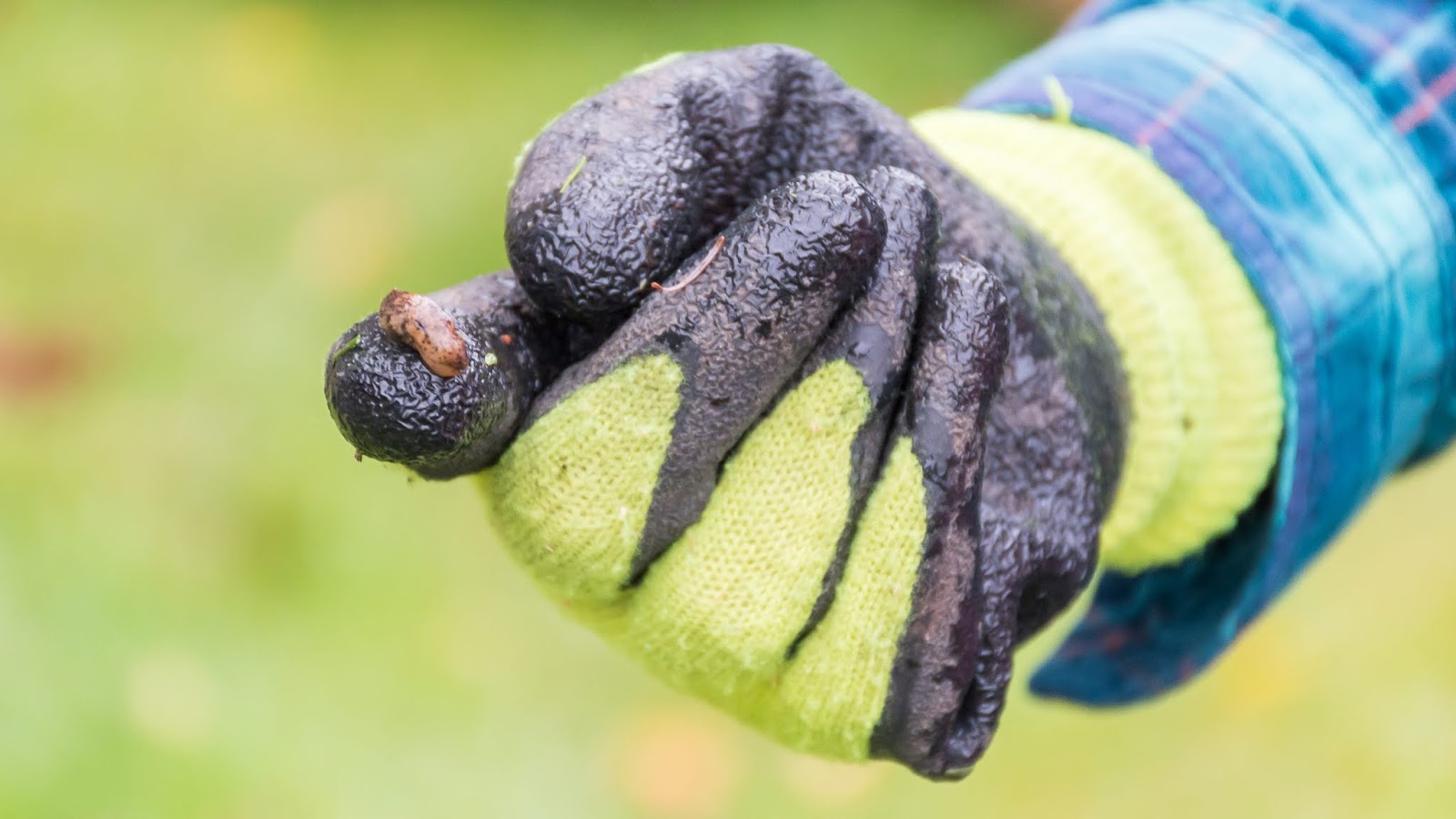
gloved hand holding slug
Welch finds a slug under a tree, but it isn't a concern
in the countries where these trees are headed
inspectors will visually examine both baled trees (trees that have been cut and wound with string to tightly secure the branches to the trunk) and cut, loose trees.

While baled trees get a close inspection, it’s the loose trees that get the action with a forceful, lengthy machine shaking that will knock loose needles and pests from the trees.

Two men holding Christmas tree in mechanical shaker
Farmworkers shake tree while Welch observes.
To the untrained eye, the shaking just appears to create a pile of dead tree needles. But inspectors know what to look for. They bend down to carefully examine the pile, looking for needles showing signs of disease or insects that have fallen out.

On this inspection, several insects had lost their grip on the tree, but none were pests of concern and inspectors did not find evidence of any diseases. This was great news for the tree farm waiting to export their trees.

As for the baled trees, they also get a good shake prior to being bound and are then visually inspected.

Haley Palec examines fallen needles for potential pests
Washington ranks fourth nationally in the production of Christmas trees, with all of those trees grown on about 400 tree farms statewide.
Noble and Douglas fir trees are the most popular Christmas trees sold in Washington, accounting for 90 percent of all sales.

But many of our state’s Christmas trees end up in Hawaii, California, Canada, Mexico, Asia, and U.S. military bases worldwide.


Friday, June 28, 2019

WSDA hosts a national Pesticide Inspector Regulatory Training

Gary Buckner and Tim W. Schultz
Pesticide Management Division

Pesticide inspectors from around the country met in Kennewick
this May for a national conference hosted by WSDA.
Pesticide inspectors from all around the United States convened in Kennewick this May for a national Pesticide Inspector Regulatory Training (PIRT) conference on pesticide drift issues.

WSDA’s Pesticide Management Division Compliance Program hosted the event in conjunction with Washington State University (WSU) Pesticide Education and with funding from the U.S. Environmental Protection Agency (EPA).

Forty-one state and tribal pesticide inspectors, 10 EPA staff, and 11 WSDA Pesticide Compliance field staff attended the four-day conference to hone their knowledge and skills about a wide range of pesticide issues, including labeling, drift, and human health concerns.

The training featured presentations from Washington State Department of Health, EPA, WSU, North Dakota State University, Arkansas State Plant Board, Colorado Department of Agriculture, University of California Davis, Illinois Fertilizer and Chemical Association, Agrimetrix Research and Training, and WinField United.

Drift happens


Demonstration of new application method for vineyards.
Pesticide drift unfortunately can occur in certain situations. How the pesticide inspector approaches the situation, understands the technology, evaluates the environmental conditions and gathers the pertinent information are key to understanding what has happened. Gathering this information helps guide the appropriate response.

The courses provided an opportunity for inspectors to learn, discuss and expand their knowledge and skills when dealing with drift related issues.

Topics covered

The conference included presentations from four inspectors sharing specific drift cases from their respective states. Participants discovered that many states share the same drift issues.

Other topics covered during the conference included:
  • Human health exposure concerns
  • Pesticide label language
  • Herbicide volatility
  • Inversions
  • Herbicide symptoms
  • Dicamba drift issues in the Midwest
  • Drift control
  • Evidence collection 
  • Adjuvants 

In the field

Tools of the trade for aerial applicators. 
Outside the conference room, attendees spent one day in the field. The morning visit featured a trip to WSU’s Prosser Irrigated Agriculture Research Extension Center (IAREC) for a look at nozzle technology, equipment issues, and new pesticide application technology in vineyards.

In the afternoon, attendees traveled to a local airfield to discuss aerial pesticide application and drift issues with three pilots who do aerial applications.

Worth the effort

Those of us at WSDA and WSU who organized the event were pleased to see the many positive course reviews from attendees. They made the 10-months of planning well worth the effort.

For tips on preventing pesticide drift see this WSDA Ag Briefs article.

Friday, September 28, 2018

Pretty pest added to invasive species priority list

Chris McGann
WSDA Communications
An adult spotted lanternfly.
Photo:Pennsylvania Department of Agriculture

The adult spotted lanternfly is a sight to behold; its wings are a tapestry of inky spots and delicate stripes underscored with broad patches of bold crimson. Its plump body is reminiscent of a bumble bee or a cicada.

But WSDA’s Plant Protection entomologists see this colorful bug as a big threat to Washington’s tree fruit and grape industry. They are gearing up to try to block the road for this insidious hitchhiker and prevent fast-spreading infestations like those seen in Pennsylvania and Virginia.

WSDA's Pest Program classifies the spotted lanternfly as a “target pest” in multiple pest surveys and earlier this month, the Washington Invasive Species Council added it to the likes of apple maggots, gypsy moths and brown marmorated stink bugs on its top priority species list.

A native of China, the spotted lanternfly first arrived in Pennsylvania in 2014 and quickly proved it is a pest to be reckoned with.

Entomologist Sven-Erik Spichiger spent a decade as Pennsylvania’s state entomologist before joining the WSDA Plant Protection team this year. He knows how bad the infestations can be from experience.

“When you’ve seen tens of thousands of spotted lanternflies on an apple tree during harvest, it will turn your head around,” Spichiger said.
Infestation
Photo:Pennsylvania Department of Agriculture

He said from an insect scientist’s perspective, the lantern fly is fascinating.

“But for the public, one bug gets their attention. Imagine how they feel when they come out to their toddler’s swing set and find it coated with more than 200,000.”

The lanternfly spreads plant disease, weakens trees and threatens the country’s multi-billion dollar grape, orchard and logging industries.

And it’s just gross.

The spotted lanternfly lays eggs in non-descript gray globs that are difficult to detect on trees, rusty cans or park benches. It multiplies insidiously by the thousands and can overtake trees, and crops -- even playground equipment – overnight.
A glob of spotted lanternfly eggs
Pennsylvania Department of Agriculture

Then there’s the “honey dew.” That’s entomologist talk for lanternfly urine. Lanternflies feed on sap and excrete sticky droplets of sugar-rich urine that rain down from infested trees so hard in some cases, people need rain coats to work in the area. The shellac of honey dew turns rancid over time and attracts swarms of bees, ants, and wasps. Finally, the coated understory becomes black with “sooty mold.”

In Pennsylvania, the infestation continues to spread, despite more than $20 million poured into research and eradication efforts this year alone. Lanternflies have now invaded Virginia, New Jersey, and Delaware.

These prolific bugs suck sap from hardwood trees, grape vines and fruit trees but its favorite food is the Ailanthus tree or “tree of heaven.”  Spichiger says the tree of heaven - another invasive species - grows in disturbed areas such as vacant lots, highway medians and especially along railroad lines.
WSDA Managing Entomologist
Sven-Erik Spichiger

“Train tracks are lined with these trees,” he said, pointing out that one of the big concerns here in Washington is that this pest is an active hitchhiker.

“All it takes is a stiff wind to knock one of these into a rusty box car and the next week it’s on the West Coast,” Spichiger said. “There is a very high likelihood that this will continue spreading.”

Early stage of spotted lanternfly infestation.
Photo:Pennsylvania Department of Agriculture
Although there is plenty of reason for concern, Spichiger said there is also hope.

Treatments that combine host removal with pesticide applications have been shown to be effective on small infestations, he said.  And because of its distinctive appearance, engaging the public to help locate infestations can be effective.

"Control strategies work best when entomologists have ability to rapidly respond to the pest," he said. "You can actually control lanternfly infestation using this strategy if you detect them early,” Spichiger said.

For more information about WSDA's Pest Protection Program.

Wednesday, May 17, 2017

WSDA fruit tree certification gets state-of-the-art greenhouse

Karla Salp
Communications

Director Sandison cuts greenhouse ribbon with project partners
WSDA Director Derek Sandison had the rare opportunity to dedicate a new greenhouse for the agency’s Fruit Tree Certification program on May 11.

For decades, WSDA has been renting space from Washington State University at their Prosser research station. There, WSDA conducted tests on new nursery stock to ensure that the plant materials entering our state’s nurseries were free of disease.

However, the increasing demand for disease-free plant materials for Washington’s booming fruit tree industry and the limitations of the existing greenhouse meant that it was time for WSDA to have a greenhouse of its own.

Building the greenhouse has taken several years and was the result of a remarkable partnership between WSDA, WSU, and the tree fruit industry. About 35 people attended the dedication ceremony – an indication both of the strong partnerships involved in building the greenhouse as well as the importance of the certification program to Washington’s fruit tree industry.

Dedication attendees get a greenhouse tour
Attendees at the dedication were treated to a tour, which included the three separate greenhouse bays. The newly dedicated 5,000 square foot state-of-the-art greenhouse is fully automated, featuring improved temperature and irrigation controls. Each growing bay is computer-controlled to maintain temperature ranges at which different fruit tree pathogens thrive.

The increased space and advances in the greenhouse technology enable WSDA fruit tree certification specialists to test trees at a greater rate than they have been able to in the past.

By screening for these fruit tree diseases, WSDA can ensure that Washington fruit tree nursery stock remains disease-free. This promotes not only the health of Washington orchards but ensures that Washington fruit trees can also be exported anywhere in the world.

Wish you could have been there? If you missed the dedication ceremony, you can still watch it on Facebook!


Friday, January 6, 2017

A look at WSDA's key accomplishments in 2016

Mike Louisell
Communications

Before 2016 fades into memory, today we’re noting examples of how our agency supported Washington’s agriculture and food industries, highlighting the work of our five divisions.

Animal Services Division
Our Animal Services Division hired an assistant state veterinarian and state veterinarian, key positions to protect livestock.

Assistant State Veterinarian Scott Haskell started in August and one of his first tasks was to support efforts to contain equine herpesvirus. Dr. Haskell worked with Washington State University and horse owners to contain the outbreak. Twenty-seven cases of West Nile virus in horses also kept veterinary personnel busy this past year.

Dr. Brian Joseph started in December as the new state veterinarian. He has connected with WSU and met with Oregon officials and livestock market representatives to review ongoing animal disease traceability efforts. Our work emphasized advances in the ability to retrieve livestock records in the event of a disease investigation.

Commodity Inspection Division
Don Potts, with our Spokane Grain Inspection Office, received a Director’s Citation Award for brokering service standards that attracted a contract with a corporation comprised of five grain companies.

In the Fruit & Vegetable Inspection Program, apple inspection standards were rewritten in “plain talk” for easier interpretation. We maintained goals to meet customer expectations for services.

The International Marketing Program participated in export promotions, including a trade mission to Vietnam.

Food Safety & Consumer Services
The Food Safety Modernization Act (FSMA) involves a major update to FDA food laws to prevent and detect safety problems. Our Food Safety Division has adopted federal FSMA rules under state code. Our staff members have begun outreach and education efforts on food, feed, and produce safety that are fundamental to the successful implementation of the FSMA.

Our agency also supported efforts to reduce childhood obesity and provide access to healthy foods in schools and to low-income families through the Food Assistance Programs and Farm to School activities, which also generated new markets for farmers.

Pesticide Management Division
Employees managed the disposal of 95,000 pounds of pesticides that owners no longer needed, enforced state and federal pesticide laws and confirmed compliance with laws that cover manure from livestock operations.

Informed the ag industry of new worker protection standards required by the Environmental Protection Agency. It was a major effort. The demand to train pesticide handlers increased and the agency’s Farmworker Education Program conducted numerous workshops. Training included hands-on exercises, demonstrations, illustration and videos.

Plant Protection Division
After conducting its second largest gypsy moth eradication ever this past spring, the Pest Program management announced there would be no spraying for the pest in 2017.

In other pest management, WSDA developed a regulatory approach for transporting municipal green waste to Eastern Washington based on a pest risk analysis for apple maggot.

WSDA’s efforts to sample and certify the largest state hop harvest ever brought us kudos, with reporters covering some of our work.  And the Washington State Liquor and Cannabis Board partnered with WSDA, committing to purchasing testing equipment and funding staff dedicated to testing pesticide levels in marijuana products.

Stay connected with WSDA
These highlights barely scratch the surface of all the work accomplished by WSDA personnel. To stay up with the latest news, sign up to follow us in 2017 through this blog, on Facebook or Twitter (our Twitter handle is @WSDAgov).

Wednesday, October 12, 2016

Egg hunts - WSDA style

Karla Salp
Pest Program 


Gypsy moth egg masses in CT
Not all egg hunts happen in the spring. In the Washington State Department of Agriculture Pest Program employees hit the road for a unique egg hunt with a higher cause – protecting Washington’s environment from the invasive gypsy moth.

In the shadow of Mount Rainier on a crisp and sunny fall day, about a dozen yellow WSDA vests could be seen wandering around a neighborhood near Graham. Such “egg hunts” occur in areas of interest to the pest program after summer gypsy moth trapping results.

The eggs they were looking for, however, are a lot harder to see than brightly colored eggs in the grass. Gypsy moth egg masses are cream, white, or orange colored. They are usually oblong and fuzzy. The egg masses can be laid on any outdoor surface, but the moths tend to prefer the base of trees.

Having seen so many egg masses on my trip back east this summer, I volunteer to help out. Here are some things I learned on the hunt: 


  1. Needle in the football fields – Looking for gypsy moth egg masses is much like looking for the proverbial needle in the haystack – if that haystack was strewn over an area about the size of 15 football fields.
  2. Egg masses can be anywhere – Gypsy moths will lay their eggs on any surface. In the past, WSDA has found egg masses not only on trees, but also on tires and even on a cup.
  3. Trees are the easy part – We started looking in an almost park-like setting with trees and grass, which was easy enough. When we got to items outside of houses, it became overwhelming: carports, lawnmowers, stacks of wood or junk, garden decorations, fences, vehicles, birdhouses, bushes, tires – the possibilities are endless.
  4. Pushups are optional – I was super impressed by one of the trappers who, rather than get dirty by laying on the ground to look under a trailer, did a slow pushup to lower himself down, look under the trailer, and then push himself back up. The rest of us just got on the ground.
  5. Mirror, mirror – Small telescoping mirrors were a godsend for looking under small areas without having to do #4.
  6. Bragging Rights – When it comes down to it, it takes a lot of time and even more luck to find a gypsy moth egg mass on these hunts. Serious bragging rights can be had by finding an egg mass.


In the end we didn’t find any egg masses that day, but the hunt continues. WSDA staff will be searching again this month, weather permitting. Once the egg mass survey is complete, the program will decide if treatments will be recommended for any areas in 2017. Stay tuned for that announcement, expected later this year.
 

Tuesday, September 27, 2016

What's up in your grill?

Karla Salp
Pest Program Outreach Coordinator

Have you ever looked at your vehicle’s grill and found a bee, butterfly or some other bug stuck there, unable to get out of the way as you cruised down the highway? Well, checking vehicle grills is just one of the less illustrious things our staff does at WSDA. Let me explain…

A primary way that many invasive pests enter Washington is by hitching rides when people move here from infested states, unwittingly transporting devastating pests into their new neighborhoods.
To protect our state, WSDA conducts periodic vehicle checks at weigh stations, collaborating with USDA Smuggling Interdiction and Trade Compliance and the Washington State Patrol.

Together, we conducted one such check last month at two different weigh stations: Liberty Lake and Plymouth. Between the two locations, a total of 167 inspections were performed, including inspections of 19 moving trucks.

Japanese Beetle in a pickup grill
 One of the most common places to find invasive bugs is in the grill of the vehicle, and the inspected vehicles did not disappoint at this inspection. WSDA found Japanese Beetles – an invasive pest that has taken hold in the Eastern and Midwestern states – in the grills of several trucks.

But the grill isn’t the only place to find invasive pests, nor is it the most worrisome as those bugs are usually dead. Normally, the most threatening are items hauled from the infested location itself, like outdoor furniture. Some pests, like the gypsy moth, require a checklist to be completed if you are moving from a quarantined area to our beautiful state.

Luckily, no living invasive pests were detected in the latest operation. There were, however, several movers who either did not do the required checklist or whose checklists were incomplete.

If you or someone you know is moving to Washington from a gypsy moth quarantine area, make sure they check for gypsy moth egg masses and have their completed checklist. Everyone is welcome in Washington, but leave your bugs behind!


Special thanks to WSDA pest biologist Jenni Cena for the photos.