Wednesday, July 5, 2023

Summer is here - time to put your Hornet Hunter hat back on

Karla Salp
Communications

man wearing sunglasses putting on a tan hat with a hornet on it
Gov. Inslee dons a hornet hunter hat while 
touring the hornet detection area in 2022. Gov.
Inslee and the Washington Legislature have been
very supportive of the hornet eradication efforts.
July is finally here and you know what that means around WSDA: time to start trapping for hornets! Our hornet trappers are already out in the field setting hornet traps in Whatcom County.

Since the first confirmed detection of the northern giant hornet (Vespa mandarina, also known as the Asian giant hornet) in 2019, there has been overwhelming interest from the public to help eradicate this invasive pest.

WSDA has welcomed this community support, leading to a hybrid government-public response that has been revolutionary – and effective. More than half of the confirmed hornet detections in the state have come from public reports. Three of the four nests eradicated in the state were found as the direct result of public reports.

The community has played a game-changing role in WSDA’s efforts to eradicate the hornets from our state. Although we had no detections last year, we’re not out of the woods yet.

We still need you.

northern giant hornet on paper plates
Hornet sighting reported
to WSDA via social media
in 2020.
Your eyes, ears, and traps are still needed to detect any hornets that might still be lurking in the state. Here are three ways that you can help.

  1. Trapping. WSDA has established a Public Hornet Trapping project, which provides community members with information on how to build and check hornet traps and report any hornets that are caught. The traps are placed in July and are left up through November.
  2. Watch a Wasp Nest. The public and WSDA staff have witnessed northern giant hornets repeatedly attacking paper wasp nests. These nests can easily be found under the eaves of many buildings. By joining the “Watch a Wasp Nest” program, you commit to spending five minutes a week observing paper wasp nests on your property and logging activity, including whether you notice hornets at the nest.
  3. Report sightings. Helping detect northern giant hornets can be as simple as being aware of your surroundings. If you think you spot one, get a photo if you safely can. Report suspected sightings with as much detail as possible, including where the insect was spotted, what it was doing, and if it flew off, the direction in which it headed.

EVERY hornet report matters. Whether found while trapping, watching paper wasp nests, or just being observant when you are out and about, it is critical to report each and every suspect hornet sighting. We get hundreds – if not thousands – of false reports each year, but we gladly accept them because it means you are on the lookout and that means we receive the few but critical confirmed detections we need to eradicate the hornets for good. 

Friday, June 23, 2023

Budget highlights: WSDA secures funding to expand programs through 2025

Daniel Schafer
Communications
Director Sandison stands with team members in front of the  Emergency Food Network van.
Director Sandison visits the Emergency Food Network.

The Washington State Legislature approved the state’s two-year operating budget April 23, and Governor Jay Inslee approved May 16. The new budget will fund the state’s government through June 30, 2025.

Along with other state agencies, the Washington State Department of Agriculture (WSDA) has received funding that will allow us to continue providing the services we already offer our partners. But over the next two years, we’ll also have the resources we need to expand some important programs. In this article, we’ll highlight three areas where WSDA will be growing.


Improving food systems while advancing equity

Since the onset of the global pandemic, WSDA has been at the leading edge ensuring Washington’s food systems are strong and effective while decreasing food insecurity within the state.

As part of this effort, WSDA uses grant opportunities to provide a safety net for many producers. To support us in this effort, WSDA received $8 million dollars for local food system and infrastructure grants, $1 million for meat and poultry assistance grants, $30 million for food assistance programs, and $10.6 million in Coronavirus State Fiscal Recovery Funding to provide supplemental flexibility in spending to continue supporting our Washington farmers and their families.

Additionally, funding for our We Feed Washington initiative and related programs totaled $63 million in the 2023 budget. These funds will be used to decrease food insecurity for hungry Washington families.

What’s more, WSDA is committed to advancing equity and environmental justice in our state, with the goal of ensuring every Washingtonian has access to healthy, safe, and culturally relevant food. To contribute to these goals, WSDA was awarded $180,000 to continue working with communities while responding to recommendations we made to the state legislature in 2022.

Continuing collaboration efforts

From invasive pests to water availability, Washington’s food producers face a slew of challenges. The 20232025 budget includes funds designed to increase collaboration across that state, equipping producers to face these challenges. These funds include $400,000 that will allow WSDA to partner with WSU’s IMPACT Center to conduct an Ag competitiveness study that will analyze producers' challenges and identify tools to address them. WSDA also received $581,000 to enhance the WA Soil Health Initiative and implement a voluntary program that provides producers with tools to track soil health, providing the state with information that will be critical to improving farming viability in the future.

Responding to the threat of invasive pests


WSDA works to maintain and improve the health of Washington’s farms, but eradicating and containing invasive pests – including insects, noxious weeds, and more – benefits the entire state. We have already made significant progress in detecting, trapping, and eradicating many invasive pests, but the effort is ongoing. Thanks to funding from the Washington State Legislature, we can continue our efforts of detecting and eradicating invasive pests that pose the greatest threats in our state: northern giant hornets, spotted lanternfly, popillia japonica (Japanese beetle), and invasive moths.


Looking ahead


With WSDA’s budget set for another two-year cycle, we are excited to continue our mission to protect consumers, ensure public health, and serve as stewards of the environment in Washington state through service, regulation, and advocacy.

To learn more about the 20232025 budget, visit the
State budgets page on the Washington State Office of Financial Management’s website.

Tuesday, June 20, 2023

Six ways you can help #BeatTheBeetles

Karla Salp
Communications

beetle in a green bag beetle trap
First WSDA-trapped Japanese beetle of 2023
The first Japanese beetle of 2023 has been detected! Our Japanese beetle trappers were out checking traps this morning and they discovered the first beetles in a trap near the high school in Grandview. So the adults are here and it is time to take action!

We conducted our second beetle treatment this spring and WSDA trappers have placed hundreds of traps in and near previous beetle detection sites that we’ll be checking regularly until the fall.

We’re doing everything we can to protect schools, parks, gardens, and farms from this invasive pest, but there are many ways that you can help.

  1. Report Japanese beetle sightings. If you spot a Japanese beetle (or several,) snap a photo and report them online or by emailing pestprogram@agr.wa.gov.

  2. Place your own traps. You can join the trapping effort by placing your own traps. Traps can be obtained at local farm and garden centers as well as online. If you do trap, please either count and report your trap catches online (with a photo of your catch!) or drop off traps with beetles in them at the following locations:

         - Valley Wide Cooperative (Grandview)
         - Riders True Value (Grandview)
         - Wapato City Hall (Wapato)

  3. Treat your property. If you notice beetles on your property, you may want to apply an effective treatment for adults (WSDA’s treatment earlier in the year was for grubs.) Washington State University has provided guidance to homeowners in English and Spanish on the best products for Japanese beetles (not all products listed for Japanese beetles have been proven effective.) If you choose to treat your property, follow the label instructions on using the product exactly.

  4. Graphic asking people not to spread Japanese beetle through yard waste, potted plants, or soil.
    Don’t move plants.
    If you live in or near an area where Japanese beetle has been found, do not move plants. Sharing plants from your yard with a friend or neighbor could spread the beetle from your yard to theirs. Don’t purchase plants from inside the quarantine area and take them home if you are outside the quarantine area. You could bring Japanese beetle into your yard.

  5. Keep yard waste and soil in the quarantine area. Yard waste and soil could also transport beetles. Moving plants, yard waste, or soil out of the quarantine area is prohibited if you live in the quarantine area. Instead, WSDA has established a yard waste drop-off site at 875 Bridgeview Rd. Grandview, WA.

  6. Spread the word, not the beetles. Learn more about Japanese beetles and encourage your friends and neighbors to help detect and eradicate this pest. On our Japanese beetle webpage, you can learn more about the beetle, how you can help, join our Washington Japanese Beetle Watch Facebook group, and sign up for email alerts to stay informed about the project.
Successfully eradicating the Japanese beetle from Washington is going to take several years. By working together, we can protect Washington from this invasive pest and #BeatTheBeetle. 

Espanol

Seis maneras en las que puede ayudar a #CombatirLosEscarabajos
 
Se detectó el primer escarabajo japonés de 2023. Esta mañana, nuestros tramperos de escarabajos japoneses revisaron las trampas y descubrieron los primeros escarabajos en una trampa cerca de la escuela secundaria en Grandview. Los adultos ya están aquí; por lo tanto, es momento de poner manos a la obra. 

Durante esta primavera, hemos realizado nuestro segundo tratamiento contra los escarabajos y los tramperos del Washington State Department of Agriculture (WSDA) han colocado cientos de trampas en los lugares anteriores donde se detectaron escarabajos y cerca de ellos, los cuales revisaremos con regularidad hasta el otoño. 

Estamos haciendo todo lo posible por proteger escuelas, parques, jardines y granjas de esta plaga invasora, pero usted también puede ayudar de numerosas maneras. 
  1. Notifique avistamientos de escarabajos japoneses. Si ve un escarabajo japonés (o varios), tome una fotografía y notifique en línea o por correo electrónico a través de pestprogram@agr.wa.gov. 

  2. Coloque sus propias trampas. Puede colaborar con los esfuerzos de colocación de trampas al colocar las suyas. Puede obtener las trampas en centros agrícolas y de jardinería locales, así como por internet. Si atrapa escarabajos, cuéntelos y notifique en línea (adjunte una fotografía de los escarabajos capturados) o entregue las trampas con los escarabajos en los siguientes lugares:

         - Valley Wide Cooperative (Grandview)
         - Riders True Value (Grandview)
         - Wapato City Hall (Wapato)

  3. Realice un tratamiento en su propiedad. Si detecta escarabajos en su propiedad, puede aplicar un tratamiento eficaz contra los adultos (a principios de año, el tratamiento del WSDA era contra los gusanos). Washington State University ha elaborado pautas para los propietarios en inglés y español sobre los mejores productos contra los escarabajos japoneses (no todos los productos que se enumeran para combatir el escarabajo japonés han demostrado ser eficaces). Si decide realizar un tratamiento en su propiedad, siga con exactitud las instrucciones que figuran en la etiqueta sobre cómo usar el producto. 

  4. No traslade plantas de un lugar a otro. Si vive en una zona donde se detectaron escarabajos japoneses o cerca de ella, no traslade plantas. Compartir plantas de su jardín con amigos o vecinos podría propagar los escarabajos de su jardín al de ellos. No compre ni lleve a su casa plantas que pertenecen a la zona de cuarentena si usted vive fuera de dicha zona. De esta forma, podría traer al escarabajo japonés a su jardín. 

  5. Mantenga los desechos de jardín y la tierra en la zona de cuarentena. Los desechos de jardín y la tierra también podrían transportar escarabajos. Está prohibido trasladar plantas, desechos de jardín o tierra fuera de la zona de cuarentena si vive en dicha zona. En cambio, el WSDA estableció un sitio de depósito de desechos de jardín en 875 Bridgeview Rd. Grandview, WA.

  6. Difunda el mensaje para que los escarabajos no se propaguen. Obtenga más información sobre los escarabajos japoneses y aliente a sus amigos y vecinos a colaborar con la detección y erradicación de esta plaga. En nuestra página web del escarabajo japonés, puede leer más sobre el escarabajo y cómo puede ayudar, puede unirse al grupo de Facebook “Washington Japanese Beetle Watch” (Detección del escarabajo japonés en Washington) y puede registrarse para recibir alertas por correo electrónico para mantenerse al tanto sobre el proyecto. 
Erradicar definitivamente el escarabajo japonés de Washington va a demorar varios años. Si trabajamos juntos, lograremos proteger a Washington de esta plaga invasora y #CombatirLosEscarabajos.  


Wednesday, May 31, 2023

Watch a wasp nest to help detect northern giant hornets

Cassie Cichorz
Pest Program

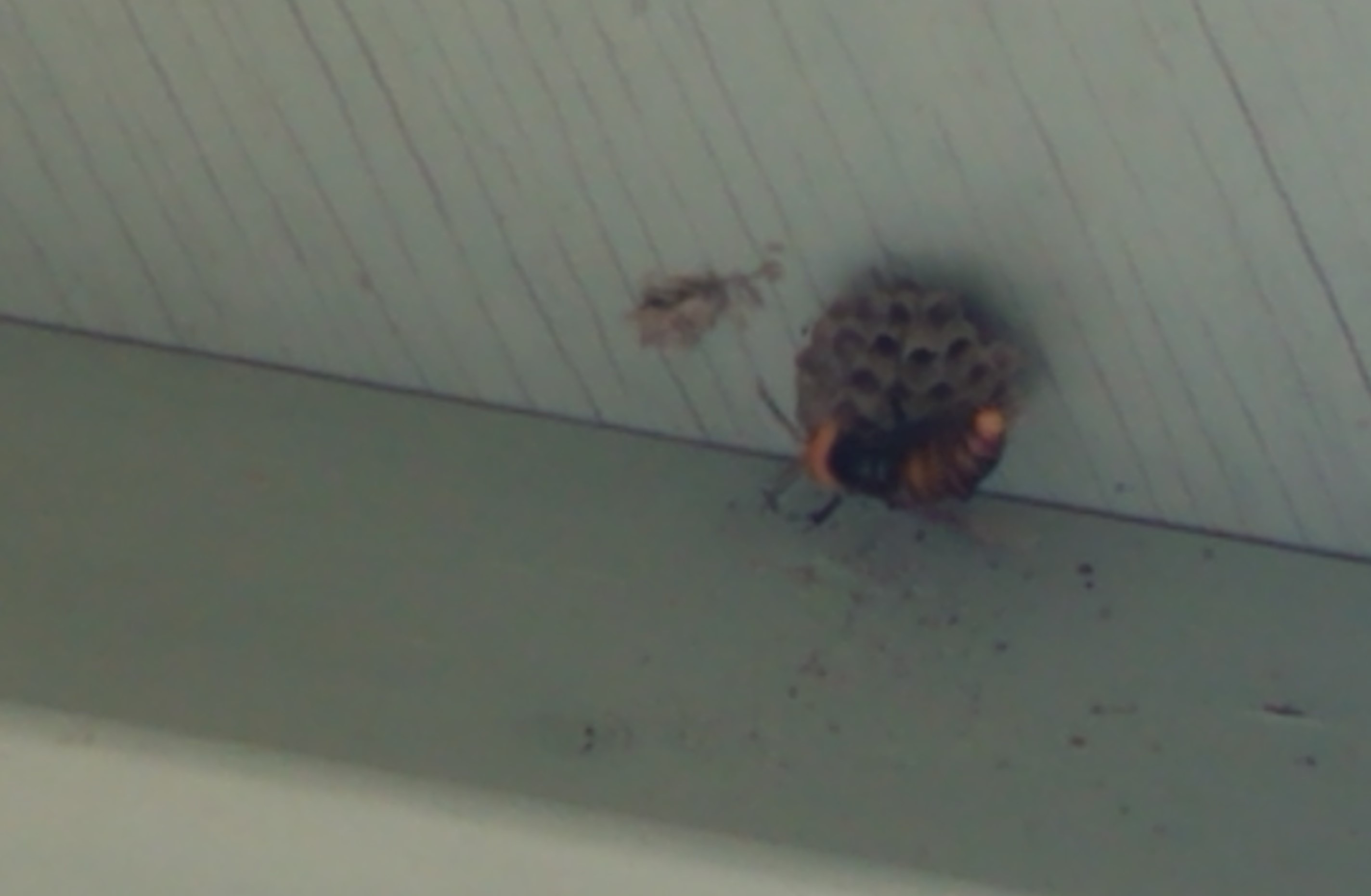
Paper wasp on a nest in Washington State

Did you know you can help protect Washington from invasive species just by taking a walk around your house or barn once a week? 

Over the last few years, residents of Whatcom County and WSDA staff have noticed hornets attacking paper wasp nests. In 2021, WSDA tracked a hornet and observed it repeatedly visiting the same paper wasp nest. Each visit lasted five to ten minutes and the hornet removed paper wasp larvae.  

WSDA invites you to help watch for northern giant hornets (Vespa mandarinia). Join our community science project to locate active paper wasp nests, watch the nests weekly, and record your observations from June through October. WSDA will continue to invite residents to participate in public scientist trapping too.

Northern giant hornet attacking a 
paper wasp nest on a house in Whatcom County

Paper wasps (Polistes dominula) can grow to about three-quarters of an inch long and have a well-defined “wasp waist” that makes them easy to identify. Paper wasps are typically not aggressive and do not readily attack people, but they can sting if threatened. They form small colonies and build hanging, open-comb nests on building eaves, frames, abandoned cars, or branches of trees and shrubs. Paper wasp nests vary in size and are usually gray to brown in color. They are made up of many exposed cells that are less than an inch deep. Nests typically range from the size of a quarter to a coffee can lid, but can be larger.

Although we invite anyone in Washington to participate in adopting a paper wasp nest, we are particularly interested in observations from Whatcom, Skagit, Island, San Juan, Snohomish, King, Jefferson, and Clallam counties.

Paper wasps tending their nest
LOCATE

Starting in June, locate active paper wasp nests that you have access to and can monitor through October. Log the nest locations using the Watch a Wasp Nest Registration Form. After submission, you’ll receive an email confirmation which will include a unique Nest ID assigned to your nest location. You will need to save this Nest ID to use during weekly check-ins. Access the registration form.

MONITOR

Each week visit the nests. Watch for any hornet or wasp activity happening at the nest. WSDA asks you to monitor the nests for at least five minutes during the day once per week, but you can check the nests as long and often as you would like.

REPORT

After monitoring you will need to report each of your observations on the Watch a Wasp Check-in form. You will also need your Nest ID which was received in a confirmation email. Click here to access the check-in form.

However, if you think you spot a northern giant hornet (it will be significantly larger than the paper wasps), safely take a photo and report it at agr.wa.gov/hornets or by emailing hornets@agr.wa.gov.

Stay Connected

WSDA is dedicated to working with the public and to providing information on northern giant hornets.

Friday, May 19, 2023

Spring into vaccines and protect your horse!

By Dr. Amber Itle |
WA State Veterinarian

Rodeos, events and shows are in full swing this spring!  Horses are on the move and so are equine diseases. Since the first of the year, 19 States have reported contagious disease outbreaks in horses nationally.  Washington is also seeing an uptick in reports.  The most commonly reported diseases in the State are Strangles, Equine Influenza Virus, Pigeon Fever, Equine Herpes Virus and West Nile Disease. 

Now is the time to update your horse’s vaccinations to mitigate disease severity and allow for continuity of business.   Talk to your veterinarian about the right protocol and cadence for you depending on your risk to include Flu/Rhino (equine influenza and herpes), West Nile and maybe even Strep equi (strangles) in addition to the core vaccines recommended by AAEP.  This is especially critical in boarding facilities where horses come and go to shows, events and even trail rides. Any commingling event is an opportunity for disease spread. Although horses that are vaccinated can still contract the virus or bacterial infection and spread it, but the course of disease should be less severe.

As soon as the attending veterinarian gets positive laboratory results for any of these diseases, they must be reported through the Reportable Animal Disease database. WSDA also reports to the Equine Disease Communication Center and they distribute minimal information that protects personally identifying information through an alert to subscribers. Usually private practitioners manage individual cases of equine diseases by performing diagnostics, addressing individual horse treatment, implementing on farm biosecurity practices, and helping the barn manager institute a self-quarantine of infected or exposed horses. 

In some cases, when there are lots of sick horses and/or stable compliance is a problem with horse movement, the State Veterinarian can be requested to assist.  WSDA field veterinarians can issue quarantines in order to mitigate the spread of disease by not allowing any movement of horses on or off the premises. A quarantine will be in place until 14-21 days after the last “new” case, allowing for a full incubation period to pass by without clinical signs.  Horses can remain contagious for 10 days after clinical signs or fever starts.  The quarantine will require that rectal temperatures be recorded daily whenever possible so that febrile horses can be rapidly isolated, tested and monitored for clinical signs.  Often viral infections can be “dose dependent” so rapid removal of sick horses can reduce viral load and transmission.

Airborne transmission or direct contact is the most common way horses become infected with respiratory disease.  Infected horses release infective droplets into the air by coughing or snorting which are then inhaled by horses in close proximity. Horses can also be exposed to the organism by coming into contact with contaminated surfaces such as stalls, wash racks, stocks, water sources, feed, tack, grooming equipment such as wipe rags, and transport vehicles. Humans can spread microorganisms from horse to horse by contaminated hands and clothing, so the adoption of biosecurity measures is paramount. 

WSDA Field veterinarians can also assist with on-farm biosecurity plans to help mitigate viral spread.  Here are some biosecurity tips you can customize for your ranch during a quarantine period to help ensure the health and welfare of your horse.  Horse owners can find this biosecurity poster on our website to be printed and posted in your barn. 

  1. Observe Strict Biosecurity
    1. Limit Stress to horses
    2. Control flies, vermin, vectors
    3. Monitor all horses on the premises with twice-a-day temperature recording
    4. Keep hoses out of free-standing water such as ponds or creeks
    5. Remove compost and manure promptly
    6. Wash hands frequently
    7. Prevent direct contact with infected horses
    8. Do not share equipment, buckets or tack
    9. Tape off an “off limits” perimeter outside any symptomatic horse stall approximately 3 feet by six feet.  Only people that need to enter the stall are permitted into this area.
    10. Place a foot bath outside the stall with disinfectant, to dip feet into prior to entering and again after exiting the stall. Be sure to clean your boots before you disinfect. 
    11. Clean and disinfect the stall frequently
    12. Designate one person to care for your horse and limit contact of personnel with exposed horses
    13. Notify your veterinarian immediately if you notice any clinical signs or changes in behavior.  Horses with viral infections are prone to secondary bacterial infections.  
    14. Coughing horses aerosolize the organism and can spread the organism as far as 150 feet
  2. Horse Management
    1. Do not move any horses on or off the farm
    2. Designate an isolation stall or quarantine barn for sick horses.
    3. Supportive care and treatment as prescribed by your veterinarian
    4. Keep in well-ventilated stall and or paddocks to reduce inhalation of dust
    5. Consider staggering outdoor paddock access to avoid nose-to-nose contact

                                                              i.      Spray any common contact areas with 10% bleach. 

    1. Consider physical barriers between outdoor runs to avoid nose-to-nose contact
    2. Keep dust down in the stall and hay (by wetting if needed)
  1. Exercise- No sick horses should be allowed in the main arena or in shared wash racks.
    1. Symptomatic horses (fever, lethargy, nasal discharge, coughing, etc)

                                                              i.      Febrile horses should remain in their stalls and allowed to rest. 

                                                            ii.      Avoid strenuous exercise and hand walk or exercise lightly for short periods of time.

·          Remember, your horse is not feeling well and may be lethargic, have painful muscles or a cough that can be exasperated by exercise.  The idea is to stretch the horses legs and provide some stress relief from being stalled. 

                                                          iii.      Lightly exercise horses in the designated round pen area away from other horses

                                                          iv.      When moving horses down the alleyway, use the closest exit and be cautious to avoid direct nose-to-nose contact with other horses.

                                                            v.      Only one horse should be exercised at a time and a schedule should be posted if needed.  

    1. Exposed, non-clinical horses (No fever, no nasal discharge, rare or occasional cough)

                                                              i.      Avoid strenuous exercise, but light riding or exercise is acceptable. 

·         Remember that your horse’s immune system may be under stress from recent exposure and fighting off potential infection. Too much exercise may exasperate clinical signs or illness.

                                                            ii.      All horses should exit the barn in a way that avoids clinical horses if possible.

                                                          iii.      Exercise horses in the designated outdoor arena space

                                                          iv.      Only one horse should be exercised at a time and a schedule should be posted if needed.  

Mapping the farm can also be helpful when thinking about horse movement patterns on the farm as well as identifying access points, parking, cleaning and disinfection stations and carcass pick-up areas. 

Additional Equine Biosecurity Resources can be found on our website.